On this page
Start with the decision, not the debate: if your dog is sound, well-conditioned, and has reliable recall in a safe space, off-leash play should be part of the week. If your dog is a puppy still building growth-plate integrity, a senior with early joint changes, or a dog recovering from injury, the leash walk is the safer default and off-leash time gets earmarked, not assumed. Everything else in this guide is about how to make that call correctly and how to combine both instead of picking one for life.
Do this first: watch your dog move for sixty seconds off leash — a full sprint, a hard turn, a sudden stop — before you decide how much of that behavior you actually want to program into a weekly routine. Puppies chase, cut, and crash into it. Older dogs, especially ones I’ve evaluated for early hip or elbow changes, tend to self-limit until something asks more of them than they’re ready to give. That’s the diagnostic value of open play: it shows you the dog’s real movement, not the polite version you see on a six-foot lead.
In my practice, one of the dogs I remember most clearly was a five-year-old Border Collie named Scout, forty-one pounds, whose owner brought her in because she’d started “skipping” on the left hind after dog-park sessions — never during, always ten or fifteen minutes after she got home, usually while getting up from a nap on the kitchen tile. The owner had been taking her to an unfenced field twice a week for full-speed fetch, and the pattern only showed up on those days, never after the shorter neighborhood walks. We tracked it over about six weeks: less full-speed lateral chase, more structured walking and controlled retrieves on a long line, and the skipping stopped showing up. That case is one dog, not a study, but it’s exactly the kind of load-versus-recovery mismatch I look for when an owner tells me their dog does “great” at the park and then goes quiet on the couch that night.
Why the two aren’t really competing for the same job
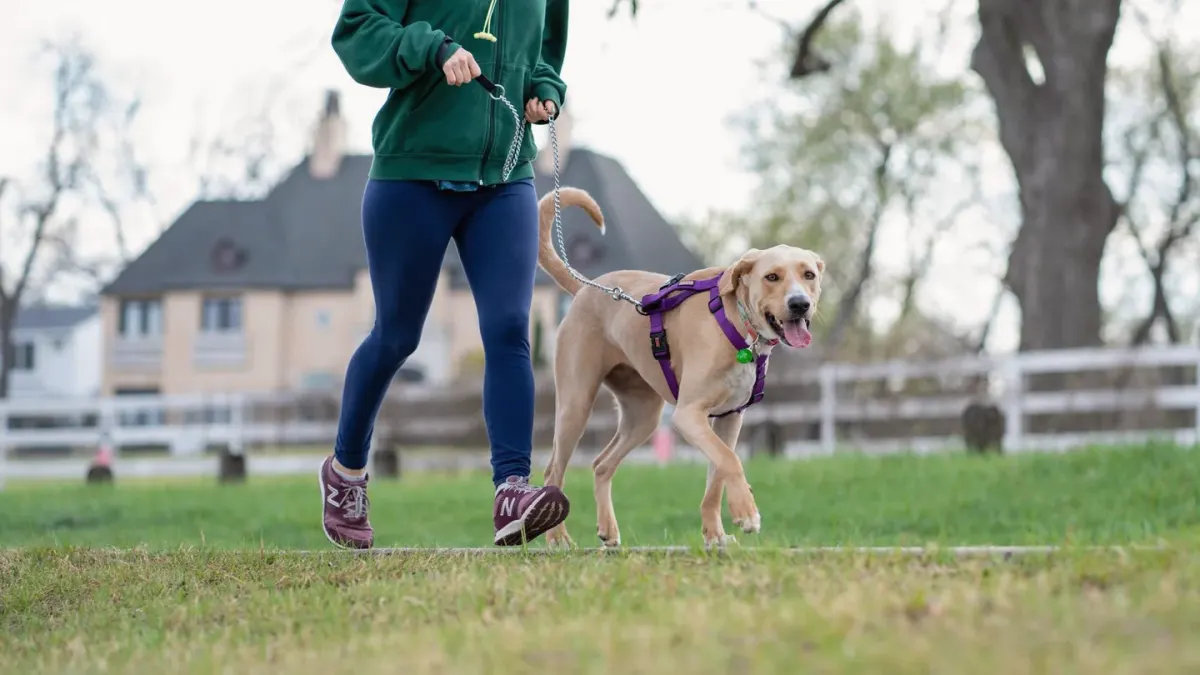
A leash walk is conditioning work: steady heart rate, predictable joint loading, a pace you control. Off-leash play is closer to interval training crossed with agility — sprints, hard direction changes, sudden stops chasing a squirrel or another dog. Both count as exercise, but they load the body differently, and that difference is the whole reason this isn’t a simple “which is better” question. A 25-minute leash walk and a 10-minute off-leash chase session are not interchangeable units of exercise, even if a fitness tracker might log similar calories for both.
For dogs building general fitness — the ones without a known orthopedic issue — a mix genuinely outperforms either activity alone. The leash walk gives you volume and control; off-leash play gives you the acceleration, deceleration, and proprioceptive demand that a straight-line walk doesn’t. If your dog is small-bodied, the calculus shifts further — our guide to exercise for toy and small breeds goes into why a compact skeleton changes how much impact work is appropriate.
Where joint load actually enters the decision
This is where I get direct with owners, because it’s the part that gets skipped in most “which exercise is better” content: off-leash play’s hard stops and cuts put meaningfully more shear and rotational force through the hips, stifles, and spine than a controlled walk does. That’s not a reason to avoid it — most healthy adult dogs handle it fine — but it’s the reason age, breed, and joint history should drive the ratio, not habit or convenience.
For dogs already showing early joint changes, the research on supportive nutrition is instructive even though it isn’t a substitute for controlling activity itself. Chondroitin has been studied for how it “supports healthy synovial fluid homeostasis,” per a 2026 review in Frontiers in Veterinary Science, while glucosamine HCl has shown the ability to “prevent experimentally induced cartilage degradation in vitro” according to a review published in the Journal of Veterinary Medical Science. Neither claim means a supplement offsets poor exercise choices — it means the ingredient category has a defensible mechanism, which is a different and more modest thing than a cure. I weigh what a supplement can realistically do for diet, mobility, and recovery, and the honest answer is: it supports the tissue environment, it doesn’t change the physics of a hard cut on a bad hip.
Green-lipped mussel has a similar evidence profile. A 2026 study in Nutrients found that mussel-derived compounds “alleviated paw swelling in rats and reduced serum levels of rheumatoid factor (RF), anti-cyclic citrullinated peptide (anti-CCP) antibody, and pro-inflammatory cytokines such as TNF-α and IL-17” in an in vitro/animal model — evidence worth knowing about, not evidence that changes how much off-leash sprinting is appropriate for a fourteen-year-old Lab.

Building a rotation instead of picking a side
Here’s the practical framework I give owners:
- Default to leash structure for puppies under 18 months on hard or uneven ground — growth plates are still closing, and repeated hard impact is the variable you can actually control.
- Use off-leash time as a fitness gauge, not just a reward, in adult dogs — a dog that tires quickly, favors a leg, or slows dramatically after ten minutes is telling you something a leash walk would hide.
- Shift the ratio toward leash walking as a dog ages or after any orthopedic diagnosis, and loop your veterinarian in before resuming unrestricted off-leash play post-injury.
- Match the terrain to the activity — soft, enclosed spaces are far more forgiving for off-leash sprinting than gravel, pavement, or an unfenced field with unpredictable footing.
If your dog can’t do either safely right now, our piece on enrichment when a dog can’t exercise covers how to keep them engaged during a restricted period. And if distance is the real question rather than leash status, see how far a dog can actually hike in a day for the conditioning limits that apply regardless of leash.
I think about a twelve-year-old mixed-breed I saw last spring, sixty-two pounds, whose owner was debating whether to keep up their Sunday dog-park routine now that the dog had visible early arthritis in both hips. We didn’t cut off-leash time entirely — that would have cost the dog something real, socially and mentally — but we restructured it: shorter sessions, softer ground, no fetch-with-a-ball-launcher, and daily leash walks doing the conditioning heavy lifting instead. The owner told me eight weeks later that the dog was getting up from the car more easily, which lines up with less repetitive hard-impact loading, though I’d call that one household’s observation, not a trial result.
Bottom line
Neither activity replaces the other, but they aren’t equally safe defaults for every dog. Healthy adult dogs benefit from both in rotation; young, aging, and joint-compromised dogs should lean leash-first and treat off-leash sprinting as a controlled, occasional addition rather than the baseline. If your dog is escape-prone or you’re nervous about recall in open space, a GPS tracker built for an escape-prone dog is a reasonable way to extend off-leash access without gambling on it.
Frequently asked questions
Is off-leash play more tiring than a leash walk?
Often yes, minute for minute, because of the sprints and direction changes involved — but "tiring" isn't the same as "appropriate for every dog's joints," which is why age and orthopedic history should guide the ratio.
How much off-leash time is safe for a puppy?
Keep hard sprinting and sharp turns limited on unforgiving surfaces until growth plates close, generally around 12–18 months depending on breed size; leash-structured walks are the lower-risk default before then.
Can supplements make off-leash play safer for an older dog?
Ingredients like glucosamine, chondroitin, and green-lipped mussel have documented support for joint tissue, but none of them change the physical forces involved in a hard cut or sprint — activity modification still matters most.
Sources
- Chondroitin sulfate and synovial fluid homeostasis in dogs — Frontiers in Veterinary Science
- Glucosamine HCl and experimentally induced cartilage degradation — Journal of Veterinary Medical Science
- Green-lipped mussel compounds in an arthritis model — Nutrients