On this page
Short walks beat long hikes for a stiff senior dog, and frequency matters more than mileage. I weigh exercise as joint nutrition in motion: enough to feed cartilage and hold muscle, not so much that inflammation decides the next day.
My senior-joint checklist before you leash up:
- Split the dose: 2–3 short walks of 10–20 minutes rather than one long outing
- Warm up 3–5 minutes at a loose-leash amble, then settle into steady pace
- Choose traction and level ground; avoid sprint, fetch, and slick floors
- Track the 2-hour and next-morning test: lingering limp, lagging, or reluctance to rise means you overshot
- Keep body condition lean and muscle engaged with sniff breaks, gentle hills, and rehab-style weight shifts
- Feed the diet first, then weigh what a joint supplement can realistically add for mobility and recovery
An 11-year-old, 68-pound retriever mix shuffled out stiff for the first six steps each morning, then loosened and begged to keep going around the block. His owner worried rest would protect him and asked whether one 40-minute walk or three 12-minute loops was safer. We made the decision concrete on a weekday schedule: morning, lunch, and evening loops on flat grass, 5-minute warm-up, no ball, dinner plus a measured joint diet. By day 10 the marker that changed was the morning start-up — down from six stiff steps to two — without adding distance.
Move a little, often — or rest it out?
Rest feels protective, but full rest costs muscle fast in older dogs. My recommendation is controlled, near-daily movement in small bouts, adjusted to the dog’s response that evening and the next morning.
The strongest counterargument is real: on a sore day, pushing through stiffness can flare pain and erode trust. That is why I still land on frequent short movement rather than forced rest or weekend mileage. Cartilage has no direct blood supply and relies on loading cycles for nutrient exchange, while muscle guards unstable joints. Short bouts deliver that loading without the prolonged fatigue that triggers compensatory gait.
If a dog is acutely non-weight-bearing, swollen, panting at rest, or worse after 24 hours, that is not a training problem. Stop, rest, and call your veterinarian.
When short walks backfired
A 9-year-old, 42-pound border collie mix loved her evening mile and pulled to extend it. Three weeks in to a new routine, her owner added a Saturday 3-mile rail-trail hike to “make up” for short weekdays. She finished bright, then stiffened that night and refused stairs the next morning, lagging 10 feet behind on what is usually an easy loop. The tradeoff was clear: one big bout undid five good days. We cut the long hike, kept two 15-minute weekday walks with sniff pauses, and added five minutes of slow figure-eights and curb step-ups on soft ground twice weekly. Her evening lag resolved, and Saturday became a second 12-minute neighborhood loop instead of an endurance test.
What the right dose looks like in practice
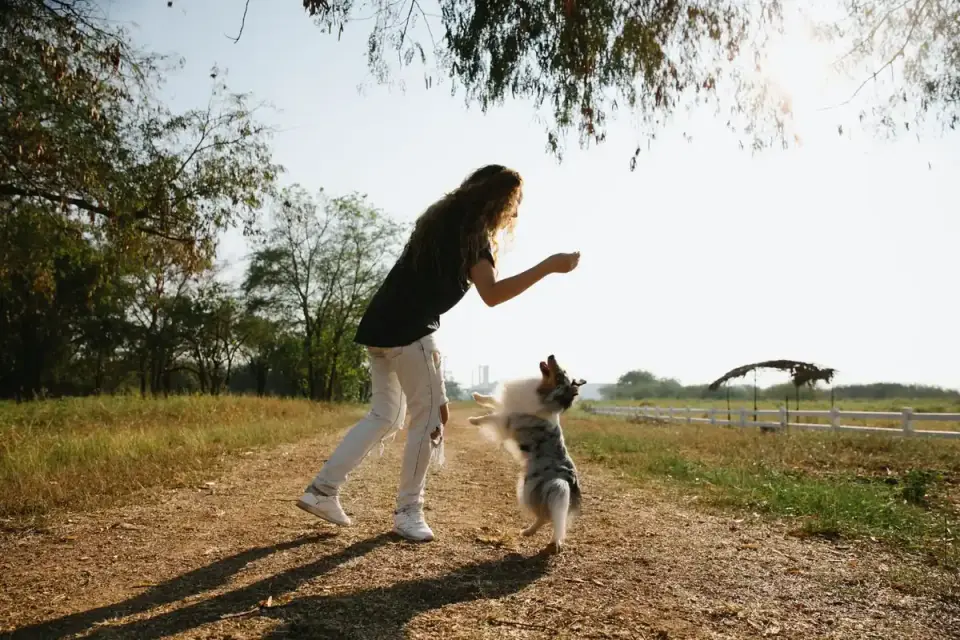
Start with what the dog can repeat tomorrow. For many stiff seniors, that is 10–15 minutes twice daily on level, high-traction surfaces. Add 5 minutes per walk only if the dog rises normally the next morning for three days straight.
Pace matters more than distance. Let the dog warm up, then hold a rhythmic walk where the nose can still sniff. Break every 5–7 minutes for a weight shift or sit-to-stand if your rehab vet has cleared them. Avoid sprint-recall games, downhill charging, and long standing on slick kitchen floors.
Heat and cold change the dose. Cold mornings lengthen warm-up; hot afternoons shorten total time. Older dogs with cardiac disease, collapsing episodes, or neurologic knuckling need a veterinary exercise prescription, not this general template.
For days you must cut walking, swap in enrichment rather than skipping engagement entirely. Nose work, lick mats, and short training reps preserve routine without pounding joints. I point owners to Mental and Physical Enrichment When Your Dog Can’t Exercise and to the comparison of Off-Leash Play vs On-Leash Walks for why I favor controlled on-leash work for stiff dogs.
Where nutrition and joint support fit
I ground an integrative claim in the nutritional evidence: food therapy builds the base — complete senior diet, lean body condition, adequate protein for muscle, and omega-3s where your vet advises — while a supplement may help support whole-patient mobility around that base.
Glucosamine and chondroitin are among the most studied joint support ingredients for dogs. In the lab literature, one paper reported that a tested intervention could “prevent experimentally induced cartilage degradation in vitro,” as reported in the Journal of Veterinary Medical Science, and a separate review noted that chondroitin “supports healthy synovial fluid homeostasis,” as reported in Frontiers in Veterinary Science. Green-lipped mussel work is earlier-stage and largely mechanistic; one study in rats found that “BMO, GMO, and KO all alleviated paw swelling in rats and reduced serum levels of rheumatoid factor (RF), anti-cyclic citrullinated peptide (anti-CCP) antibody, and pro-inflammatory cytokines such as TNF-α and IL-17,” as reported in Nutrients.
That is ingredient-literate context, not a promise. A supplement cannot replace weight control, strength, or pain management.
The rainy-week edge case that changes the math
A 13-year-old, 24-pound terrier mix lived for his morning block, but a week of ice forced three indoor-only days. His owner worried about losing ground and considered two hours of hallway fetch to compensate. We chose the opposite: three 8-minute indoor circuits with rug traction, doorway sniff searches, and three slow sit-to-stands, plus a 10-minute outdoor potty walk when sidewalks cleared by day 4. The observable marker was evening restlessness — pacing dropped from 20 minutes to under five — without next-day stiffness. For fragile seniors, environmental risk resets the dose. Traction, lighting, and footing outrank mileage, and a treadmill or outdoor route question is best answered with safety first, as outlined in Dog Treadmill vs. Outdoor Walking.
My take: protect repeatability. Two short walks you can do tomorrow beat one heroic walk you pay for all week.
For related context, read Dog Park vs Structured Exercise: Which One Actually Meets Your Dog’s Needs.
For related context, read Exercise Ideas for Toy and Small Breeds: A Vet’s Mechanism-First Guide.
Frequently asked questions
How many minutes per day should a stiff senior dog walk?
Many do well on 20–40 total minutes split into 2–3 short walks, starting at 10–15 minutes twice daily and adding time only if mornings stay normal for three days.
Is it better to walk every day or take rest days?
Near-daily short movement preserves muscle and joint range better than long gaps plus big weekend outings, unless your vet prescribes rest for acute injury or flare.
Should I stop if my dog is stiff at the start?
Mild start-up stiffness that eases within 3–5 minutes of easy walking is common; stop and call your vet for non-weight-bearing lameness, swelling, or lameness that worsens during the walk.
Sources
- DOI:10.1292/jvms.25-0293 — Journal of Veterinary Medical Science
- DOI:10.3389/fvets.2026.1536366 — Frontiers in Veterinary Science
- DOI:10.3390/nu18020215 — Nutrients