On this page
Maya adopted a 3-year-old, 68-pound German Shorthaired Pointer after his first family discovered apartment life and a field dog do not mix. On day one she tried what felt logical, a five-mile Saturday run to drain the tank, and by Sunday he was stiff getting off the couch, panting through a short evening loop, and suddenly disinterested in fetch. The decision she was really weighing was not how far he could go once, but how to build repeatable work across a week that left him fitter on Friday than he started on Monday.
That fork — one big effort versus layered conditioning — decides almost everything for adult working breeds. These dogs were selected for sustained trot, carry, pull, and search, which means they have the drive to override early fatigue signals. My position as a nutritionist working in sports medicine is direct: prioritize aerobic base, strength variety, and recovery tracking first, and treat joint supplements as background support for diet and mobility, not as permission to add miles faster.
Start with work, not miles
Working breeds do best when you program time at effort rather than distance covered. A Malinois, Lab, Husky, or Australian Cattle Dog can cover ground efficiently once fit, but tendons, paw pads, and thermoregulation adapt more slowly than enthusiasm suggests.
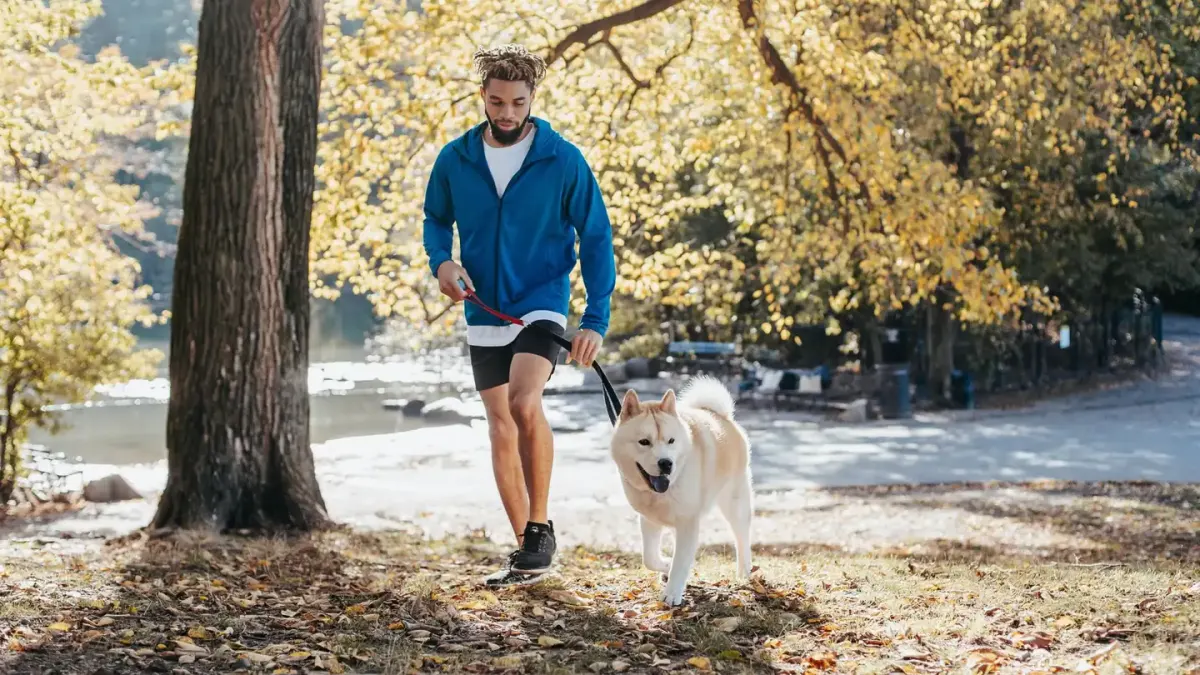
For the first two weeks, keep most sessions conversational — brisk walking, easy trotting, sniff breaks allowed — and finish with the dog still wanting more. Alternate surfaces across days, grass or trail one day and sidewalk the next, and separate hard days with an easy day. Owners who want ideas for mixing formats can borrow from the logic in Dog Park vs Structured Exercise: Which One Actually Meets Your Dog’s Needs and Off-Leash Play vs On-Leash Walks: Which Actually Exercises Your Dog Better, using parks and free play as skills and social time while leashed trot and hike build the base.
Watch breathing, gait, and next-day eagerness more than your watch.
The dog should recover to easy nasal breathing within ten minutes of stopping.
Add load before you add distance
Three weeks in, Maya made the classic tradeoff. Her Pointer, now 66 pounds and visibly leaner, could trot 45 minutes without breaking stride, so she doubled the long run and added a weighted backpack on back-to-back days. By day 10 of that block he started lagging on hills, licking a front carpus in the evening, and waking stiff before loosening up. She had built engine faster than chassis, and the failed approach clarified the rule: increase only one variable at a time.
Hold total weekly time steady for a week while you add one new stressor — gentle hills, short interval surges, a draft or carry task, or balance work on uneven ground. Then let volume follow. A practical progression is to extend the longest session by about 10 to 15 percent per week, keep two shorter strength or skill days, and keep one true rest day with only sniff walks and food puzzles. Handlers managing heat or trail limits will find the same ceiling logic detailed in How Far Can a Dog Hike in One Day? A Vet’s Guide to the Real Limits.
Where joint nutrition fits — and where it doesn’t
Food therapy first: an adult working dog in training needs enough complete-food calories to hold lean muscle, plus water, electrolytes from diet, and rest to remodel tissue. Supplement science sits on top of that foundation.
Glucosamine and chondroitin are among the most discussed ingredients in this category, and the laboratory evidence is narrow and ingredient-literate. Research described in the Journal of Veterinary Medical Science found that glucosamine could “prevent experimentally induced cartilage degradation in vitro,” which speaks to cartilage biology in a dish rather than proven performance gains on the trail. Related work summarized in Frontiers in Veterinary Science describes chondroitin as an ingredient that “supports healthy synovial fluid homeostasis,” a structure-function framing around the joint environment rather than a promise of pain relief. For marine lipids, a study in Nutrients reported that “BMO, GMO, and KO all alleviated paw swelling in rats and reduced serum levels of rheumatoid factor (RF), anti-cyclic citrullinated peptide (anti-CCP) antibody, and pro-inflammatory cytokines such as TNF-α and IL-17.”
Weigh what that can realistically do for diet, mobility, and recovery. Those findings may help support whole-patient joint nutrition alongside training, but they do not rebuild fitness or protect an under-conditioned dog from a sudden jump in mileage.
The strongest counterargument deserves a fair hearing: that if a dog looks sound, joint support is unnecessary until middle age. I still land on early, diet-consistent support during a build because working breeds accumulate repetitive load long before they show it, and nutritional support has low downside when the diet is already balanced — provided owners do not use it to justify skipping rest days.
A four-week build that holds up
By week four, a different edge case tested Maya’s plan. Her 4-year-old neighbor’s 72-pound Labrador, cleared by his vet after a prior forelimb strain, was invited for weekend hikes while still on a restricted weekday schedule. On paper both dogs needed more exercise; in practice the Lab needed shorter, more frequent leash walks plus rehab exercises, while Maya’s Pointer needed longer aerobic sets. Same breed group, opposite prescriptions, and the difference was history and recovery rather than enthusiasm.
Use this template and adjust to the dog in front of you. Week one establishes baseline with four 30- to 40-minute easy sessions. Week two holds frequency while adding hills or 30-second trot surges. Week three extends one session toward 60 minutes. Week four deloads slightly, then reassesses body condition, pad toughness, and next-day energy before the next block. Handlers returning from injury layoff should review low-motion options in Mental and Physical Enrichment When Your Dog Can’t Exercise (Vet-Guided) rather than rushing the timeline.
Stop and check with your veterinarian for persistent lameness beyond 24 hours, swelling, reluctance to rise, or heavy panting that does not resolve with rest and cooling.
Built this way, exercise becomes training: measurable, repeatable, and kind to the joints that have to carry it.
Sources
- Protective effects of turmerosaccharides rich extract of Curcuma longa L. in osteoarthritic dogs — Frontiers in Veterinary Science
- Glucosamine and cartilage degradation in vitro — Journal of Veterinary Medical Science
- Marine oils and paw swelling in rats — Nutrients