On this page
Ask how far a dog can hike in one day, and the range runs from two to fifteen miles. That spread is not a hedge; it reflects four variables that each move the ceiling independently: conditioning, breed build, age, and heat. Sort a dog through those four filters before you sort by mileage, and the right number for that particular animal, on that particular day, becomes obvious.
Conditioning sets the floor, not the trail
A dog’s cardiovascular and musculoskeletal systems adapt to load the same way a person’s do: gradually, and only under repeated, moderate stress. A dog that walks the block twice a day is not conditioned for an eight-mile ridge hike, regardless of breed or age. American Kennel Club guidance on canine athletic conditioning frames fitness and conditioning as separate qualities: fitness is the capacity to perform a task, conditioning is the capacity to recover from it. A dog can look fit and still be poorly conditioned for sustained climbing or uneven terrain.
The practical rule that sports-medicine trainers use is a weekly mileage increase of roughly 10-15%, changing one variable at a time rather than distance, terrain, and pace all in the same outing. That pacing gives tendon, ligament, and connective tissue time to remodel under load instead of failing under it.
Joint tissue in particular benefits from that gradual approach, and it is worth understanding what is actually being asked of a joint on a long hike. Cartilage has no direct blood supply; it depends on the mechanical loading and unloading of walking to circulate synovial fluid and nutrients through it. Research on chondroitin has found it “Frontiers in Veterinary Science: supports healthy synovial fluid homeostasis,” while glucosamine hydrochloride has been shown in laboratory work to help “prevent experimentally induced cartilage degradation in vitro,” per a review in the Journal of Veterinary Medical Science. A separate line of research on green-lipped mussel powder, published in Nutrients, found extracts “alleviated paw swelling in rats and reduced serum levels of rheumatoid factor (RF), anti-cyclic citrullinated peptide (anti-CCP) antibody, and pro-inflammatory cytokines such as TNF-α and IL-17” — early evidence, not a hiking prescription, but a reasonable data point for owners weighing joint support alongside a mileage-building plan. None of these ingredients turns an unconditioned dog into a hiking dog; they are, at best, a complement to gradual training, not a substitute for it.
Breed and body build change the ceiling
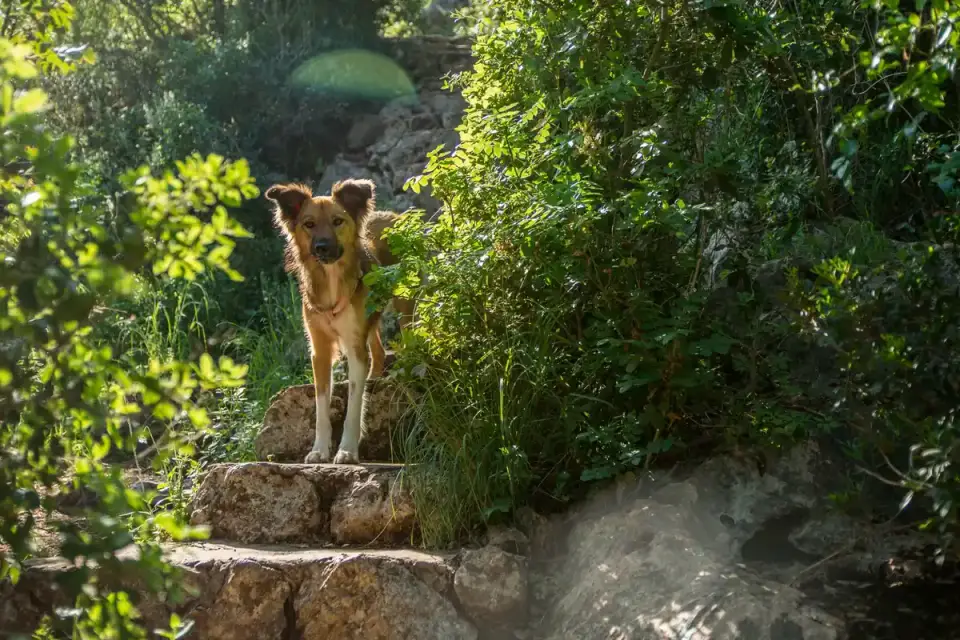
Skeletal proportion, coat, and airway anatomy all set a hard limit that no amount of conditioning fully overrides. A lean, long-legged herding or sporting breed built for endurance work will comfortably cover more ground than a short-legged, barrel-chested breed carrying the same fitness level. Flat-faced breeds face a separate, more serious constraint: reduced surface area for evaporative cooling and higher airway resistance mean brachycephalic dogs can develop Brachycephalic Airway Syndrome in Dogs: exercise intolerance and overheating at exertion levels and ambient temperatures that a mesocephalic dog would shrug off. For these breeds, “how far” is often better measured in minutes of shade-and-water breaks than in miles.
Small and toy breeds carry a different limitation: proportionally longer strides relative to body size mean a five-mile hike costs a ten-pound dog considerably more energy expenditure than it costs a sixty-pound dog covering the same ground. For guidance on matching activity type to a compact frame, see this publication’s exercise ideas for toy and small breeds.
Age and joint capacity across a dog’s life
Growth plates in large-breed puppies commonly remain open past a year of age, and repetitive high-impact mileage before they close is a recognized driver of early joint injury. On the other end of the age spectrum, senior dogs retain plenty of enthusiasm for a hike well after their joints have quietly lost some cartilage volume and proprioceptive precision, which is why distance for an older dog should be judged by recovery the following day, not by how eager the dog looked at the trailhead.
Heat and humidity set the day’s real ceiling
Even a well-conditioned, well-built dog is bounded by thermoregulation. Dogs cool primarily through panting and limited paw-pad sweating, both of which lose effectiveness as humidity rises; evaporative cooling drops sharply once relative humidity climbs past the mid-30% range. Heat Stroke in Dogs: VCA Animal Hospitals notes that heat stroke develops once core temperature climbs to roughly 105°F or higher, and that working dogs can develop hyperthermia in as little as thirty minutes without adequate shade, water, and rest. That window shrinks further for overweight dogs, puppies, thick-coated breeds, and brachycephalic breeds, sometimes to temperatures as low as 70-75°F. Practically, this means the same eight-mile trail that’s routine on a cool, dry morning can be unsafe by early afternoon in July, independent of the dog’s fitness level. For dogs carrying a heavy double coat, planning around cooling options for a thick-coated breed at home before and after a hike matters as much as the mileage decision itself.
Reading the trail, not just the map
A short pause here: distance is a planning number, not a promise. The dog in front of you, on that particular trail, in that particular weather, is the only reliable measure. Watch for a change in gait, reluctance to keep pace, or panting that doesn’t ease during a rest break — these typically arrive before visible exhaustion and are the more useful signal to turn back. If a hike takes you somewhere a dog could bolt after wildlife or lose the trail, pairing that judgment with a GPS tracker for an escape-prone dog is a sensible layer of safety, separate from the distance question itself.
Put together, the honest planning approach is to build mileage in small increments, size the plan to the breed’s build and airway, weigh age and joint condition into the decision, and let the day’s heat and humidity — not the map — set the final number.
Frequently asked questions
Can a puppy hike the same distance as an adult dog?
No. Growth plates in large-breed puppies typically don't close until 12-18 months, and repetitive high-impact mileage before then is a common driver of early joint strain. Short, frequent outings beat one long push.
Is a flat five-mile walk the same load as a five-mile hike?
No. Elevation change, uneven footing, and load-bearing (a pack, deep sand, snow) all raise metabolic and joint demand well above what the mileage number alone suggests.
Sources
- Heat Stroke in Dogs — VCA Animal Hospitals
- Brachycephalic Airway Syndrome in Dogs — VCA Animal Hospitals
- Canine Athlete Conditioning Basics: Tips to Keep Your Dog in Top Shape — American Kennel Club
- Protective effects of turmerosaccharides rich extract of Curcuma longa L. in osteoarthritic dogs — Frontiers in Veterinary Science
- Glucosamine hydrochloride and cartilage degradation — Journal of Veterinary Medical Science
- Green-lipped mussel powder and inflammatory joint markers — Nutrients