
On this page
A twelve-year-old Labrador named Otis came into my practice three days after a cruciate repair, and his owners were exhausted before the recovery had even really started. He was too big and too anxious to settle in the crate they’d borrowed from a friend, pacing and drooling every time the door latched. We talked it through, and by the end of the week they’d swapped the crate for a gated-off section of the mudroom with his bed, water, and a low stool for him to rest his chin on. He calmed down within a day. That case sits with me because it’s such a common mismatch — the confinement tool is right for the surgery, but wrong for the dog in front of you.
What each option is actually built to do
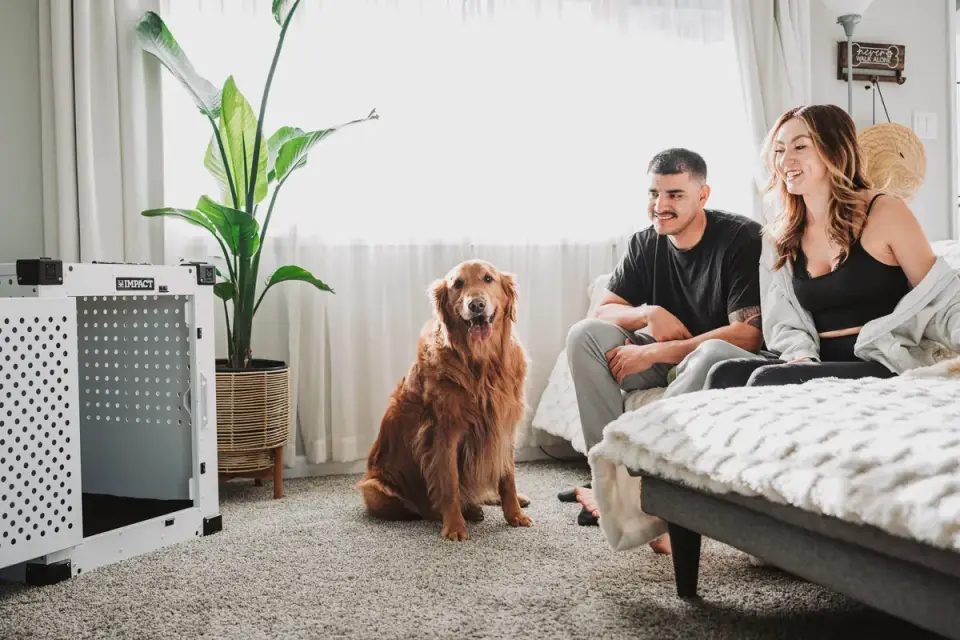
A crate is the smallest, most contained option, and for a lot of dogs that containment is exactly the point — it removes the ability to build up speed, pivot sharply, or launch off furniture. The American College of Veterinary Surgeons notes that pets should be kept in a controlled environment such as a crate or small room after surgery, specifically to prevent unsupervised activity while they’re still healing, even on days they seem to feel fine.
An exercise pen sits in the middle. It gives a dog room to stand, turn, and stretch out fully, but it still keeps the perimeter tight enough that running and jumping aren’t really possible — as long as the dog respects the walls. That’s the catch. A calm, low-drive dog does well in a pen. A dog who paws, climbs, or has ever escaped a baby gate before will treat an x-pen as a suggestion rather than a boundary.
A gated room is the most spacious of the three and the easiest on a dog’s mental state, but it’s also the hardest to fully control. Furniture, stairs, and slick flooring inside the room become variables you have to manage yourself, and a determined dog has more real estate to build momentum in before you can intervene.
Sizing the choice to the dog, not the surgery
This is where I push back on advice that treats confinement like a single rule applied to every recovery. The VCA Animal Hospitals overview on exercise restriction is clear that the confinement method should match the pet’s condition, and that a veterinarian may recommend a crate or a small room depending on the situation — it’s a judgment call, not a default.
In my own casework, I default to the crate first for anxious or destructive dogs recovering from anything orthopedic, because the failure mode of “too calm” is far safer than the failure mode of “found a way to jump.” I default to a pen or gated room for dogs who are naturally settled, older, or already stiff enough that a burst of speed isn’t realistic. The Choosing a recovery crate or pen guidance from The Rehab Vet makes a similar distinction: an exercise pen works well for dogs who don’t do well in crates, provided they aren’t likely to jump or push against the sides, and larger dogs recovering from surgery are often simply too big to be comfortable in a crate for the many weeks a repair needs to heal.
There’s a smaller, quieter truth in that last point that gets lost in most comparisons: comfort matters to healing, not just safety. A dog who is miserable in confinement sleeps worse, eats less, and in my experience is more likely to have a setback out of sheer frustration than a dog who is bored but settled. I’ve started asking owners, before we even talk about surgery type, what their dog’s stress signals look like — because that answer changes my recommendation more than the orthopedic details usually do.
A recovery that changed how I counsel this
I remember a young Border Collie mix, barely a year old, who’d had a fracture repair and was sent home with strict rest orders. Her owners tried a standard wire crate, and within two days she’d bent one of the door latches trying to get out toward the sound of kids playing outside. We moved her to a fully gated bathroom with the door reinforced and nothing she could climb on, and it held — but only because the room had no furniture and a non-slip mat covering the tile. That’s the piece owners underestimate: room rest isn’t just picking a room, it’s stripping a room down to nothing a healing dog can slip on, climb, or launch from. The families who do that prep well tend to have calmer, less eventful recoveries; the ones who assume “she’ll just lie there” usually call me back within the week.
If you’re setting up any of these three options for the first time, the groundwork is the same whether it’s a new puppy or a dog on medical rest — see our guide to setting up a crate for a puppy’s first night for sizing and placement basics, and our kitchen puppy-proofing walkthrough if the gated room you’re considering happens to be the kitchen.
When the three work better in sequence than in competition
Recovery timelines aren’t static, and a dog doesn’t have to stay in the same setup for the whole stretch. It’s common for a dog to start in a crate during the highest-risk early days, then graduate to a pen or gated room as swelling goes down and the surgical team eases restrictions. Recovery from significant orthopedic work often runs six to eight weeks of restricted activity before a return to light exercise, and a dog that jumps, slips, or twists too early in that window can undo weeks of healing — which is exactly why the tighter option early on is worth the extra fuss.
If you plan to move your dog between rooms or take them to follow-up visits during recovery, how they’re restrained in the car matters just as much as how they’re confined at home. We’ve compared that separately in Dog Car Seat Belt vs Crate vs Barrier, and if you’re using a crate for transport, securing it properly in the car is worth doing right the first time.
My recommendation
I land on the crate as the default for the first phase of any strict-rest recovery, especially for dogs with any history of anxiety, escape attempts, or high energy — not because it’s the most comfortable option, but because it’s the hardest one to defeat by accident. Once a veterinary team clears more freedom, I’ll move a settled dog into a pen, and reserve full gated-room rest for dogs who are either too large for a crate to be humane or calm enough that the extra space won’t be misused. None of these choices is a cure for what a dog is recovering from — they’re structure/function support for the healing process, buying the body time to knit back together without a setback getting in the way.
Frequently asked questions
Can I switch from a crate to a playpen partway through recovery?
Often, yes, once your veterinary team clears more movement — many recoveries start in the tightest confinement and loosen from there, but the timing should come from your surgeon, not a fixed calendar.
Is a gated room ever safer than a crate?
For very large or crate-anxious dogs, a properly stripped-down gated room can be safer in practice, because a miserable, thrashing dog in a too-small crate is its own risk.
Sources
- Postoperative Care After Surgery: What Animal Owners Should Expect — American College of Veterinary Surgeons
- Exercise Restriction in Dogs — VCA Animal Hospitals
- Choosing a recovery crate or pen — The Rehab Vet