On this page
Here’s the fork most owners face at the gate: your dog is 22 pounds, technically eligible for either side, and both gates are open. Which one do you actually walk through?
I get some version of this question constantly. In my practice I’ve had owners bring in a 9-pound Chihuahua mix named Pepper after a rough afternoon at the local park — nothing dramatic, no puncture wounds, just a dog who wouldn’t put weight on her left front leg by that evening. Her owner had let her into the all-size area because “she does fine with big dogs at home.” What actually happened, based on the exam and the owner’s description, was a 70-pound Lab mix bowling her over mid-chase — not aggression, just mass and momentum. Pepper had a soft-tissue strain that resolved in about ten days of rest, but it was the kind of injury that’s entirely avoidable with the right side of the fence.
Size isn’t really the variable — mass and play style are
A small-dog area exists because of physics as much as temperament. A 60-pound dog running full speed doesn’t need to intend harm to knock over, step on, or body-check a 12-pound dog hard enough to cause a fracture or joint injury. Many municipal and private parks now build separate enclosures for exactly this reason, using a weight or height cutoff — often somewhere in the 25–35 pound range — to sort dogs before they’re off leash, according to Wikipedia’s overview of dog park design. That’s a blunt tool, but it’s a reasonable one: a dog’s mass, not its personality, determines how much force is behind an accidental collision.
Play style matters just as much as weight, though. A stocky 30-pound bulldog with a low, slow gait is a very different play partner than a 30-pound border collie mix running at full tilt. If your dog is on the borderline and easily overwhelmed, startles at sudden movement, or has a bite history — even a minor one — the small-dog side is usually the safer default regardless of what the scale says.
What actually goes wrong when sizes mix
The behavioral concern that gets the most attention here is what trainers and behaviorists call predatory drift — a shift where a larger dog’s play arousal tips into a prey-like chase-and-grab response, often triggered by a smaller dog’s high-pitched yelp or fast, erratic movement. The term is generally attributed to veterinary behaviorist Ian Dunbar, and while it isn’t universally accepted as a distinct clinical phenomenon, the underlying pattern — arousal escalating past the point where a dog is still reading social cues — is well documented in canine behavior writing, including in PetHelpful’s overview of the concept. Most dogs never do this. But it’s part of why size-matched play areas exist even at parks where every regular dog is considered friendly.
The more common injury isn’t a bite at all — it’s blunt trauma. A small dog underfoot during a chase game, knocked sideways by a shoulder check, or landed on during a play-wrestle can end up with a fractured limb, a luxated patella, or a soft-tissue strain, the kind Pepper had. None of that requires an aggressive dog. It requires an unmatched one.
Reading your own dog before you read the sign
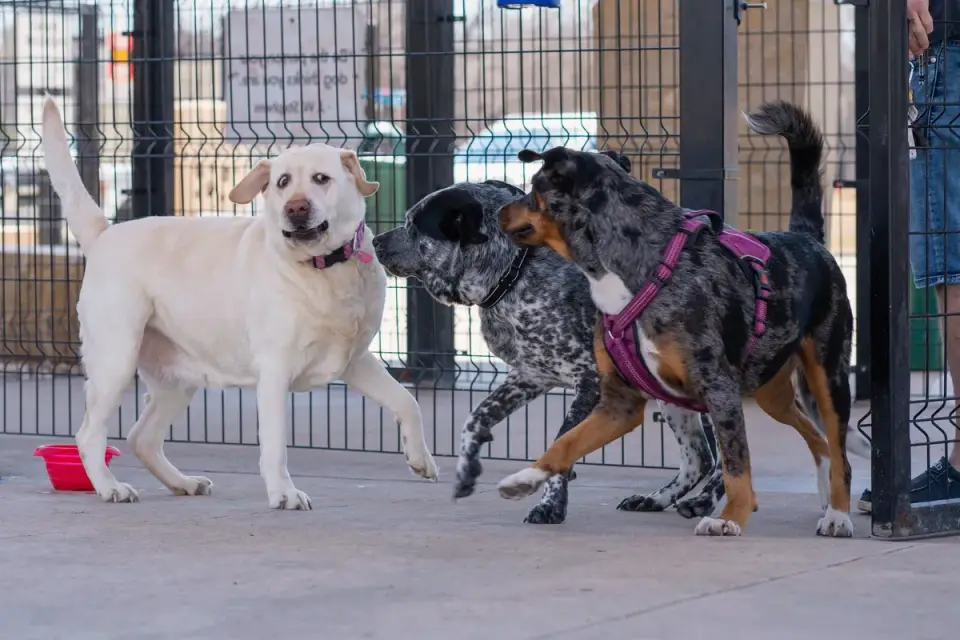
The weight cutoff on the gate is a starting point, not a verdict. A confident, well-socialized 20-pound dog who plays hard and reads other dogs well may genuinely do fine in mixed company with the right supervision. A nervous 35-pound dog who freezes or bolts under pressure may be safer, and happier, on the small-dog side even if it’s crowded with dogs half its weight. What you’re actually assessing is arousal control — can this dog disengage when a game gets too intense, and can you physically intervene in time if it doesn’t.
If your dog is new to a park, I’d rather you start on whichever side has calmer energy that day and watch one full play cycle — chase, pause, re-engage — before deciding you’ve picked the right area. Off-leash park time is one of the better forms of structured exercise for social dogs, and pairing it with other predictable outlets matters too; our guide to exercise ideas for toy and small breeds covers lower-arousal options for dogs who don’t do well in high-traffic group play at all.
The recommendation
I’ve watched enough of these visits play out to land somewhere specific rather than neutral: if your dog is under roughly 25 pounds, start in the small-dog area by default, and only graduate to mixed play once you’ve seen how your dog handles arousal, not just how it handles size. If your dog is borderline and easily overstimulated, treat the small-dog side as the safer choice even past the cutoff weight. The strongest counterargument I hear is that segregating by size limits socialization — that a small dog who never plays with bigger dogs stays anxious around them. That’s a fair concern, and it’s true that some dogs benefit from calm, supervised exposure to size differences. But that exposure belongs in a controlled one-on-one setting with a known, gentle dog, not in an open group play area where you can’t control who joins the game mid-run.
For dogs who do best outside the fenced play areas entirely, patio and public outings are a lower-arousal alternative — see our piece on finding dog-friendly patios and breweries for how to vet those spaces before you go. And if you’re building any new skill for group settings, a reliable recall or “leave it” cue matters more at the dog park than almost anywhere else; our comparison of clicker vs. verbal marker training is a useful starting point if you’re working on that foundation.
So: which gate do you walk through today? If you’re not sure your dog can disengage from a game once it gets loud and fast, that uncertainty is your answer.
Frequently asked questions
What weight cutoff do most small-dog areas use?
It varies by park, but many use somewhere between 25 and 35 pounds as the dividing line, sometimes paired with a height cutoff for leggy but light breeds.
Sources
- Dog park — Wikipedia
- What Is Predatory Drift in Dogs? (And How to Prevent It) — PetHelpful