
On this page
Here’s the fork most owners are standing at: do you shut the biting down hard right now, or do you let your puppy keep mouthing you so it can learn how much pressure is too much? I always land on the second option, and I tell clients that on day one.
In my practice I see this exact scenario at least once a week. A family brings in an 8-week-old Labrador mix, and by the second visit they’re describing puppy teeth marks up and down their forearms. One client, raising a 10-week-old Aussie named Piper, told me she’d started wearing long sleeves in July just to answer the door. She’d first noticed it during evening play sessions on the living room rug, right around 6, when Piper got overtired and the mouthing turned from soft to sharp in about ten minutes flat. The owner was weighing whether to just stop playing with her hands entirely versus push through and teach the lesson. I told her what I tell most people in that spot: don’t take your hands out of the game, take the sting out of it instead. Over about three weeks of consistent yelp-and-withdraw responses, Piper’s bite pressure dropped from bruising to barely-there.
Weeks 8–10: why the needle teeth are actually doing you a favor
A young puppy’s mouth is how she explores everything, and those needle-sharp teeth exist for a reason most owners don’t expect: they hurt just enough to teach bite inhibition while the jaw is still too weak to do real damage. This is the window I want owners leaning into, not avoiding. If you stop all mouthing outright at this stage, you can rob your puppy of the feedback loop that teaches soft-mouth control later, when the jaw is strong enough to matter.
The mechanic is simple: when your puppy bites too hard, yelp in a short, high pitch, pull your hand back, and pause the game for 10–20 seconds. Then resume. Puppies who get consistent, immediate feedback like this generally soften their bite within a couple of weeks. It’s not instant, and it’s not one clean lesson — it’s dozens of small repetitions a day.
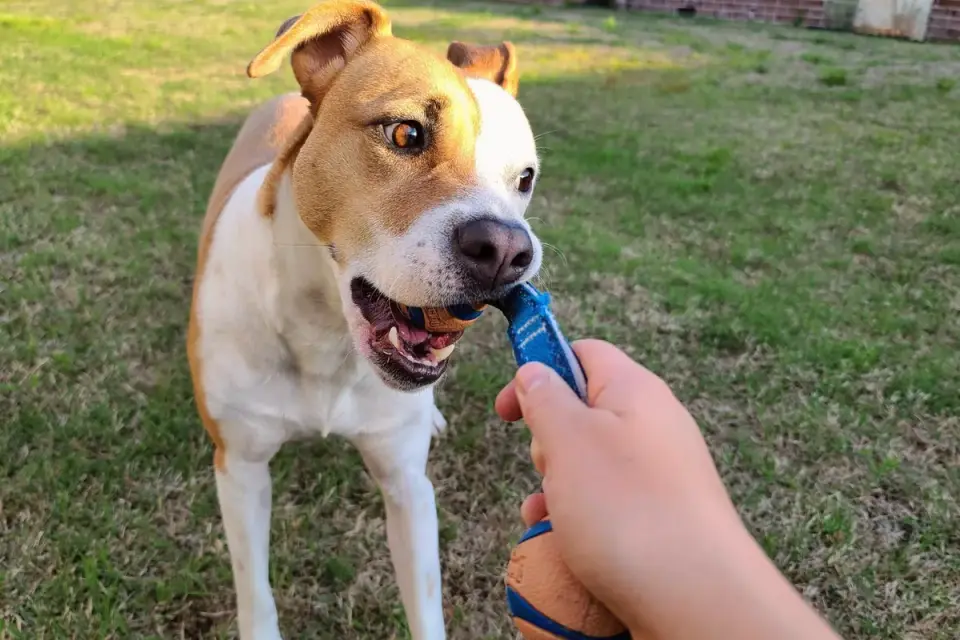
Weeks 10–16: redirecting onto appropriate targets
Once the yelp-and-pause pattern is established, start layering in redirection. Keep a toy within arm’s reach during play so that the instant your puppy’s teeth land on skin, you can swap in the toy instead of just withdrawing. This teaches two things at once — bite inhibition and an acceptable target — rather than just teaching your puppy to stop biting people without giving her mouth anything else to do.
This is also the stage where overtiredness becomes the biggest driver of hard biting, more than any single training gap. Puppies who are wound up from a long day of visitors, a new environment, or a missed nap tend to mouth harder and more erratically. If you notice biting spiking in the evening, the fix often isn’t more correction — it’s an earlier bedtime.
Teething genuinely hurts here too, and a lot of the mouthing at this age is a puppy trying to relieve gum pressure on anything within reach, including hands and shirt sleeves. Frozen washcloths and appropriately sized chew toys give that pressure somewhere else to go.
Weeks 16–24: the adolescent test of everything you’ve taught
By four months, most puppies who’ve had consistent redirection show a noticeably softer mouth, but this is also when adolescent impulsivity creeps in and undoes some of that progress. You’ll often see a temporary regression — more jumping, more grabbing at clothing, more mouthing during greetings — right as the adult teeth finish coming in. This is normal, not a sign the earlier training failed.
Consistency matters more than intensity at this stage. If every person in the household responds differently — one person yelps and withdraws, another shouts, a third just lets the puppy chew on them — the dog gets mixed signals and the behavior takes longer to resolve. A five-minute conversation with everyone in the house about the same response protocol saves weeks of confusion.
Some dogs at this age are also mouthier specifically because they’re anxious or overstimulated rather than simply playful, and it’s worth watching for that distinction — a dog who mouths hardest right before visitors leave, or during loud household moments, is often managing stress through the behavior rather than just playing.
Where calming support fits, and where it doesn’t
Calming ingredients are not a substitute for bite-inhibition training, but for a puppy whose mouthing spikes specifically around overstimulation or stress, some owners look at supportive ingredients alongside — not instead of — the behavioral work above. Chamomile has a long history in traditional herbal care to support relaxation, though a recent review notes that “for the remaining species, evidence is derived mainly from preclinical studies or traditional use,” so expectations should stay modest (Biomedicines). L-theanine, an amino acid found in tea, has been studied for its calming properties, and a review in Molecular Psychiatry found effects in human anxiety research, “except for one study on psychotic anxiety (SMD = 0.54; 400 mg/day for 8 weeks)” — a human dose that doesn’t translate directly to dogs. Ashwagandha, specifically the KSM-66 form, has more consistent backing: a systematic review in Cureus “analyzed multiple RCTs and concluded that ashwagandha has a moderate positive impact on stress reduction and cognitive performance.”
None of that replaces the yelp-and-redirect work above. If a puppy’s mouthing is genuinely rooted in overarousal, this can sit alongside training as one supportive layer, not the fix itself.
When mouthing looks like something else
I think about a case that still shapes how I counsel new puppy owners. A 14-week-old Border Collie mix came in because his mouthing had a different quality than typical puppy nipping — it happened almost exclusively when he was cornered near his crate or startled awake, and it came with a stiff body and a hard stare rather than the loose, bouncy body language of normal play-biting. That distinction is the one I want every owner watching for: playful mouthing is loose and often paired with a play bow or wagging tail, while fear- or frustration-driven biting comes with tension, stillness before the bite, and avoidance. If you see the second pattern, or if a puppy’s biting isn’t softening at all by 5–6 months despite consistent redirection, that’s a signal to bring in a professional rather than keep managing it solo. For dogs whose mouthing seems tied up with a broader startle response, our guide on why a dog might growl when petted covers the same distinction between pain-driven and fear-driven reactions, and it’s worth reading if the biting comes with any stiffening or avoidance.
If the mouthing seems tangled up with a dog who can’t settle when you leave the room, our piece on independence training for a velcro dog covers a related overarousal pattern. And if you’re building out the redirection toolkit, our buyer’s guide to training treats breaks down what actually holds a puppy’s attention long enough to make the swap work.
The recommendation
If I had to boil down every consult I’ve had on this topic, it’s this: don’t try to eliminate mouthing outright in a young puppy, teach it to soften. The yelp-and-withdraw method, paired with consistent redirection onto toys, is the approach with the longest track record and the most predictable timeline — most puppies show real improvement within a few weeks and settle into a soft mouth by 5–6 months. Calming ingredients can support an overstimulated puppy alongside that work, but they’re a supporting player, not the plan.
What would change if you stopped thinking of the biting as a problem to eliminate and started thinking of it as a skill still being taught?
Frequently asked questions
At what age do puppies stop biting so hard?
Most puppies show a real softening in bite pressure between 8 weeks and 6 months, as bite inhibition develops through consistent feedback like the yelp-and-withdraw method.
Is it bad to let my puppy mouth my hands?
Some supervised mouthing during this stage helps a puppy learn bite pressure while the jaw is still weak; the goal is softening the bite, not eliminating mouthing outright.
Why does my puppy bite harder in the evening?
Overtiredness is one of the biggest drivers of harder biting; an earlier bedtime often reduces evening mouthing more than additional correction does.
Sources
- Chamomile and stress: evidence landscape across species — Biomedicines
- Ashwagandha (KSM-66) systematic review on stress and cognitive performance — Cureus
- L-theanine and anxiety: review findings — Molecular Psychiatry