
On this page
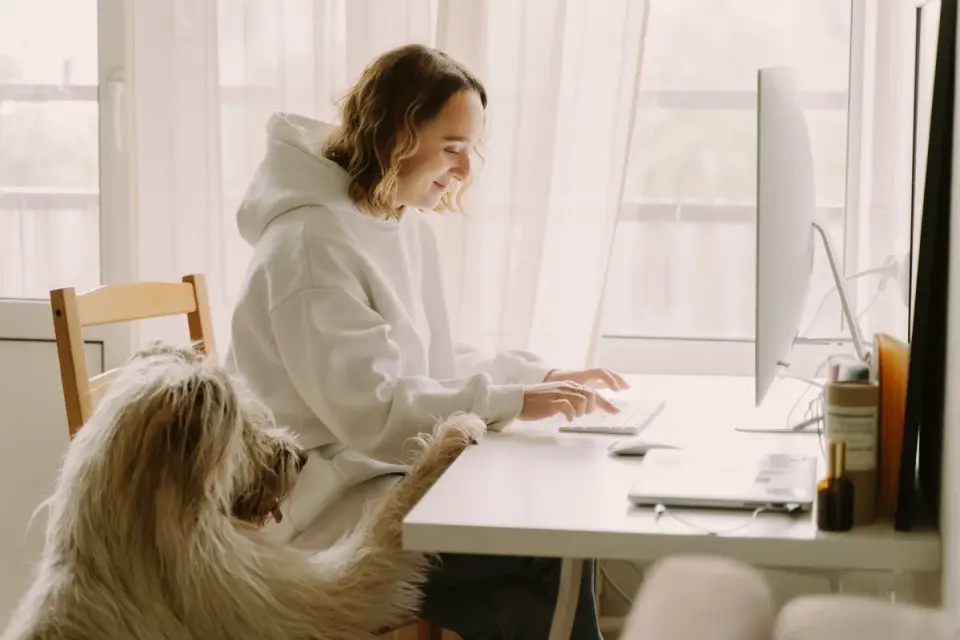
A reader we’ll call Dana works from a home office with a glass door. Her dog, a two-year-old terrier mix named Biscuit, spends the day parked three feet from her chair. Bathroom trips have an audience. Getting the mail means Biscuit is pressed against the front door before Dana even stands up. Dana isn’t bothered by the affection. She’s worried about what happens the day Biscuit has to be left alone for a full workday, and whether the constant shadowing is a habit that’s gotten out of hand.
This is one of the most common behavior questions we hear, and it deserves a direct answer up top. To stop a dog from following you everywhere, build tolerance for distance gradually rather than blocking access outright. Closing doors, yelling “stay,” or suddenly crating a dog who has never practiced being apart tends to spike anxiety rather than resolve it.
Why dogs become velcro in the first place
Dogs are a social species, and staying near a trusted person is a normal survival strategy, not a flaw. Several things push a dog from “likes company” toward “can’t function without visual contact.” Breed tendencies matter — herding and companion breeds were selected for close human orientation. So does life history: dogs adopted as adults, rehomed dogs, and dogs who went through a recent move often shadow more tightly for weeks or months afterward. Routine changes count too. A dog whose owner recently started working from home, then went back to an office, frequently develops sudden following behavior once the household rhythm shifts again.
It helps to separate two different pictures. A dog who follows around the house but naps calmly in another room when you step outside is showing a preference, not a problem. A dog who whines, paces, or tries to block your path the moment you head for a door is showing something closer to anticipatory anxiety, and that calls for a different response.
The training framework that builds independence
Start small. Most trainers structure independence work in three stages, and the point of each stage is to make the next increment boring rather than alarming.
First, teach a settle spot — a mat, bed, or crate the dog can be rewarded for lying on near you. Reward calm behavior on that spot, in several short sessions a day, before asking for any distance at all.
Second, add small increments of physical distance while the dog stays on the mat. Walk to the next room and back. Return before the dog gets up, not after. This detail matters more than almost anything else in the process: rewarding the dog for staying, rather than for choosing to break position and follow, is what actually teaches tolerance.
Third, extend duration before you extend distance further. A dog who can hold a three-minute settle across the room is a better candidate for a longer absence than a dog who’s only ever practiced thirty seconds. Progress in steps small enough that the dog rarely fails, and treat failures — the dog getting up and trailing you — as information that you moved too fast, not as disobedience.
Practical departure cues help too. Pick up your keys, put on your shoes, and sit back down repeatedly through the day so those cues stop predicting a stressful absence. Keep actual departures low-key: no prolonged goodbye, no dramatic return greeting.
Where calming support fits — and where it doesn’t
Some owners look to calming ingredients as a bridge while training takes hold, and it’s worth understanding what the evidence actually says. Chamomile has a long history in traditional herbal use for relaxation, but according to a review published in Biomedicines, “for the remaining species, evidence is derived mainly from preclinical studies or traditional use.” Ashwagandha has firmer human data: a review in Cureus notes that “a systematic review analyzed multiple RCTs and concluded that ashwagandha has a moderate positive impact on stress reduction and cognitive performance.” L-theanine shows a similar pattern in humans — a review in Molecular Psychiatry reported an effect on anxiety “except for one study on psychotic anxiety (SMD = 0.54; 400 mg/day for 8 weeks).”
The honest takeaway: these ingredients are reasonably well studied in people, and the research base in dogs specifically is still developing. They may support a calmer baseline during training, but they don’t replace the mechanical work of teaching a dog to tolerate distance. Ingredients help set the stage; they don’t do the training for you.
When following everywhere signals something more
Some dogs need more than a home training plan. Watch for destructive behavior only when alone, house-soiling despite being fully house-trained, drooling or panting that starts before you even leave, or vocalizing that continues for the full duration of an absence. Those patterns are consistent with separation-related distress, and a veterinarian or a certified behaviorist can help build a structured desensitization plan and rule out pain or a medical cause behind sudden clinginess.
Biscuit, for what it’s worth, didn’t need that level of intervention. Three weeks of short settle-and-return sessions, plus keeping departures low-drama, got him to the point where he’d stay on his bed through a full grocery run.
In brief: velcro behavior usually responds to patient, incremental distance work rather than a single fix. Build the settle habit, extend distance and duration in small steps, treat calming ingredients as a possible supporting tool rather than a solution, and get professional input if the following behavior comes with real distress.
Frequently asked questions
Is it bad to let my dog follow me everywhere?
Not inherently. Many dogs simply prefer proximity to their person. It becomes worth addressing when the dog can't settle, paces, or shows distress the moment you're out of sight, since that pattern can tip into separation-related distress.
How long does independence training take?
Owners often see small changes — a dog choosing to stay on a mat for a few minutes — within one to two weeks of daily short sessions. Full comfort with longer absences typically takes longer and should be built gradually.
Should I ignore my dog when it follows me?
Ignoring the behavior outright isn't usually the fastest path. It works better to reward the dog for choosing to stay put or settle at a distance, so the dog learns that space is safe and still earns attention.
Sources
- Chamomile and Anxiety/Stress: A Review — Biomedicines
- Systematic Review of Ashwagandha for Stress and Cognitive Performance — Cureus
- L-Theanine and Anxiety: A Systematic Review — Molecular Psychiatry