On this page
- Start here: the checklist before you pick a system
- Why gesture tends to win the head-to-head
- Where I land with clients, and the counterargument I take seriously
- When verbal cues actually deserve to lead
- Signal vs. cue: is there a difference?
- Common dog hand signals to start with
- A short case for treating this like any other buyer’s-guide decision
- The bottom line
- FAQs
Start here: the checklist before you pick a system
- Default to gesture first, word second. Teach the hand signal, get it reliable, then pair the verbal cue on top — not the reverse.
- Keep the signal visually distinct. A flat palm for “stay” and a raised arm for “sit” should not blur together at 20 feet.
- Use verbal cues for anything out of sight. If your dog needs to respond around a corner or in the dark, the word has to carry the weight.
- Never assume the word is loading real meaning. Most owners repeat a verbal cue with a hand motion baked in without realizing it, so the “word” is really doing half its work as a gesture.
- Match the system to the dog in front of you. A deaf or hard-of-hearing dog needs hand signals as a primary language, not a backup.
- Test each cue in isolation. If your dog only responds when both cues fire together, you don’t have two independent cues yet — you have one blended one.
I ask new clients to run that list before we ever talk about which specific word or gesture to use, because the order you teach in matters more than the vocabulary you pick.
Why gesture tends to win the head-to-head
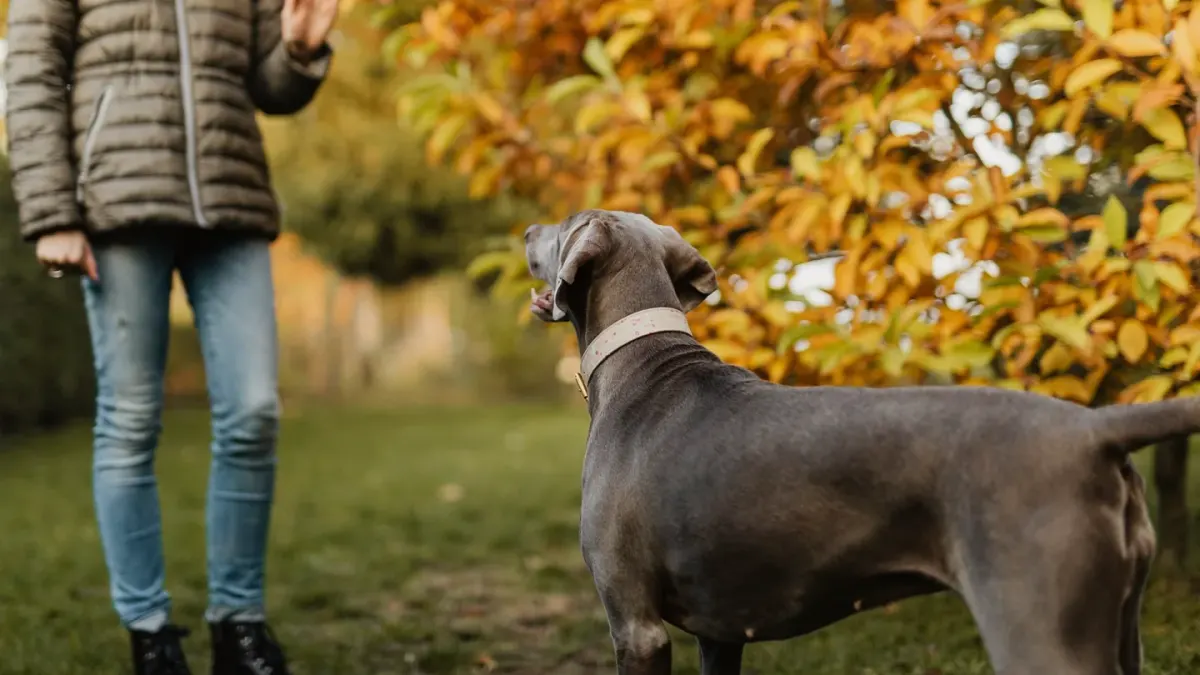
Dogs are, structurally, better wired to read bodies than to parse speech. A study on working dogs found that ScienceDirect: dogs responded to hand signals more reliably than to verbal cues alone, and that familiarity with the person giving the cue changed performance more than the cue type itself — meaning your dog’s accuracy with either system depends partly on how well he knows you as a signaler, not just on the command.
That tracks with what The Science Dog lays out in a review of the visual-versus-verbal literature: when a hand signal and a verbal cue are pitted against each other, dogs default to the gesture a large majority of the time, even when the word is one they know well. Speech is not a dog’s native channel. Human infants take roughly a year of dedicated exposure to start mapping sound to meaning, and dogs never fully get there — they get close enough to be useful, but a flick of the wrist reads faster and cleaner than a syllable.
Psychology Today summarized water-rescue dog testing where handlers gave conflicting hand and voice cues on purpose, and the dogs sided with the hand signal in most trials. These weren’t untrained pets — they were working dogs fluent in both systems, which makes the gesture bias more telling, not less.
Where I land with clients, and the counterargument I take seriously
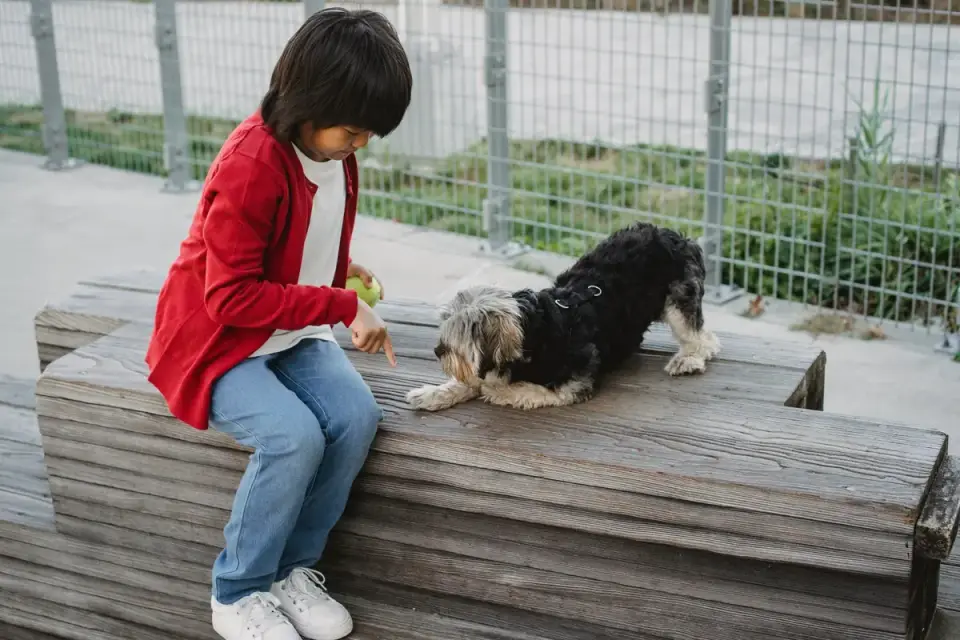
In my practice I start almost every obedience conversation with hand signals, and I tell owners why up front: it’s the fastest route to a dog that actually generalizes the behavior instead of just performing on cue in one context. I had a twenty-two-pound terrier mix named Peanut, four years old, whose owner had spent months on “come” with mixed results — reliable in the living room, useless at the dog park. We swapped to a big sweeping arm pull-in gesture paired with the word, and within three weeks Peanut was recalling off-leash across the park at 40 feet, well past where he could have picked the word out from ambient noise. The owner kept using the word too, mostly for her own habit, but the arm motion was doing the actual work at distance.
The strongest counterargument is real, and I don’t dismiss it: verbal cues are the only option when your dog can’t see you, and life is full of those moments — behind furniture, around a blind corner, in a dark yard at 10 p.m. If you train hand signals exclusively, you’ve built a dog who’s fluent in a language that fails exactly when visibility fails. That’s a legitimate gap. My answer isn’t to skip verbal training — it’s to sequence it. Teach the gesture until it’s rock-solid, then layer the word over it consistently enough that the word eventually earns its own independent meaning. Skipping straight to verbal-only, in my experience, produces the shakier foundation, not the other way around.
The American Veterinary Society of Animal Behavior’s position statement on humane training doesn’t take a side on gesture versus voice specifically, but it’s worth reading before you pick any training system, because it frames the bigger point: how you deliver a cue matters less than whether the learning process itself stays reward-based and low-stress. A dog who’s anxious about getting a cue “wrong” won’t reliably respond to either channel.
When verbal cues actually deserve to lead
There are dogs and situations where I flip my own default. Older dogs losing vision benefit from verbal cues carrying more weight over time, for the obvious reason that the visual channel is degrading. Dogs who are hearing-impaired need the opposite adjustment — hand signals become the primary language, not a redundant backup, and training a hearing-impaired dog with hand signals requires more precision in the signal set than most hearing dogs ever need, since there’s no word to fall back on if a gesture gets muddled.
Multi-dog households are another case. If you’re cueing one dog out of three sitting in a line, a verbal cue paired with the dog’s name is often cleaner than a gesture, because gestures can read as directed at whichever dog is looking at you, not the one you meant.
Signal vs. cue: is there a difference?
In everyday training talk the words are used interchangeably, and that is mostly fine. Strictly, a cue is anything that tells your dog a particular behavior will now pay off: a word, a gesture, a whistle, even your hand moving toward the leash. A hand signal is one kind of cue, a visual one, and a verbal cue is another kind, a spoken one. “Command” is an older word for the same thing; many trainers prefer “cue” because it describes information, not pressure. When this article compares hand signals and verbal cues, it is comparing two channels for delivering the same kind of cue.
Common dog hand signals to start with
There is no single official set, so consistency matters more than which version you pick. These are widely used and visually distinct from one another:
- Sit: palm up at your waist, hand rising toward your chest.
- Down: flat palm, facing the floor, lowered toward the ground.
- Stay: flat palm held out toward the dog, like a stop sign.
- Come: arm out to the side, swept in toward your chest.
- Watch me: index finger moving from the dog’s eye line to your own eyes.
- Leave it or off: a flat hand sweeping sideways, away from the item.
- Heel or with me: a light pat on your thigh on the side the dog walks.
For a deaf dog, these signals are the commands, so add two more before anything else: a marker that means “yes, that earned a reward” (a thumbs-up or a quick open-and-close of the hand), and a way to get attention when the dog is not looking at you, such as a gentle touch on the shoulder, a stomp the dog can feel through the floor, or a porch light flicked on and off at night. Picture a deaf adolescent dog that keeps missing cues in the yard: the cues are usually fine, and the missing piece is a reliable way to make the dog look up before the cue is given. Every signal should look the same every time, from everyone in the household.
A short case for treating this like any other buyer’s-guide decision
Here’s a genuinely short thought: this is a training-system choice, not a gear choice, but I score it the same way I’d score a leash — on what holds up under real conditions, not what looks good in a quiet living room.
Owners often ask whether they should use a clicker on top of all this, and that’s a separate but related decision — see our breakdown of clicker training versus a verbal marker word if you’re still choosing a marker system. The marker question and the cue-delivery question (hand versus word) aren’t the same thing, but they interact: a clicker plus a hand signal is one of the cleanest combinations I recommend, because neither channel competes with the other for the dog’s attention.
If you’re building a full training routine, the treat side of it matters just as much as the cue side. A treat pouch used correctly keeps your reward timing tight enough that whichever cue system you’re using — gesture, word, or both — actually gets reinforced at the moment the dog performs it, not three seconds later when you’ve fumbled a bag open.
The bottom line
Teach the hand signal first. Add the verbal cue once the gesture is reliable across contexts, and keep both alive long-term rather than fading one out — you’ll want the word for low-visibility moments and the gesture for everything else. If your dog is a puppy still building any cue vocabulary at all, this same principle applies well beyond obedience commands; it’s part of why a structured potty-training schedule leans on consistent cues from week one rather than introducing new ones piecemeal.
I keep coming back to one exchange with a client, an older Lab named Duchess, twelve years old, whose owner was frustrated that “off” had stopped working around the counter. Duchess’s hearing had been quietly declining for months — nothing dramatic, just a slower response to the doorbell, then to her name from another room. We ran a quick at-home check, confirmed the hearing loss was real and not defiance, and rebuilt her entire cue set around hand signals starting that week. Within ten days she was responding to a flat-palm “off” more consistently than she’d responded to the word in the prior six months. The owner’s biggest adjustment wasn’t teaching new signals — it was remembering to look at Duchess before cueing her, since a hand signal only works if the dog is watching.
FAQs
Q: Should I teach hand signals and verbal cues at the same time, or one after the other? A: Sequence them. Get the hand signal reliable first, then add the verbal cue consistently on top of it so the word eventually carries meaning on its own.
Q: Is it too late to add hand signals to a dog who only knows verbal cues? A: No. Most dogs pick up a paired hand signal within a few weeks of consistent practice, since you’re layering a naturally easier channel onto an existing behavior rather than starting from zero.
Sources
- Just Show Me A Sign — The Science Dog
- Position Statement on Humane Dog Training — American Veterinary Society of Animal Behavior
- Effectiveness of verbal and gestural signals and familiarity with signal-senders on the performance of working dogs — ScienceDirect
- Are Voice Commands or Hand Signals More Effective for Dogs? — Psychology Today