On this page
I still remember a Cavalier puppy named Biscuit, ten weeks old, whose owners came in frustrated after two weeks of what they called “failed” potty training. They’d printed a schedule off a blog: out every two hours, no exceptions, seven days a week. Biscuit was having accidents almost every afternoon, right around 3 p.m., like clockwork. It took about five minutes of asking questions to find the pattern. Biscuit’s afternoon nap ran until 2, and by the time anyone noticed she was awake and moving toward the back door, twenty minutes had already passed. The schedule wasn’t wrong because it was too rigid. It was wrong because it ignored what she actually did between naps.
A rigid schedule copied from someone else’s routine will always miss your puppy’s actual patterns.
That’s the core problem with most potty training advice: it treats the clock as the variable that matters, when the variable that matters is your puppy’s age, bladder size, and daily rhythm.
Why the Printable Chart Usually Fails
Generic charts assume every puppy of a given age needs a bathroom break at the same interval, fed on the same schedule, sleeping the same hours. In practice, a 9-week-old Great Dane puppy and a 9-week-old Chihuahua puppy don’t hold urine for the same length of time, and neither one holds it as long after a play session as after a nap. The American Kennel Club frames the standard rule of thumb this way: a puppy can generally hold its bladder for roughly one hour per month of age, up to a ceiling of about eight to nine hours in a mature adult. That’s a starting estimate, not a promise. An 8-week-old puppy might need to go out closer to every 45 minutes during an active stretch of the day, even if the “one hour per month” math suggests two hours.
Build the Framework Around Age First
Start with the bladder-capacity estimate, then adjust downward for activity. Waking up, eating, drinking, and vigorous play all shorten the interval, sometimes by half. A puppy who just finished a five-minute game of tug needs a bathroom trip within minutes, regardless of what the clock says the “scheduled” break should be.
A workable framework looks roughly like this by age:
- 8–10 weeks: potty trips every 45–60 minutes while awake, plus immediately after waking, eating, or playing
- 10–14 weeks: every 60–90 minutes, with the same after-wake/after-meal rule
- 14–20 weeks: every 2–3 hours, holding times lengthening as bladder control matures
- 5–6 months and up: 3–4 hours during the day for most breeds, though large and giant breeds often mature more slowly
Overnight is its own category. Most puppies under 12 weeks need at least one middle-of-the-night break, and trying to force an 8-week-old puppy through an 8-hour night is setting up an accident, not a training failure. The goal in those early weeks isn’t a full night’s sleep. It’s steady, unhurried repetition.
Where the Crate Fits In
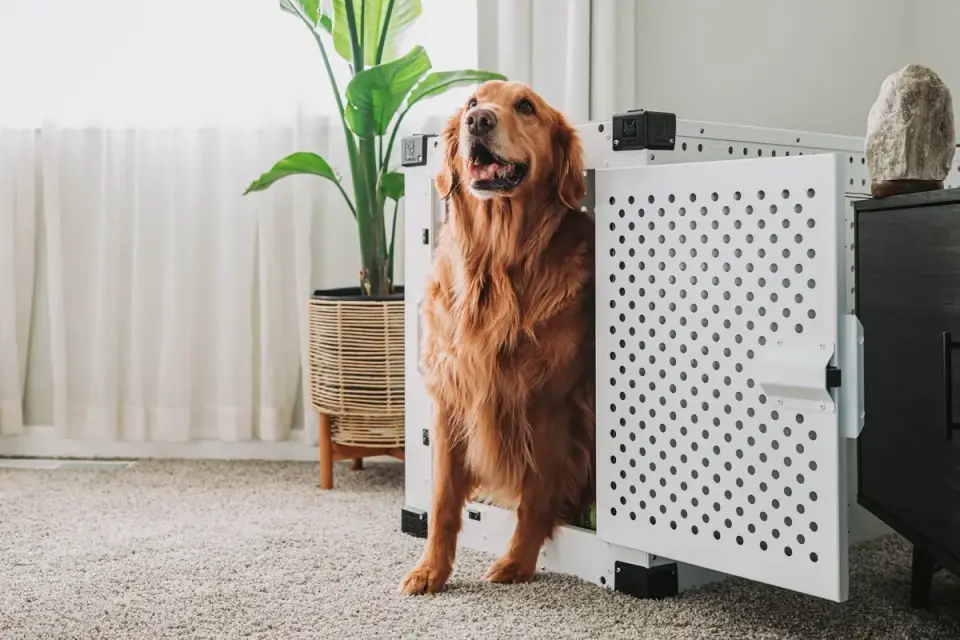
A crate isn’t a punishment tool, and it isn’t optional scaffolding either — it’s one of the few pieces of equipment that does real work in house training, because most puppies are reluctant to soil the space they sleep in. Cornell University’s College of Veterinary Medicine notes that crates can support house training and reduce destructive behavior when a puppy can’t be directly supervised, provided the crate is sized so the puppy can stand, turn around, and lie down comfortably without extra room to use one corner as a bathroom. Size the crate for the adult dog’s expected frame if you can, then block off the excess space temporarily rather than buying a series of crates as your puppy grows.
If your household is already leaning on a crate for structure, it’s worth pairing that habit with a plan for calmer alone time; our guide to independence training for a velcro dog covers how to build that tolerance without creating separation anxiety.
Reading the Signs Between Scheduled Breaks
A schedule handles the predictable part of the day. It won’t catch every accident, because puppies don’t wait for a countdown. Circling, sniffing the floor with sudden intensity, whining at a door they don’t normally whine at, or simply stopping mid-play to stand still are all signals worth interrupting for. I tell owners to treat the first two weeks like a supervised experiment: keep the puppy in the same room as you, on a leash indoors if needed, so a sniffing episode gets noticed in the ten seconds it matters, not the ninety seconds it takes to walk in from another room.
Reward the moment the puppy finishes outside, not the walk back inside. Timing the reward to the actual elimination, rather than to the return trip, is the detail most owners get backward, and it’s close to the same timing principle we cover in how to use a training treat pouch effectively — a pouch loaded and ready at the door removes the fumbling that costs you those critical seconds.
When the Schedule Stalls Out
I worked with a Labrador mix named Otis, four months old, whose family had done everything close to right — consistent meal times, a crate sized correctly, breaks every two hours — and he was still having accidents indoors twice a week, always on the same rug near the kitchen. What we eventually figured out was that the rug had become a habitual spot after two early accidents there went uncleaned with an enzymatic product, and Otis kept returning to it out of scent memory rather than urgency. Once the family swapped the rug and adjusted cleanup, the pattern broke within about ten days. It’s a reminder that a stalled schedule isn’t always a training problem. Sometimes it’s a residue problem, and sometimes it’s a signal to rule out a urinary issue with your veterinarian before assuming it’s purely behavioral.
If accidents persist well past the age where bladder control should be improving, or if you notice straining, frequent small amounts of urine, or blood, that’s a conversation for your veterinarian, not another two weeks of the same schedule.
Socialization Doesn’t Pause for Potty Training
One mistake I see often: owners keep a young puppy fully housebound until potty training is “done,” out of a reasonable worry about incomplete vaccines. The American Veterinary Society of Animal Behavior takes the position that the first three months of life are the primary window for safe, low-risk socialization, and recommends starting before vaccinations are fully complete, using sensible precautions like avoiding areas with unknown-vaccination dogs. Potty training and socialization can run on parallel tracks. Skipping one to protect the other usually isn’t necessary.
If your household eventually brings in outside help for either goal, our guide to how to choose a qualified dog trainer walks through what credentials and methods actually matter.
The Realistic Timeline
Most puppies show real, dependable progress by 4 to 6 months, with occasional slips continuing until closer to a year in some individuals, especially large breeds that mature more slowly. That’s not a failure of the schedule. It’s the expected shape of the process. What I tell every owner in that first exam room visit is the same thing: build the schedule around this puppy, in this house, with this routine, and expect that some weeks will look like more progress than others. Biscuit, the Cavalier from the beginning, was fully reliable by five months, once her family stopped fighting her nap schedule and started working with it.
Key Takeaways
- Base break intervals on your puppy’s age and bladder capacity, not a fixed clock, per the American Kennel Club guideline of roughly one hour per month of age
- Shorten intervals after waking, eating, drinking, or play, regardless of the scheduled time
- A correctly sized crate, as described by Cornell University College of Veterinary Medicine, supports the schedule but doesn’t replace supervision
- Reward the moment of elimination outside, not the walk back inside
- Keep socialization running alongside potty training rather than delaying it, per the American Veterinary Society of Animal Behavior
- Expect real progress by 4–6 months, with full reliability sometimes taking longer in large breeds
Frequently asked questions
How often should an 8-week-old puppy go outside?
Roughly every 45 to 60 minutes while awake, plus immediately after waking up, eating, or a play session, since young puppies have very limited bladder control at this age.
Do puppies need a middle-of-the-night potty break?
Most puppies under about 12 weeks do, since asking a very young puppy to hold it for a full night usually sets up an accident rather than teaching anything.
How long does full house training usually take?
Many puppies show reliable, dependable progress by 4 to 6 months, though occasional accidents can continue closer to a year in some dogs, particularly larger breeds that mature more slowly.
Sources
- Puppy Potty Training Schedule: A Timeline for Housebreaking Your Puppy — American Kennel Club
- Dog crates: When to use them and how to pick one — Cornell University College of Veterinary Medicine
- AVSAB Position Statement on Puppy Socialization — American Veterinary Society of Animal Behavior