On this page
Start with the decision fork, because most owners skip it: do you want to slow down how fast your dog eats, or do you want to occupy what your dog’s brain does for twenty minutes? Those are not the same problem, and the two categories of gear solve them differently enough that picking the wrong one wastes money and frustrates the dog.
A food-dispensing toy — the stationary or semi-stationary kind, stuffed and often frozen — asks for licking, gnawing, and repeated manipulation at a fixed location. A treat ball asks the dog to chase, nose-nudge, and re-orient a moving object across a floor, releasing a few pieces of kibble at a time as it rolls. Mechanically these are different jobs. One is fine-motor and jaw-heavy; the other is gross-motor and locomotion-heavy.
In my practice I’ve watched this distinction matter more than the marketing ever suggests. A twelve-year-old spayed female beagle mix, about 24 pounds, came in because her owner said she’d “stopped caring about her puzzle toy.” The dog hadn’t lost interest in food or in enrichment generally — she’d developed mild bilateral hip discomfort that made chasing a rolling ball across hardwood uncomfortable, something the owner hadn’t connected because the dog still ate her meals fine from a bowl. Switching her to a stationary silicone lick mat, no chasing required, restored what looked like “engagement” within about a week. The toy hadn’t failed. The joints had changed what the dog could tolerate, and nobody had asked that question first.
What a food-dispensing toy is mechanically asking for
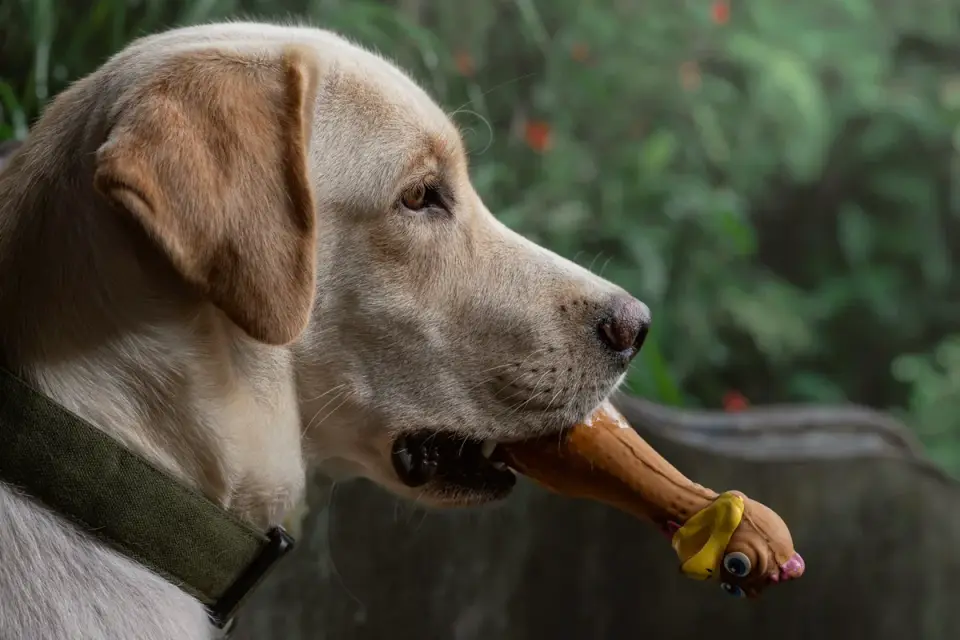
Most food-dispensing toys in this category — Kongs, Toppls, and similar hollow-rubber designs — depend on tongue and jaw persistence rather than movement across a room. The dog licks, gnaws, and occasionally flips the toy to reposition the food inside. VCA Animal Hospitals groups these under “licking toys” and “hunting toys,” noting that foraging enrichment encourages sniffing, chasing, capturing, manipulating, seeking, licking, chewing, and crunching — and that this kind of activity decreases boredom and improves quality of life while giving puppies (and adult dogs) an appropriate outlet for oral behavior that might otherwise land on furniture or trim.
That oral-behavior channeling matters clinically. Dogs recovering from orthopedic surgery, dogs with reduced joint tolerance, and dogs who simply do better lying down are frequently better candidates for a stationary dispensing toy than for anything that requires locomotion. The tradeoff is difficulty calibration: a completely frozen, densely packed Kong can occupy a food-motivated dog for 20 to 30 minutes, but an under-stuffed one is finished in 90 seconds and teaches nothing.
What a treat ball is actually recruiting
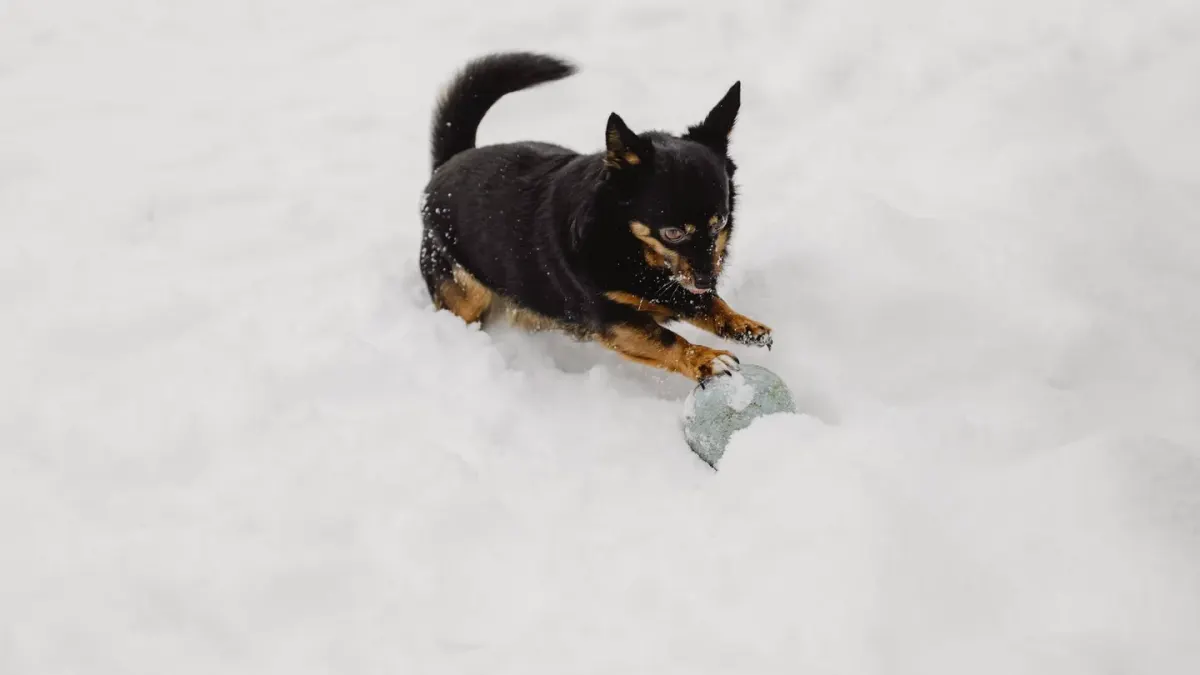
A treat ball’s job is different. It rewards the dog for pushing, nosing, or pawing an object that moves unpredictably, releasing food incrementally as the internal chambers align with an opening. This is a whole-body task — neck, shoulders, and hips are all in motion, and the dog has to track a moving target rather than manipulate a stationary one. For a young, physically sound, high-drive dog with energy to burn and no particular interest in slow licking, this is often the more satisfying category, because it converts hunger into locomotion rather than into stillness.
The mechanism that makes both categories worth using at all is eating rate. Rapid eating and air-gulping are recognized, modifiable feeding-practice risk factors that veterinary sources consistently flag, and slowing a meal down — whether by licking a mat or chasing a ball — is one of the more defensible reasons to reach for either product category rather than a plain bowl.
Where the acupuncture needle fits next to the imaging study
I bring this up because I think in both directions at once — Western mechanism first, whole-patient second — and enrichment gear is a place where that habit pays off. A dog who “won’t work” for a puzzle toy is sometimes bored, but is sometimes signaling discomfort that hasn’t been imaged yet: a subtle lameness, a sore neck from tracking a moving ball, a GI issue that makes food itself less rewarding. My default is to rule out the structural explanation before assuming the toy is wrong. Where a workup comes back clean and the dog still seems anxious or restless around mealtime, I’ve also seen owners get real, if modest, value from acupuncture as an adjunct — not as a substitute for behavior modification or for addressing the joint problem, but as one more tool aimed at calming an overaroused nervous system so the dog can actually engage with a slower-paced feeding task instead of gulping it into oblivion. The counterargument I hear most often — that this is “just placebo through the owner’s hands” — is fair to raise and impossible to fully rule out in a non-blinded home setting, but it doesn’t change what I recommend, because the risk of trying it, done by a trained CVA-certified practitioner, is low and the downside of ignoring an anxious dog’s mealtime behavior is not.
Matching gear to the dog in front of you
Run through this before buying either:
- Check mobility first. If the dog is over eight, has any gait asymmetry, or has been diagnosed with hip or elbow changes, start with a stationary dispensing toy, not a rolling one. If you’re already managing evening restlessness alongside a mobility question, it’s worth reading Why Your Dog Won’t Settle in the Evening before assuming the toy alone will fix it.
- Match difficulty to food drive. A treat ball with large release holes empties in under a minute for a determined Labrador; the same ball with small holes can occupy a low-drive toy breed for much longer. See Exercise Ideas for Toy and Small Breeds if you’re working with a dog under 15 pounds.
- Consider the floor. Treat balls are loud on hardwood and tile, and some dogs are noise-sensitive enough that the rattling itself is aversive rather than engaging. A licking mat or stuffed toy sidesteps that entirely.
- Clean on a schedule, not an afterthought. Both categories accumulate saliva and bacteria in crevices that are hard to reach. Whatever you choose, How to Clean and Disinfect Dog Toys covers the actual mechanics of doing this without ruining the rubber.
- Don’t confuse “won’t engage” with “doesn’t like it.” If a dog who used to work a toy stops, rule out pain before you rule out interest.
One of the dogs I still think about was a nine-year-old male Australian Shepherd, roughly 55 pounds, whose owner switched him from a treat ball to a puzzle feeder over about three weeks because he’d started refusing to chase anything after dinner, standing stiffly instead of trotting toward the sound of rolling kibble. The change looked like pickiness at first. It turned out to be early lameness in a rear limb that hadn’t yet shown up as an obvious limp on the leash. The owner’s instinct to swap gear rather than push through it wasn’t a workaround — it was, in hindsight, the first real clue.
Verdict
Neither category is universally “better.” A food-dispensing toy is the more defensible default for older dogs, dogs recovering from orthopedic issues, and dogs who need calm, jaw-focused occupation. A treat ball earns its place with young, mobile, high-drive dogs who need the locomotion as much as the food reward. If a dog’s engagement with either one changes suddenly, treat that as a symptom worth investigating, not a training failure.
Frequently asked questions
Is a treat ball or a food-dispensing toy better for slowing down a fast eater?
Both can slow eating rate, but a stationary dispensing toy is usually easier to calibrate for a genuinely fast, anxious eater, since a treat ball's release rate depends partly on the dog's own persistence and can be inconsistent early on.
Can I use both types of gear for the same dog?
Yes, and alternating them is often more useful than picking one permanently — it varies the physical task the dog is doing and can reveal, over time, whether a change in preference tracks a change in mobility or mood.
My dog used to love her treat ball and suddenly won't touch it. What should I check first?
Rule out pain and mobility changes before assuming boredom. A sudden drop in interest in a moving toy, especially in an older dog, is worth mentioning at the next veterinary visit.
Sources
- Behavior Management: Enrichment and Foraging Toys — VCA Animal Hospitals