On this page
I still see the fork in the road the same way every time a new client sits down across from me with a leash wrapped twice around their hand. The dog on the other end of that leash isn’t the problem — the plan is. Somewhere between the puppy class flyer and week three at home, most beginners drift onto one of two paths: they either give up on structure because the dog “just doesn’t listen,” or they escalate to a firmer correction because the treats “stopped working.” Neither path is really about the dog. Both are about what the owner expected training to feel like, and how fast.
Where the Fork Actually Splits
I ask new clients to walk me through a normal Tuesday before we talk about cues at all. What I’m listening for isn’t ambition — it’s whether the plan matches the dog’s actual week. A husky mix getting one ten-minute session after a nine-hour workday is not an unmotivated dog; it’s an unrealistic schedule colliding with real fatigue and understimulation. A shepherd puppy who “won’t settle” during dinner is often a dog who’s never been taught what settling on a mat even looks like, because nobody practiced it outside of asking for it in the moment. The split I see over and over: owners either lower the bar until training quietly stops, or they raise the pressure until the dog starts avoiding the whole interaction. Both are avoidable if the first few sessions are built around what the dog can actually do that week, not what the owner hoped a weekend would fix.
Mistake One: Inconsistent Cues, Inconsistent Household
This is the mistake I flag first, because it’s invisible to the people making it. One person says “down,” another says “off,” a third just points at the floor — and the dog, reasonably, treats these as three different problems to solve. The American Kennel Club notes that randomly changing rules, cues, or approach mid-training is one of the fastest ways to stall progress, because the dog isn’t generalizing a rule so much as pattern-matching a specific voice, tone, and context. Fixing this rarely requires a better dog trainer. It requires a shared cue sheet taped to the fridge, and every adult in the house using it — including on the days training feels like a low priority.
Mistake Two: Rewarding the Wrong Half-Second
The second mistake is timing, and it’s sneakier than inconsistency because it looks like generosity. An owner asks for a down, the dog sits first and then lies down a beat later, and the treat lands the moment the dog’s elbows touch the floor — which is correct in theory, except the dog’s brain logged the sit as the rewarded event because it happened closer to the verbal marker. Repeat that pattern for two weeks and you’ve quietly trained a dog to sit-then-down instead of down. I also watch for “cue nagging” — asking “sit, sit, sit, SIT” — which teaches a dog that the first three requests are optional. A single clear cue, then a pause, then a consequence (reward or redirection) holds up better than repetition ever does.
Mistake Three: Reaching for Correction Before Connection
This is the one I feel the most strongly about, and I’ll say the counterargument plainly before I dismiss it: some owners tell me a firm correction “worked instantly,” and in the narrow sense of stopping a behavior in that moment, it often does. Suppression is fast. What it doesn’t do is teach the dog what to do instead, and a growing body of research suggests it carries a welfare cost that reward-based methods don’t. A PLOS ONE study comparing dogs from reward-based and aversive-based training schools found that dogs trained with aversive methods showed more stress-related behaviors, higher post-training cortisol increases, and more pessimistic responses on a cognitive bias task than dogs trained with rewards — and that the effect was strongest in the highest-aversive-use group. The American Veterinary Society of Animal Behavior’s position statement goes further, stating there’s no evidence aversive methods outperform reward-based training in any context, and recommending reward-based approaches for all training, including behavior problems. I still land on reward-based work as the default for beginners specifically because they’re the ones least equipped to read a dog’s early stress signals before a correction escalates past what they intended.
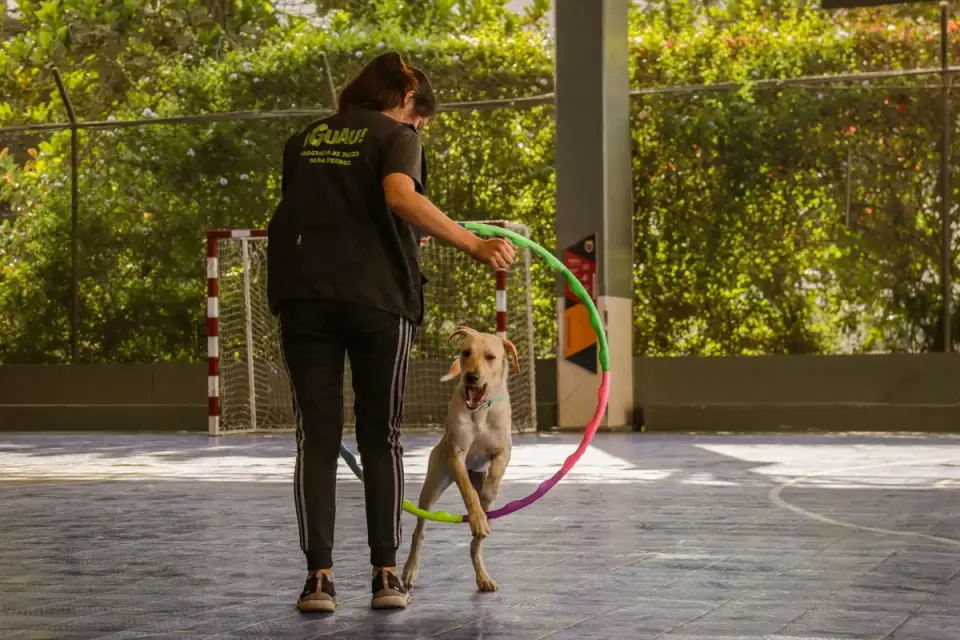
A retriever puppy named Otis stands out to me from a few years back — four months old, about twenty-two pounds, whose owners had been doing “everything right” on paper and still felt like they were losing ground. They’d been running fifteen-minute sessions after work, in the driveway, with a new cue every few days because the online videos kept changing. By the third week Otis wouldn’t hold a sit for more than a second before scanning for the next instruction, clearly unsure which version of “good” he was chasing. We didn’t change the treats or the dog. We cut sessions to five minutes, moved them into the kitchen where there was less to react to, and picked one word per behavior that nobody was allowed to swap out. Within ten days the owners told me Otis was offering sits unprompted at the door — not because he’d suddenly gotten smarter, but because the rules had finally stopped moving.
Mistake Four: Training in One Room and Expecting It Everywhere
Dogs don’t generalize a skill across locations automatically; a rock-solid sit in the kitchen can fall apart completely at the vet’s waiting room or the sidewalk outside a coffee shop. This is a mistake of expectation, not obedience. Beginners often assume a behavior learned once is learned everywhere, then get frustrated when it “breaks.” The fix is boring but reliable: once a cue is solid at home, practice it in two or three new locations with lower distraction before asking for it somewhere genuinely busy. This same logic is why format matters — a dog who’s only ever practiced in a private living room may need a different bridge than one built for a group setting; our breakdown of group classes, private lessons, and online coaching walks through which format suits which kind of dog.
Reinforcement quality matters here too. If a beginner’s reward is a low-value kibble the dog only tolerates, generalizing a behavior to a distracting new environment is much harder — the payoff simply isn’t competing with the environment. Our guide to training treats sized and valued for the job covers how to match reward value to difficulty, and our piece on using a treat pouch effectively addresses the timing problem directly, since a pouch that’s hard to reach is a pouch that delays the reward past the window that actually teaches the dog anything.
Where I Land With Clients
When I counsel a new owner, I try to set the expectation before we set the cue. I tell them plainly: this dog is not going to be reliably obedient in three days, and if a method promises that, be suspicious of what it’s actually doing to get there. I’ve watched the households that stick with short, consistent, reward-based sessions pull ahead of the households that escalate to more forceful tools looking for a shortcut — not because the forceful tools never produce a fast result, but because the dogs I see afterward from that path are often more avoidant, more likely to have gaps in areas nobody trained on purpose, and harder to read. The owners who succeed aren’t the most talented trainers in the room. They’re the ones who picked one plan, wrote the cues down, and gave it three consistent weeks before deciding whether it was working. If your dog’s early training feels like it’s stalling, the schedule underneath it is worth checking before the dog’s ability is. For dogs still working through house-training on the same timeline, our potty-training schedule guide covers a parallel version of this same consistency problem.
Key Takeaways
- Inconsistent cues across household members are one of the most common — and most fixable — causes of stalled training.
- Reward timing matters more than reward size; a delay of even a second or two can reinforce the wrong behavior.
- Research comparing training methods has linked aversive techniques to more stress behavior and higher cortisol than reward-based training.
- A behavior learned in one room isn’t automatically generalized; practice in a few new locations before expecting reliability in public.
- Short, consistent sessions with one fixed cue per behavior tend to outperform longer, inconsistent ones.
So where does a beginner actually start — with a better method, or a clearer plan?
Sources
- Position Statement on Humane Dog Training — American Veterinary Society of Animal Behavior
- Does training method matter? Evidence for the negative impact of aversive-based methods on companion dog welfare — PLOS ONE
- What Your Dog Trainer Wishes You Knew About Consistency — American Kennel Club