On this page
Which fix actually matters when a dog starts sliding on the kitchen floor: something added to the nail, something added to the pad, or something removed from the nail altogether? That’s the fork every owner hits once a dog starts hesitating at the top of the hallway.
I’ve watched this play out with a 9-year-old Labrador named Gus, about 78 pounds, whose owner first noticed him splaying his back legs on the tile by the water bowl. It started as an occasional slip after naps, when his muscles were cold and his nails had gone two weeks past a trim. Within a month he was avoiding the kitchen entirely, walking the long way around through the carpeted hallway instead. The owner tried a bath mat first, which helped only in that one spot. What actually changed his confidence was addressing the nails themselves, not the floor — a distinction that gets lost in most slipping-and-sliding advice.
Why long nails cause more sliding, not less
The mechanism is more counterintuitive than it looks. A dog with overgrown nails tries to compensate on a hard surface by flexing its toes and digging the nail tips down for grip, the same way a person might curl their toes on ice. On carpet or grass that works reasonably well. On tile, laminate, or sealed hardwood it does the opposite: the nail meets a hard, low-friction surface at a steep angle and skates instead of catching, and the flexed toe joint means the paw pad — the part of the foot actually built for grip — never makes full contact with the floor.
Whether nail length changes gait in a measurable way is still being sorted out. A 2026 study in Frontiers in Veterinary Science, Trimming of nails in healthy dogs does not change gait parameters when comparing pre- and post-nail trim, found no significant change in stride length, stance-phase duration, or vertical ground-reaction force before and after trimming — though front-paw length was about 2mm shorter and center-of-pressure movement shifted slightly after the trim. That’s a small, local effect on paw mechanics, not proof that trimming rewrites a dog’s whole gait. It’s a reasonable summary of where the evidence actually is: nail length affects how the foot contacts the ground, but the downstream effects on movement are subtler than the marketing copy around most nail products suggests.
Toe grips: rubber traction on the nail itself
Toe grips are small rubber caps that fit over each nail tip, functioning like a cleat rather than changing the nail underneath. They’re a reasonable option for a dog whose nails are already a manageable length but who still slides on smooth flooring, or for owners who can’t yet get a dog comfortable with grinding.
The one published gait study on this category, NCBI/PMC: Dr. Buzby’s ToeGrips® Application Results in Minimal Changes in Kinetic Gait Parameters in Normal Dogs, tested grips on dogs with otherwise normal gait and found the grips produced only minimal changes to kinetic gait parameters. That’s a useful, honest data point, but it’s worth being precise about what it does and doesn’t show: it was conducted in dogs without existing mobility problems, so it tells you the grips don’t disrupt a normal gait — not that they measurably improve traction or confidence in a dog that’s already struggling. Owners report the latter anecdotally, and it’s plausible given the mechanism, but the study itself doesn’t establish it.
Paw wax: grip added at the pad, not the nail
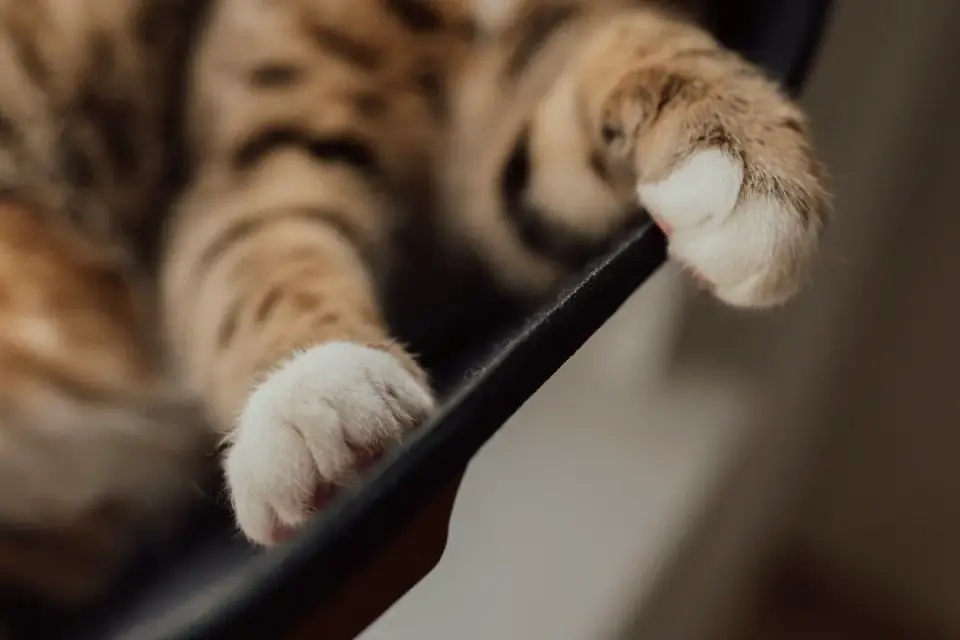
Paw wax works on an entirely different part of the foot. It’s a balm — typically a blend of harder waxes like carnauba and beeswax rather than the softer oils used in moisturizing balms — applied directly to the pad. Manufacturer guidance from Musher’s Secret describes it as forming a semi-permeable barrier on the pad that both protects against hot pavement, salt, and ice, and adds grip on smooth indoor flooring once the wax has set.
The tradeoff is that wax addresses the pad’s contact with the floor, not the nail’s interference with that contact. On a dog with genuinely overgrown nails, wax on the pad won’t stop the toe from flexing and skating in the first place — you’re improving grip at a point of contact the dog isn’t fully using. It tends to work best as a complement to nail management, not a substitute for it, and it needs reapplication as it wears off.
A quick paragraph on cost and maintenance, since it matters here: wax is the cheapest of the three options up front but the highest-maintenance long-term, since it has to be reapplied every few days to weeks depending on activity and flooring.
Nail grinding: removing the cause instead of compensating for it
Grinding — using a rotary tool to gradually shorten the nail and round its edge — addresses the mechanism directly rather than working around it. A properly trimmed nail restores normal toe-joint flexion and lets the pad, not the nail tip, take the dog’s weight on a hard floor. It’s the option that changes the underlying geometry instead of adding something on top of it, which is why I generally recommend it as the foundation and treat grips or wax as add-ons for a dog that still needs help between trims. Our guide to choosing a nail grinder covers what actually matters in a tool — motor noise, grit, and how gradually it removes nail — since a grinder a dog tolerates is the only kind that gets used consistently.
The honest caveat, and it’s an important one: grinding requires a dog that will hold still and tolerate the vibration and sound, which is its own training project for a lot of dogs, especially ones who’ve had a bad nail-trim experience. It’s also not instant. You’re not fixing tonight’s slipping problem; you’re removing the cause of next month’s.
By the time Gus’s owner brought him in for a recheck, the nails were back to a length where his toes could flex normally, and the sliding by the water bowl had stopped without a single trip through the hallway detour. That’s one dog, not a study, but it tracked with what the mechanism predicts.
Setting up the rest of the room while you sort out the feet
None of these three fixes exist in isolation from the rest of the house. A dog recovering confidence on hard floors often benefits from the same environmental thinking that goes into other home setups — for instance, our walkthrough on setting up a crate for a puppy’s first night covers surface and footing choices that apply just as well to an older dog relearning a slippery kitchen. And if the slipping is happening near the food station specifically, a non-slip mat under the bowls, covered in our guide to feeding station mats, removes one predictable trouble spot without touching the dog’s feet at all.
Bottom line
Start with the nails: get them to a length where the toe can flex normally, using a grinder if the dog will tolerate one, since that addresses the actual mechanism rather than compensating for it. Add toe grips if a dog still slides on smooth floors between trims, and use paw wax as a supplementary layer of pad grip and protection, not a replacement for nail care. Combining a floor mat or two in the highest-risk rooms with proper nail length solves more of the problem than any single product marketed as a traction fix.
Frequently asked questions
Can toe grips replace regular nail trims?
No. Toe grips add traction to the existing nail length; they don't correct overgrown nails or restore normal toe-joint flexion the way trimming or grinding does.
How often does paw wax need to be reapplied?
It varies with activity level and flooring, but expect to reapply every few days to a couple of weeks as the wax wears off the pad.
Is nail grinding safer than clipping for traction purposes?
Grinding lets you remove nail gradually and round the edge, which many owners find easier to judge than a single clip, but either method works as long as the nail ends up short enough for normal toe flexion.
Sources
- Dr. Buzby's ToeGrips® Application Results in Minimal Changes in Kinetic Gait Parameters in Normal Dogs — NCBI/PMC
- Trimming of nails in healthy dogs does not change gait parameters when comparing pre- and post-nail trim — Frontiers in Veterinary Science
- Musher's Secret FAQs — Musher's Secret