On this page
Start here, before you fall for a face on a screen: check the tail, then the bone.
Quick checklist before you go further:
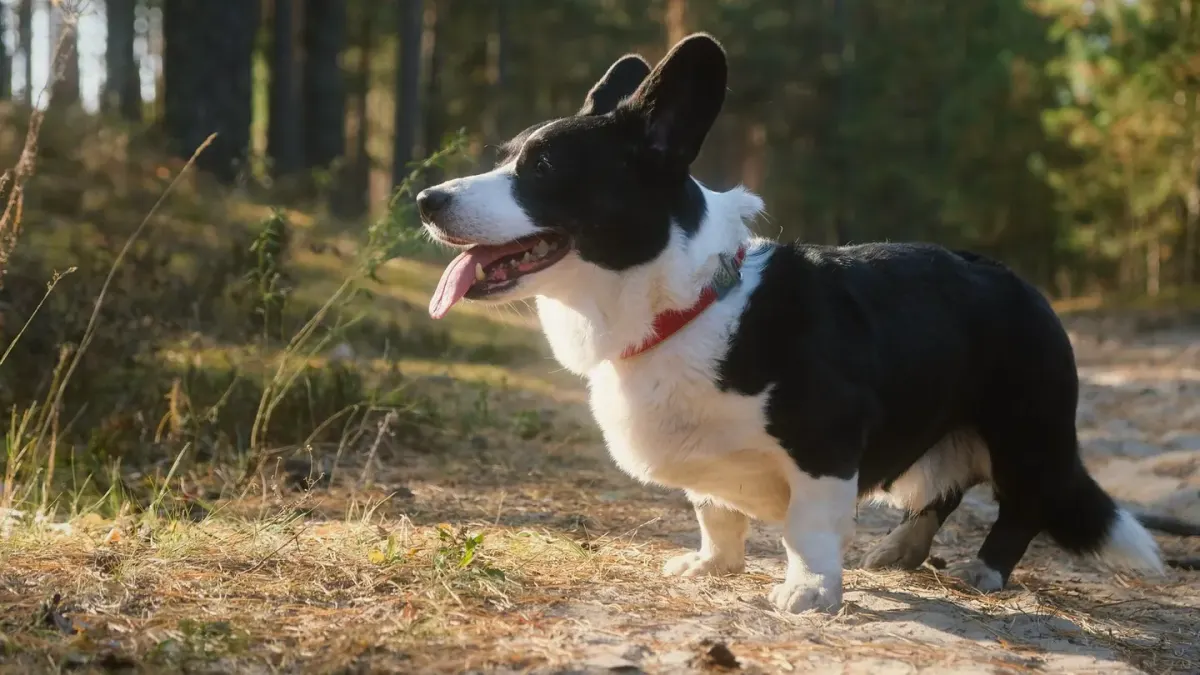
- Tail — Cardigans keep a long, foxlike tail; Pembrokes are docked or naturally bobbed.
- Bone and body length — Cardigans run heavier-boned with a longer back; Pembrokes are more compact.
- Weight — Cardigans typically run 25–38 lb; Pembrokes 28–30 lb, per the AKC.
- Ears — Cardigan ears are larger and more rounded; Pembroke ears are smaller and pointed.
- Spinal risk profile — both are chondrodystrophic and disc-disease prone; Cardigans carry a documented degenerative myelopathy risk allele that shows up later in life.
- Coat color range — Pembrokes: red, sable, tricolor. Cardigans: a much wider palette including brindle and blue merle.
Most people walk into a shelter or a breeder’s yard already picturing “the Queen’s dog” — that’s a Pembroke. The Cardigan is the older breed, and it’s the one still wearing its tail.
In my practice I saw a nine-year-old Pembroke named Biscuit, 27 pounds, whose owner called on a Tuesday because he’d stopped wanting to jump onto the couch — nothing dramatic, just a hesitation at the edge, a small hop instead of the usual bound. She’d noticed it over about ten days, first at night after he’d been lying still for a while, better by morning. No yelping, no obvious pain on palpation, but a stiff, guarded gait through the lower back. That’s the exact pattern I watch for in this breed: gradual reluctance around jumping, worse after rest, before anything looks like an emergency. We started activity modification immediately — ramps instead of jumping, weight check, no more twisting fetch games — because with a chondrodystrophic spine, waiting for a dramatic sign usually means you’ve already lost the easy window to intervene early.
The Tail Is the Fast Answer, Not the Whole Answer
If you only remember one thing, remember the tail — but don’t stop there, because tail alone won’t tell you which health conversation you’re walking into.
Cardigans have a long, foxlike tail; Pembrokes are docked or born with a natural bobtail, and the AKC standard for the Pembroke still calls for that docked look. Beyond the tail, Cardigans run larger-boned with a longer body, typically 25 to 38 pounds against the Pembroke’s tighter 28-to-30-pound range. Ear shape differs too — rounder and larger on the Cardigan, smaller and more pointed on the Pembroke. Color is where the Cardigan really opens up: brindle, blue merle, and other patterns the Pembroke standard doesn’t allow, which sticks to red, sable, and tricolor.
None of that structure is cosmetic trivia. Longer body, short legs, heavy bone on a short frame — that’s chondrodysplasia, and it’s the reason both breeds land on the same short list of spinal concerns.

Two Different Spinal Risks, Same Body Plan
Both breeds share the short-legged, long-backed structure that predisposes them to intervertebral disc disease. According to Cornell University College of Veterinary Medicine, chondrodystrophic breeds carry a genetic form of dwarfism that predisposes their discs to premature degeneration, and disease can appear anywhere from young adulthood onward. In Corgis specifically, IVDD tends to show up between roughly ages three and six, and can range from reluctance to jump through to loss of bladder control in severe cases.
Cardigans carry an additional, separate concern: degenerative myelopathy, a late-onset spinal cord disease unrelated to disc herniation. The Cardigan Welsh Corgi Health Foundation, Inc.: Cardigan Welsh Corgi Health Foundation tracks DM as a genetic-risk condition with a DNA test available since 2008 — carrying the at-risk genotype doesn’t guarantee a dog develops clinical disease, and DM is often confused with IVDD or ordinary aging because both start with subtle hind-limb weakness. If you’re choosing a Cardigan specifically, ask the breeder for DM test results the way you’d ask about hips.
I keep this framing simple with clients of either breed: structure/function, not fear. Feed to a lean body condition, control the jumping onto furniture, use a ramp early rather than after the first bad week, and get any hind-limb weakness checked promptly rather than waiting to see if it resolves. That’s realistic prevention, not a promise that either breed will avoid spinal disease — it’s shortening the odds and catching problems on a shorter leash.
Living With Each Breed Day to Day
A longtime Cardigan owner I worked with, a couple in their sixties with a fenced quarter-acre, had picked the breed specifically because they wanted something a notch calmer than the Pembroke they’d had as a young couple. Their Cardigan, a 34-pound brindle male, was food-motivated and steady, happy with two structured walks and a slower pace than their memory of Pembroke energy. That’s a real pattern, not universal — individual temperament still swings widely — but Cardigans are often described as slightly more reserved, and Pembrokes as more overtly driven and vocal. Neither trait is a dealbreaker; it’s a fit question, the same way you’d match energy level to routine before choosing any working breed for an apartment (see our guide to best dog breeds for apartment living).
Both breeds herd by nature, both nip at heels when understimulated, and both need a job — physical and mental — or they’ll invent one you won’t like. If you’re weighing this decision against other popular herding-breed comparisons, it’s worth reading how we frame Border Collie vs. Australian Shepherd, since the “give them work or they’ll make work” logic holds across the group. Grooming is a wash between the two — both are double-coated, seasonal heavy shedders, closer in maintenance than either is to a low-shed breed like the ones covered in our Goldendoodle coat genetics guide.
Where I Land
For most households asking “which Corgi,” I steer toward the Pembroke for pure predictability of temperament and availability — it’s the far more common breed in the US, which means more breeders, more rescues, and more established health-testing pools to vet against. But if you specifically want a slightly larger, often calmer dog and you’re willing to ask hard questions about DM testing before you commit, the Cardigan is not the lesser choice — it’s a different bet with a longer tail and, arguably, a longer breed history behind it.
Near the end of a wellness visit for an eleven-year-old Pembroke, her owner asked me, almost offhand, whether she should have “gotten the other kind” instead — the Cardigan a neighbor had. I told her what I tell most owners choosing between these two: the deciding factor isn’t the tail, it’s which spinal conversation you want to have early — IVDD risk you manage through weight and activity in either breed, or that plus a DM genetic test you can actually screen for before you bring a Cardigan puppy home. Expectation first, timelines realistic: neither breed is fragile, but neither is a dog you raise on hard floors and high jumps and expect no consequences.
Bottom line: Check the tail to identify the breed, but choose based on the spine — ask for hip and disc history either way, and add a DM test to that list if you’re leaning Cardigan.
Frequently asked questions
What is the easiest way to tell a Pembroke and Cardigan Welsh Corgi apart?
Look at the tail first — Cardigans keep a long, foxlike tail while Pembrokes are docked or naturally bobbed. Ear shape and bone are secondary clues: Cardigans have larger, rounder ears and heavier bone.
Are Cardigan Welsh Corgis at higher health risk than Pembrokes?
Both breeds share chondrodystrophic-related IVDD risk. Cardigans carry an additional, separate degenerative myelomapathy genetic risk that can be screened with a DNA test, per the Cardigan Welsh Corgi Health Foundation.
Which Corgi breed is calmer, Pembroke or Cardigan?
Individual temperament varies, but Cardigans are often described as slightly more reserved while Pembrokes tend to be more overtly driven and vocal. Neither is objectively "easier" — match the dog's energy to your routine.
Sources
- The Cardigan Welsh Corgi vs. the Pembroke Welsh Corgi — AKC
- Chondrodystrophy and Intervertebral Disc Disease (CDDY/IVDD) — Cornell University College of Veterinary Medicine
- DM — Cardigan Welsh Corgi Health Foundation, Inc.