
On this page
- The short answer: yes, but unevenly
- The genetics behind the coat, not the marketing
- Puppy coat to adult coat: the transition owners aren’t warned about
- Coat type is the better predictor than “Goldendoodle” as a label
- Does generation (F1, F1B, multigen) actually predict this?
- No, “hypoallergenic” isn’t quite the right word
- Grooming reality across the dog’s life, not just the shedding question
- The bottom line
Here’s the decision fork every prospective Goldendoodle owner eventually hits: do you pick a puppy based on generation label (F1, F1B, multigen), or do you wait and judge the coat you actually see in front of you? I’ve counseled families through both approaches, and the honest answer is that neither one is foolproof — but understanding why is what actually helps you plan.
The short answer: yes, but unevenly
Goldendoodles shed. Some shed so little that vacuuming becomes a once-a-week chore instead of a daily one; others lose hair at a rate that would surprise anyone who bought the dog specifically to avoid it. The spread exists because a Goldendoodle is, genetically, a blend of a Golden Retriever (moderate-to-heavy seasonal shedder) and a Poodle (minimal shedder with continuously growing hair). Which parent’s coat genes “win” in a given puppy is not fully predictable from the litter alone, though it is far from random.
I’ve had this exact conversation more times than I can count. A family comes in with a 9-week-old F1 Goldendoodle puppy, soft and fuzzy, and asks me to confirm the breeder’s promise that “doodles don’t shed.” I have to tell them the truth: I can’t confirm that from a puppy coat, because puppy coat texture is not a reliable predictor of adult coat. What I can do is walk them through what actually determines it, so they know what to watch for over the next year instead of feeling blindsided at month eight.
The genetics behind the coat, not the marketing
Coat shedding, curl, and length in dogs are largely governed by three well-characterized genes, and the veterinary genetics company Embark Veterinary lays out how each one works: FGF5 controls hair length, KRT71 controls curl, and RSPO2 controls “furnishings” — the mustache-and-eyebrow look and the low-shedding texture people associate with Poodles. A dog needs the low-shedding variant of RSPO2 in particular to get real shedding reduction; curl alone doesn’t guarantee it.
That RSPO2 finding isn’t marketing copy — it traces back to a peer-reviewed genetics study on the Portuguese Water Dog, another Poodle-relative breed, published and indexed in PubMed, which correlated a specific RSPO2 insertion with the “improper coat” (i.e., the shedding, non-furnished coat) some dogs in that breed unexpectedly produce. The same underlying biology applies across Poodle-crossed breeds, Goldendoodles included: a puppy can inherit the Golden’s version of that gene even from parents that both look low-shedding, because coat genetics aren’t simply additive.
Puppy coat to adult coat: the transition owners aren’t warned about
This is where I see the most frustration, and it’s worth walking through chronologically because the timing catches people off guard.
Birth to about 4 months — nearly every Goldendoodle puppy has a soft, fine puppy coat regardless of what its adult coat will become. This is the coat breeders show in photos, and it tells you almost nothing about shedding as an adult.
Roughly 5 to 10 months — the “puppy coat blowout.” The soft puppy fuzz sheds out in clumps as the adult coat comes in underneath, and it can look and feel like a shedding problem even in dogs that will end up low-shedding for life. I tell owners this is normal, not a sign something’s wrong, and that it resolves as the mature coat finishes coming in — usually by the first birthday, sometimes closer to 18 months in slower-maturing lines.
12 to 24 months — the adult coat settles into its true texture: curly, wavy, or straight. This is the point where shedding behavior becomes honest.
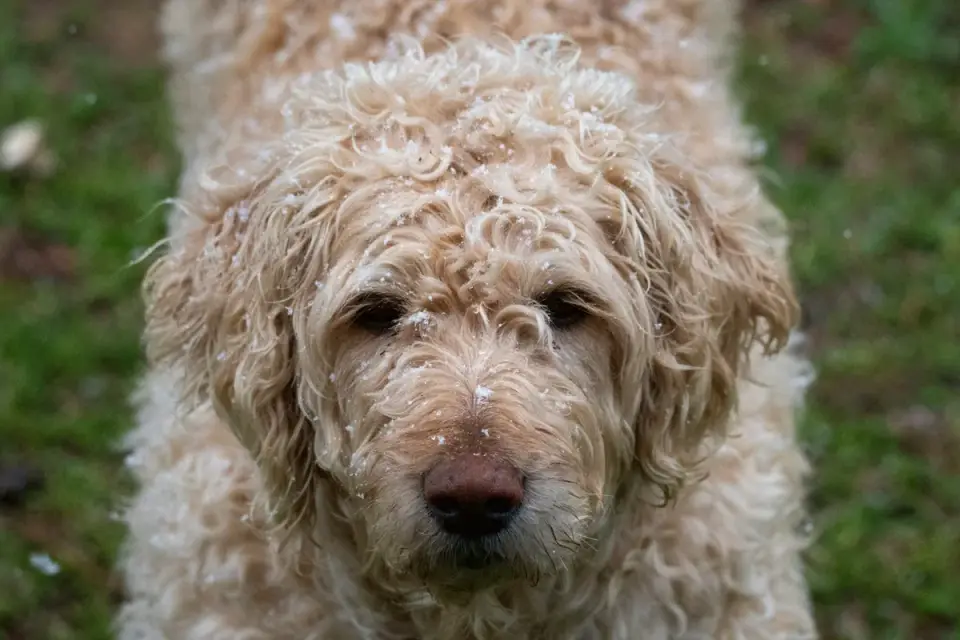
I remember a family with a 7-month-old F1 Goldendoodle, a 42-pound male named Biscuit, who came in convinced something was medically wrong because he was leaving fur on the couch and the kitchen tile for the first time since they’d brought him home. Nothing had changed about his food, his routine, or the season — it was mid-March, and they lived in a two-story house with hardwood floors, so the shed hair was unusually visible. I checked his skin and coat, found nothing abnormal, and explained the blowout timeline. Three months later, at his booster visit, the shedding had dropped off almost entirely and his coat had thickened into a loose wave. That’s a fairly typical arc for a dog with decent furnishings genetics — but it’s exactly the stretch where owners understandably panic.
Coat type is the better predictor than “Goldendoodle” as a label
By the time the adult coat is in, you’ll generally see one of three textures, and they don’t shed the same:
Curly coat
Closest to a purebred Poodle coat. Continuously growing hair instead of a shed-and-regrow cycle, which usually means minimal loose hair around the house — but it mats easily and needs brushing several times a week plus a trim every 6 to 8 weeks.
Wavy coat
The most common Goldendoodle coat, sometimes called a “fleece” coat. Low to moderate shedding, less mat-prone than curly, and generally the easiest coat to maintain for owners who don’t want a heavy grooming schedule.
Straight coat
Behaves the most like a Golden Retriever’s coat: sheds more visibly, especially seasonally, and is the least likely of the three to be marketed accurately as “low-shedding” — because it isn’t.
Does generation (F1, F1B, multigen) actually predict this?
Partially. It shifts the odds, but it isn’t a guarantee, and I try to be direct about that with clients rather than let the breeder’s paperwork do the talking. An F1 Goldendoodle is a 50/50 first-generation cross and has the widest spread of possible coats, from straight-and-shedding to curly-and-minimal. An F1B is bred back to a Poodle, which pushes the genetic mix toward roughly 75% Poodle, and in practice improves the odds of a low-shedding, furnished coat — though not every F1B puppy gets there. Multigenerational Goldendoodles, bred over several generations specifically for coat consistency, tend to produce the most predictable low-shedding litters, particularly from breeders who test for the RSPO2 and related coat markers rather than guessing from appearance.
None of this is a promise. Shedding also involves other genes beyond the three main ones, and individual variation inside any litter is normal.
No, “hypoallergenic” isn’t quite the right word
A lot of Goldendoodle marketing leans on “hypoallergenic,” and it’s worth being precise here because it affects real decisions for allergy sufferers. The research reviewed in the Journal of Allergy and Clinical Immunology found that home allergen levels didn’t differ meaningfully between homes with supposedly “hypoallergenic” dog breeds and homes with other breeds — because the primary dog allergen is a protein shed through dander, saliva, and urine, not hair itself. A dog that sheds less does spread less hair-borne allergen around a house, which is a real, practical benefit. It does not mean an allergic person won’t react. The American Kennel Club makes the same point: no breed is allergen-free, low-shedding coats just reduce one delivery mechanism.
If you or someone in your household has a diagnosed dog allergy, I’d always recommend spending real time with an adult dog of the specific coat type you’re considering — ideally more than one visit — before bringing a puppy home on the assumption that “doodle” solves the problem.
Grooming reality across the dog’s life, not just the shedding question
Whatever coat your Goldendoodle ends up with, the maintenance case matters as much as the shedding case. Low-shedding coats trade loose hair on your floor for hair that stays trapped in the coat and mats if it isn’t brushed out — so a “non-shedding” dog is not a low-maintenance dog. I tell every doodle family the same thing: budget for a brush, a slicker or pin brush that reaches the undercoat, and either a grooming appointment or a serious home routine every 6 to 8 weeks. Thick, furnished coats also trap heat, which matters more in warm months; families dealing with a heavy-coated dog through summer often do better with structured cooling options for a thick-coated breed at home and supervised water play, like the setups covered in our guide to backyard sprinkler and splash games for hot days, rather than relying on the coat to manage itself.
For families bringing home a young puppy while all of this is still unknown, getting the basics of the first weeks right matters more than the coat question does. Our walkthrough on setting up a crate for a puppy’s first night covers that groundwork, and it’s worth handling before you’re also managing a coat blowout at five months.
I think back to a client with an 18-month-old F1B Goldendoodle, a 55-pound spayed female, whose owner had let grooming slide for about ten weeks over a busy stretch at work. The coat wasn’t shedding on the floor — it never had been the problem — but it had matted so thickly behind the ears and along the hindquarters that the only responsible option was a full shave-down at the groomer. The owner was surprised, because in her mind “low-shedding” had meant “low-maintenance.” I’ve seen that mismatch play out often enough that I now say it out loud at every doodle puppy visit: the less hair you find on your couch, the more time you’ll likely spend with a brush in your hand.
The bottom line
If minimizing loose hair around the house is your priority, look past the word “Goldendoodle” entirely and ask about adult coat type and generation specifically — a wavy or curly F1B or multigen dog, ideally from a breeder who tests for furnishings genetics, gives you the best odds. But go in accepting that low-shedding and low-maintenance are two different promises, and that no dog, regardless of coat, is allergen-free. Meet the actual dog, or its close relatives, before you commit if allergies are the reason you’re considering a doodle at all.
Frequently asked questions
At what age can I tell if my Goldendoodle puppy will shed a lot?
Not reliably before 12 months, and sometimes not until closer to 18 months. The puppy coat gives little information, and the "blowout" period between roughly 5 and 10 months can look like heavy shedding even in dogs that end up low-shedding as adults.
Is an F1B Goldendoodle guaranteed to be low-shedding?
No. F1B breeding shifts the odds toward a low-shedding, furnished coat because it's roughly 75% Poodle genetics, but individual puppies in the same litter can still vary, and only DNA-based furnishings testing gives real certainty.
Sources
- Dog Shedding Explained — Embark Veterinary
- An insertion in the RSPO2 gene correlates with improper coat in the Portuguese water dog — PubMed
- The myth of hypoallergenic dogs (and cats) — Journal of Allergy and Clinical Immunology
- Hypoallergenic Dogs: Does Such a Thing Really Exist? — American Kennel Club