On this page
Before we get into why it happens, here’s a quick checklist for the moment your dog starts nipping and mouthing because they’re wound up:
- Freeze the game, don’t fight it. Stop moving your hands; a static hand is a boring hand.
- Redirect to a toy in under three seconds. A tug rope or chew in the mouth beats teeth on skin.
- Ask for a known behavior. A sit or down interrupts the arousal spiral and gives you something to reward.
- Withdraw attention if mouthing continues. Tuck your hands, turn away, or step behind a door for 15-30 seconds.
- End the session before it escalates. A short, calm finish teaches more than a long, chaotic one.
- Build impulse control between excitable moments, not just during them.
Each of those points is worth unpacking, because the why behind overexcited mouthing changes what actually works.
What’s Actually Happening When a Dog Gets Nippy and Mouthy
Most dogs that turn nippy and mouthy when overexcited aren’t being aggressive — they’re overstimulated, and the mouth is the fastest outlet a dog has. According to the ASPCA, dogs frequently mouth hands during petting or play, and encouraging noncontact games like fetch or tug — rather than hands-on wrestling — gives a dog an appropriate place to put that energy instead of a person’s arm.
Think of arousal as a dial, not a switch. A dog greeting a visitor, chasing a ball, or getting worked up during a rowdy play session climbs that dial quickly, and once it’s high enough, the parts of the brain responsible for calm decision-making take a back seat. The mouth — grabbing, tugging, chewing — is often the default motor pattern a dog falls back on when it can’t yet self-regulate. This is why the same dog that’s perfectly gentle on a quiet walk can turn into a landshark the second the leash comes out or the kids start running.
Redirect First: The Toy-in-Hand Rule
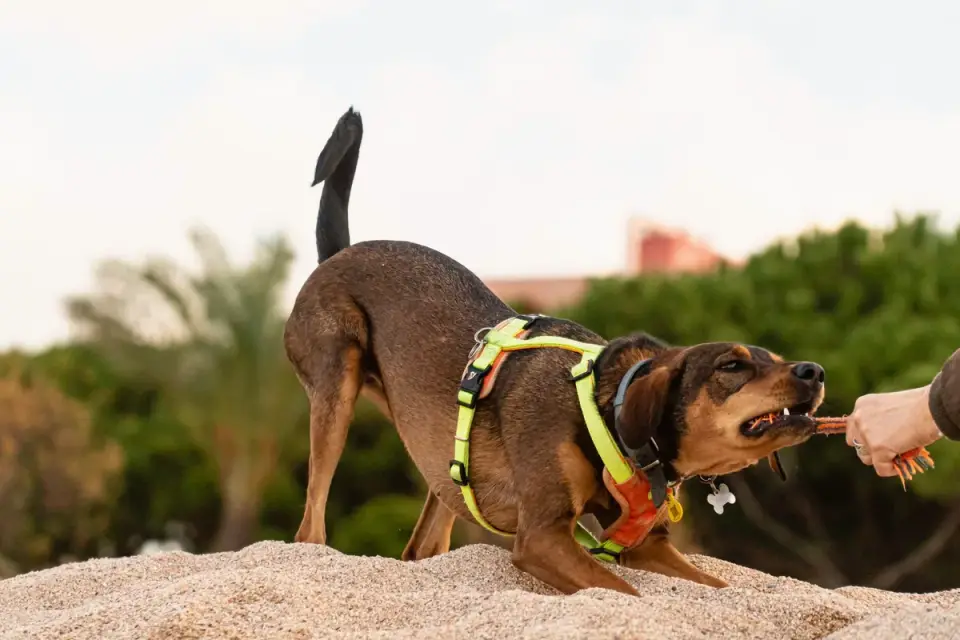
The fastest de-escalation is almost always substitution, not correction. The American Kennel Club recommends keeping toys within easy reach so you can immediately offer one when a dog’s mouth starts wandering toward hands, feet, or clothing — the goal is to make the toy the obvious, rewarding target before teeth ever find skin.
This works because it doesn’t fight the underlying drive. The dog still gets to use its mouth; it just gets redirected onto something appropriate. Over repeated reps, many dogs generalize this and reach for a toy on their own once arousal climbs, especially if the toy is consistently more rewarding (a squeaky, a tug, a stuffed chew) than the alternative.
Build Frustration Tolerance Between Excitable Moments
Noncontact games double as training. Structured tug-of-war with a clear “take it” and “drop it” cue, or a few rounds of fetch with a sit required before each throw, teaches a dog to tolerate rising excitement without losing control of its mouth. It’s a rehearsal for real life: greetings, playdates, the doorbell.
Short daily reps of sit, wait, and leave-it build the same muscle. A dog that can hold a sit while you jog in place, clap, or wave a toy is a dog that’s practiced staying settled through mild arousal, which makes the big spikes easier to manage later.
When to Stop the Interaction Entirely
Sometimes redirection isn’t enough, and that’s fine. If a dog’s mouthing continues or intensifies after a toy swap and a cued behavior, the next step is simply ending the interaction: hands tucked away, calm exit from the room, or a short break in another space. This isn’t a punishment so much as a pause button — it removes the reward (your attention, the game) until the dog’s arousal comes back down.
One short note on timing: acting early is easier than acting late. A dog at a 3-out-of-10 arousal level responds to a cue almost instantly. The same dog at 8-out-of-10 may not hear you at all, so catching the ramp-up before it peaks is worth more than any single technique.
Where Calming Support Fits, and Where It Doesn’t
Some ingredients used in calming chews have early evidence for general stress support, though none of them are a substitute for teaching a dog what to do with its mouth instead. A review in Biomedicines notes that for chamomile, “for the remaining species, evidence is derived mainly from preclinical studies or traditional use,” which is a useful reminder to keep expectations modest. A systematic review in Cureus found that “a systematic review analyzed multiple RCTs and concluded that ashwagandha has a moderate positive impact on stress reduction and cognitive performance” — encouraging, but that data comes largely from human studies. And a review in Molecular Psychiatry found an anxiety benefit for L-theanine “except for one study on psychotic anxiety (SMD = 0.54; 400 mg/day for 8 weeks),” again a human dosing context, not a canine one.
The honest takeaway: these ingredients may support a calmer baseline in a dog prone to overarousal, but they work alongside training, not instead of it. A dog still needs to learn what to do with an aroused mouth.
A Short, Real Example
A reader’s young retriever mix would go from calm to full mouthing within seconds of a tennis ball appearing — jumping, grabbing sleeves, grabbing the ball bag strap. The fix wasn’t complicated: a sit was required before every throw, and any mouthing on a person immediately ended the game for ten seconds. Within two weeks, the dog was offering a sit unprompted the moment the ball came out.
That’s the pattern worth remembering. Consistency changes the behavior faster than intensity does.
Related Reading
If mouthing shows up alongside other confusing behaviors, it’s worth looking at the fuller picture. Our guide on growling when petted breaks down how to tell excitement-driven mouth behavior apart from fear or pain signals. For dogs whose arousal is really rooted in anxiety rather than excitement, see why dogs panic at the sound of the garbage truck. New rescues often show a spike in mouthy, over-the-top greetings during the adjustment window described in the 3-3-3 rule for a new rescue dog, and building calm handling routines like the ones in getting a dog used to tooth brushing can double as impulse-control practice.
When to Call In a Professional
Most overexcited mouthing responds well to consistent redirection and impulse-control games within a few weeks. It’s time to bring in a certified trainer or veterinary behaviorist if the mouthing draws blood, the dog can’t be interrupted at all once aroused, or the behavior is paired with stiff body language, growling, or snapping rather than loose, wiggly excitement — those are signs something other than simple overarousal may be involved.
Bottom line: a dog that gets nippy and mouthy when overexcited is telling you its arousal has outpaced its self-control, not that it’s aggressive — redirect the mouth to something appropriate, reward calm, and build impulse control on quiet days so the excitable ones go smoother.
Frequently asked questions
Is arousal biting the same thing as aggression?
Usually not. Arousal or excitement biting comes from a dog that is over-stimulated and reaching for its mouth as an outlet, whereas aggressive biting is typically paired with stiff body language, growling, or an attempt to create distance rather than closeness.
Will my dog grow out of nipping when excited?
Many puppies improve significantly as bite inhibition and impulse control mature, usually by 12 to 18 months, but adult dogs that never learned an alternative outlet can keep the habit unless it's actively redirected.
Should I yelp or pull my hand away when my dog mouths me?
A sharp yelp works for some dogs but can amp up an already-aroused dog further; calmly stopping the interaction, tucking your hands away, and redirecting to a toy is a more reliable de-escalation for most excitement-driven mouthing.
Sources
- Mouthing, Nipping and Play Biting in Adult Dogs — ASPCA
- How to Stop Puppy Biting and Train Bite Inhibition — American Kennel Club
- Effects of Chamomile on Anxiety and Stress — Biomedicines
- Ashwagandha for Stress: A Systematic Review — Cureus
- L-Theanine and Anxiety: A Review — Molecular Psychiatry