On this page
Start here: if you’re choosing between a Labradoodle and a Goldendoodle, the decision fork isn’t the parent breed label on the pedigree. It’s two narrower questions — how much daily exercise can your household realistically deliver, and how much grooming maintenance are you willing to pay for or do yourself, month after month. Answer those first. The rest follows.
Step 1: Rule out the myth that either dog is “no-shed” or allergy-safe by default. Neither is guaranteed. A study on PubMed / Journal of Allergy and Clinical Immunology: dog allergen levels in homes with hypoallergenic compared with nonhypoallergenic dogs found no meaningful difference in home allergen levels tied to breed labeling — allergen load comes from dander, saliva, and urine proteins, not coat type alone. If a family member has a diagnosed dog allergy, plan a supervised pre-adoption visit before you commit to either cross, regardless of what the breeder promises.
In my practice, I’ve watched this exact conversation happen more than once. A family came in with their nine-month-old Goldendoodle, Wrigley, about 55 pounds, because he’d started matting badly behind the ears and under the collar by month five — the owners hadn’t budgeted for six-week grooming visits and were trying to stretch it to ten. We talked through what an F1 versus F1b coat actually means for maintenance, and they ended up switching groomers and shortening the interval rather than shaving him down. That’s a maintenance problem, not a health one, but it’s the single most common doodle-ownership regret I hear in exam rooms.
Step 2: Match coat generation to your grooming tolerance, not the breed name
The coat outcome depends far more on generation than on whether the retriever parent was a Labrador or a Golden.
- F1 (first-generation cross): one parent purebred retriever, one parent purebred Poodle. Coats are the least predictable — wavy, shaggy, or even flat-coated littermates from the same litter are common, and shedding ranges from light to moderate.
- F1b (backcross to Poodle): roughly 75% Poodle genetics. Curlier, tighter coats with low shedding, but a correspondingly heavier grooming and brushing commitment.
- Multigenerational: bred from two doodle parents, often selected by breeders for two copies of the furnishing gene, which produces more consistent low-shed coats — but only when the breeder actually tests for it.
If your priority is minimal shedding, ask the breeder directly which generation and whether furnishing genes were confirmed. Don’t take “hypoallergenic” as a self-explanatory label; ask what generation backs that claim.
Step 3: Weigh energy level against your actual weekly schedule
This is where the Labrador-vs-Golden parentage does matter. Reporting from Kinship and Canine Journal both describe Labradoodles as running slightly higher-energy and more independent, while Goldendoodles trend calmer indoors and more consistently people-focused. Neither is a low-exercise dog — both descend from working retriever lines — but if your week is genuinely light on off-leash time, hiking, or structured play, a Goldendoodle’s temperament may forgive an imperfect schedule more easily than a Labradoodle’s will.
A short gut-check: if you can’t commit to 45–60 minutes of real activity most days for the first two years, neither cross is a low-maintenance choice. Consider a lower-drive breed instead.
Step 3a: Build the daily routine before the puppy comes home
Set up the crate and household routine ahead of pickup day rather than improvising in the first week — our guide to crate setup for a puppy’s first night walks through the specifics. Establishing a predictable schedule early reduces the anxious, over-attached behavior that shows up in both crosses when structure is missing.
Step 4: Plan the grooming and feeding budget, not just the adoption fee
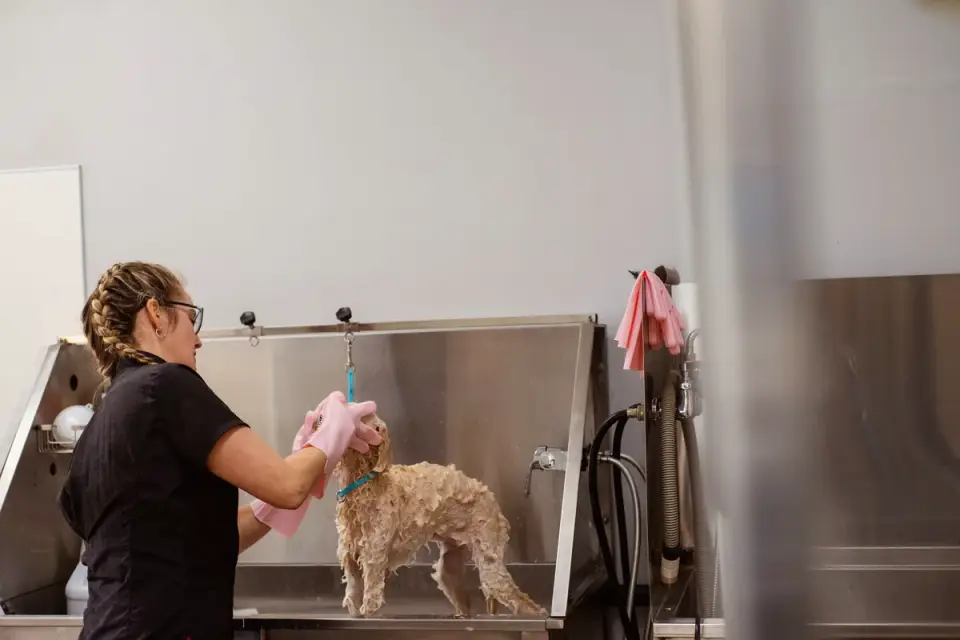
Grooming for a curlier F1b or multigen coat commonly runs every six to eight weeks; looser-coated F1s can sometimes stretch to eight to ten. That’s a recurring cost most first-time doodle owners underestimate. On the nutrition side, high-energy young doodles often do well with well-chosen training treats during the exercise and socialization phase — see our breakdown of training treats for dogs for size and ingredient considerations that matter for a growing, active puppy.
Summer heat management is worth planning for early too, especially for the thicker F1b and multigen coats. Our piece on cooling options for a thick-coated breed at home and our roundup of backyard sprinkler and splash games for hot days both apply directly to a curly-coated doodle carrying more insulation than a short-haired dog.
I think about a Labradoodle client named Otis, two years old, about 62 pounds, whose owners run a landscaping business and are outside most of the day. Otis’s F1 coat sheds lightly, matts almost never, and he keeps pace on job sites without issue. Compare that to Wrigley from earlier — same general size class, opposite lifestyle, opposite coat outcome from a different generation cross. Neither owner made a wrong choice. They matched (or in Wrigley’s case, initially mismatched) the dog’s maintenance profile to their actual daily life, and that’s the variable that predicts satisfaction two years in, not the parent-breed name on the paperwork.
Verdict: choose the generation and energy profile, not the label
Going forward, expect doodle breeders to keep leaning on generation-specific marketing — F1b and multigen listings are already commanding a premium for predictability. That trend should make your decision easier, not harder: ask pointed questions about generation, furnishing-gene testing, and actual grooming interval before you ask which retriever was in the cross.
Frequently asked questions
Is a Labradoodle or Goldendoodle more hypoallergenic?
Neither is guaranteed allergen-free. Coat generation (F1b or multigen with confirmed furnishing genes) matters more for shedding than which retriever was crossed with the Poodle, and research on hypoallergenic dogs has found no consistent difference in home allergen levels tied to breed labeling.
Which doodle needs less exercise?
Goldendoodles tend to run slightly calmer and more people-focused indoors, while Labradoodles trend a bit higher-energy and independent. Both need substantial daily activity; neither is a low-exercise breed.
How often do doodles need grooming?
It depends on coat generation more than breed. Curlier F1b and multigen coats commonly need professional grooming every six to eight weeks; looser F1 coats can sometimes stretch to eight to ten weeks.
Sources
- Dog allergen levels in homes with hypoallergenic compared with nonhypoallergenic dogs — PubMed / Journal of Allergy and Clinical Immunology
- Labradoodle vs. Goldendoodle: Key Differences and Similarities — Kinship
- Labradoodle vs Goldendoodle: Which Fluffy Friend Fits Your Life Best? — Canine Journal