On this page
A seven-year-old Lab mix named Otis used to shred the baseboards every afternoon between 4 and 6 p.m. — the stretch after his owner got home from work but before dinner. She’d tried a tougher rubber chew, thinking he needed something to gnaw on. It didn’t touch the problem. What actually changed his afternoons was a snuffle mat and a slow-feeder puzzle: Otis wasn’t under-chewed, he was under-stimulated. Within two weeks the baseboard chewing stopped and he’d settle on his bed after twenty minutes of puzzle work instead.
That’s the fork most owners are actually standing at when they ask whether to buy an interactive toy or a chew toy: it’s rarely “which is better,” it’s “which problem am I solving right now.” The two categories aren’t competing for the same slot in a dog’s day, and treating them as interchangeable is why a lot of toy boxes end up full of things a dog ignores.
What interactive toys are actually for
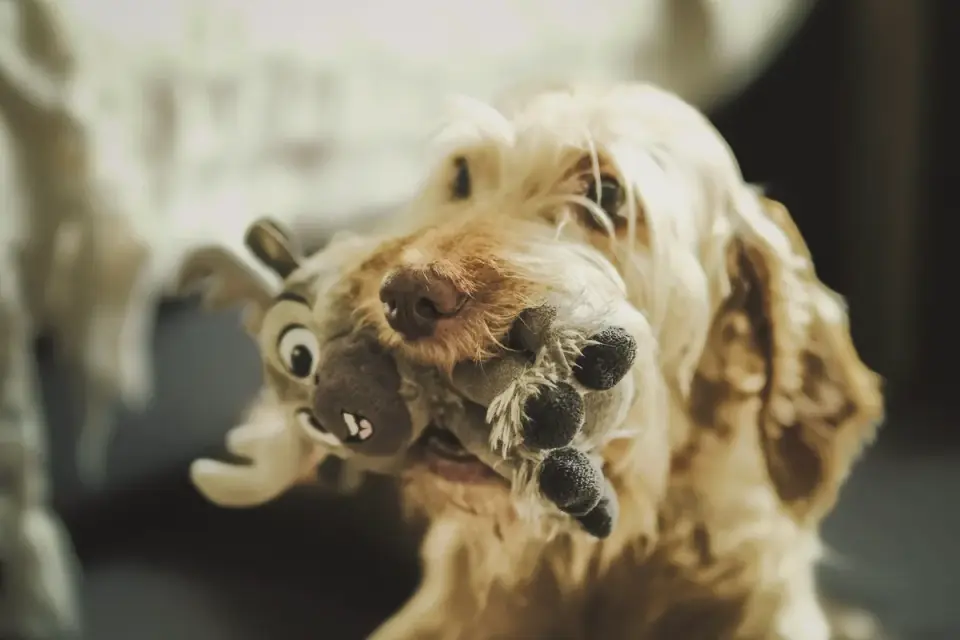
Interactive toys — puzzle feeders, treat-dispensing balls, snuffle mats, nose-work games — are built to make a dog work for a result, usually food. According to VCA Animal Hospitals, enrichment and activity toys keep dogs mentally engaged, can reduce boredom-driven destructive behavior, and are particularly useful for dogs left alone for stretches of the day or dogs recovering from an injury who can’t get their usual physical exercise.
In my practice, I reach for interactive toys first with dogs whose owners describe restlessness that doesn’t track with how much walking the dog is getting — pacing at a specific time of day, whining at the pantry, or, like Otis, destructive behavior confined to a predictable window. That pattern usually points to under-stimulation rather than pent-up physical energy, and a fifteen-minute puzzle-feeding session tends to move the needle faster than a longer walk does.
The tradeoff is durability and mess. Most interactive toys aren’t built to survive a committed chewer’s jaws, and food-dispensing designs mean crumbs on the floor. They also require some supervision at first, since a dog who gets frustrated with a puzzle can start gnawing on the plastic housing instead of working the mechanism as intended.
What chew toys are actually for
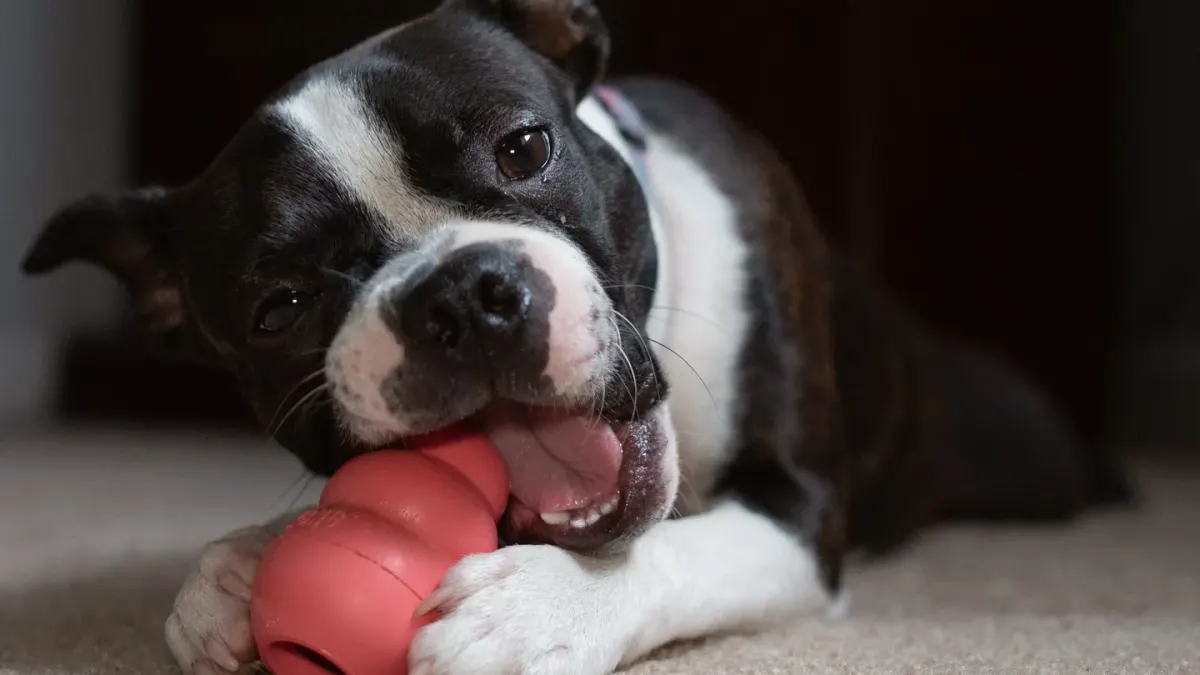
Chew toys exist for a different job: satisfying a behavioral need to gnaw, and, done right, contributing to oral health. Chewing is close to an instinctive behavior in dogs — it shows up early in puppies exploring the world with their mouths and persists into adulthood as a way to relieve stress and pass time, as Cornell veterinarian Brian Collins describes in Cornell University College of Veterinary Medicine’s coverage of redirecting chewing behavior. A review of the functional significance of chewing similarly found it’s tied to jaw strength, digestive priming, and stress regulation, not just teeth-cleaning, per findings published as NCBI/PMC: Functional Significance and Welfare Implications of Chewing in Dogs.
Where owners get into trouble is reaching for the hardest chew on the shelf because it looks like it’ll “last.” That’s backwards. According to AAHA, hard chews — real bone, antlers, hooves, hard nylon — are a leading cause of slab fractures in the large upper premolars, because the tooth gives before the chew does. The rule of thumb worth actually following: if you can’t flex it or dent it with a fingernail, and you wouldn’t want it thrown at your own kneecap, it’s a poor bet for a dog’s mouth.
I had a nine-year-old terrier mix in for a dental exam a few years back whose owner was adamant she’d never given anything but “vet-approved” antlers. Two slab fractures on the upper fourth premolars, both old enough to have gone quiet and infected under the gumline. The antler hadn’t worn down at all — that was the point being sold to her — and that’s exactly the problem. A chew that outlasts the dog’s enthusiasm for it is often a chew that’s too hard for the dog’s teeth, not a bargain.
Choosing by dog, not by aisle
The decision fork isn’t really toys-versus-toys — it’s matching the tool to what’s driving the behavior. A dog who’s bored alone all day, food-motivated, and physically tired needs interactive enrichment more than another chew. A dog who paces the house at night gnawing on furniture legs, or a teething puppy, needs an appropriate outlet for the jaw itself; see our guide on when puppies stop teething and need different toys for how that shifts with age. Anxious or crate-bound dogs often benefit from both at once — a chew to settle the nervous system, a puzzle to occupy the mind — which is also where hygiene starts to matter, since both categories accumulate saliva and food residue fast; our how to clean and disinfect dog toys piece covers material-specific routines.
Most healthy adult dogs do best with both categories rotated rather than either alone. That’s the position I land on, and I’ll name the counterargument directly: some trainers argue a single well-chosen puzzle toy can cover both mental and oral needs, since working a food puzzle involves gnawing and mouthing too. There’s some truth to that for lower-drive dogs, but it doesn’t hold for dogs with a genuine chewing drive — the terrier mix above worked puzzle toys just fine and still needed an outlet for the compulsive nighttime gnawing that had nothing to do with hunger. A puzzle toy satisfies curiosity; it doesn’t reliably satisfy the urge to bite down hard, which is a distinct behavior with its own physiology.
Building a simple rotation
A workable starting rotation: one interactive toy for daily solo time (a snuffle mat or treat ball, swapped weekly to keep novelty up), one appropriately soft-to-medium chew always available, and occasional supervised sessions with anything firmer. Reward-based games — using a treat pouch to reinforce settling on a mat after chew time, for instance — help a dog learn that calm follows the chewing rather than more excitement.
So which do you actually reach for first? If you’re only going to buy one toy this month, ask what your dog’s day actually looks like before you ask which aisle has the better reviews — the answer to that question, more than any packaging claim, is what tells you whether you’re solving a mind problem or a mouth problem.
Frequently asked questions
Can a dog have both an interactive toy and a chew toy at the same time?
Yes, and for most dogs that combination covers more ground than either alone — one addresses mental stimulation, the other addresses the physical urge to gnaw.
Are antlers and real bones safe chew toys?
Veterinary dental sources caution against very hard chews like antlers, hooves, and real bone because they're a common cause of tooth fractures; a chew that flexes slightly under pressure is a safer bet.
My dog ignores puzzle toys — is something wrong?
Not necessarily. Some dogs need an easier puzzle to start, and food-driven dogs typically take to them faster than dogs who aren't strongly motivated by treats.
Sources
- Don't Chew On This! — AAHA
- Behavior Management - Enrichment and Activity Toys — VCA Animal Hospitals
- Chew This, Not that: Brian Collins talks with WebMD about how to redirect chewing — Cornell University College of Veterinary Medicine
- Functional Significance and Welfare Implications of Chewing in Dogs — NCBI/PMC