Fit the harness frame first, then check leg clearance so straps stop rubbing behind the elbows.
On this page
Check the armpit first. If the chest strap sits in the crease behind the front legs, no padding will save the walk — move the frame or change the shape.
The fork: adjust this harness or switch the shape?
Tighten a strap that sits in the armpit and rubbing gets worse. Loosen it and the harness shifts and saws the same spot. Vets often see this loop in short-coated dogs that walk daily.
Jordan in Green Bay learned it with Jem, a 6-year-old spayed female Boston Terrier. The harness looked fine standing still, but after a 20-minute walk the skin behind both elbows was pink and Jem kept sitting to chew at one side. The fix was not tighter or looser — it was moving the side strap two finger-widths back onto rib, then admitting that H-shape still crossed too close and swapping to a Y-front.
Use that same test. Fit and walk 10 minutes. Check skin. If redness sits exactly under webbing, adjust position. If redness returns in the same line after two correct fits, change harness geometry.
Set the frame so straps clear the legs
Put the harness on, clip the leash off, and let the dog stand square. Do the fitting in standing, not sitting.
Slide the chest piece up so the front sits on sternum, not throat. Set the girth strap to sit 1 to 2 inches behind the elbows — about two fingers back on a Boston Terrier, a full hand on a large breed. Tighten until you can slide two flat fingers under every strap and the strap does not twist. Run a finger along the inside edge behind each leg. You should feel smooth webbing, not a buckle, seam, or D-ring.
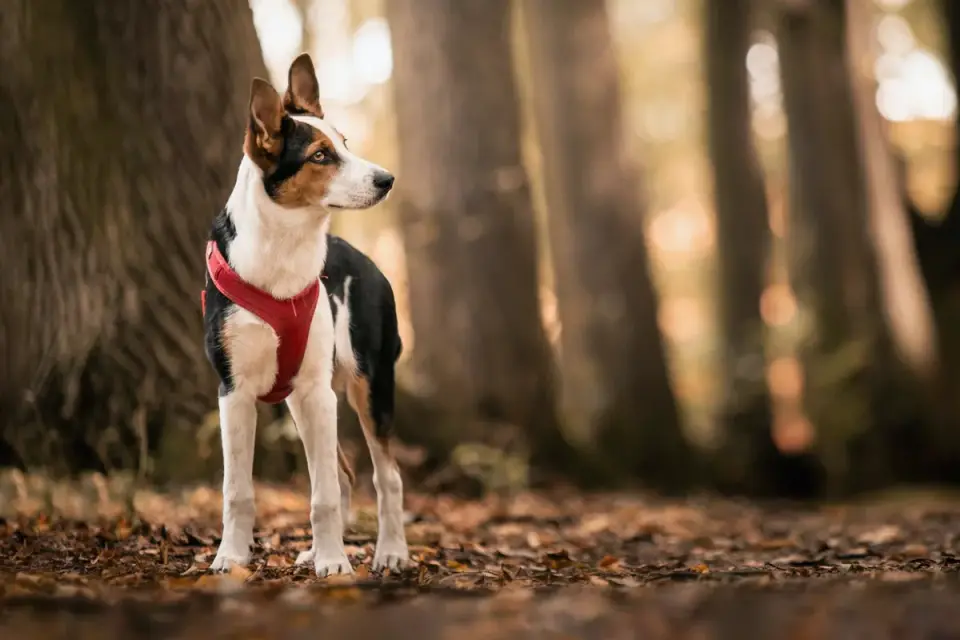
Walk the dog 30 feet and stop. Watch the elbows. Each step should clear the strap without the leg pushing it forward. If the strap rides forward into the crease, lengthen the shoulder straps a half-inch and recheck the girth. If the whole harness swings side to side, it is too loose through the chest — snug the shoulders, not the armpit edge.
This is where the evidence is thin. No published pressure study tells us a universal finger count or inch clearance that prevents rub in every breed. The Ruffwear fitting guide and the Blue Cross fitting review both land on the same practical standard — two fingers under straps and hardware kept out of the leg crease — because that is what holds up in daily use.
Recheck after coating and weight shifts
Check fit monthly. A winter coat, a summer shed, or a 2-pound gain changes where the edge lands.
When rubbing keeps returning
Do not add extra padding over a bad line. Fix contact first.
Look for three causes in order. Strap too far forward: the girth rides in the elbow pit. Strap too loose: the harness migrates with each stride. Shape mismatch: a straight chest strap crosses the leg on narrow-chested or short-legged dogs, while a Y-front leaves the shoulder and elbow free.
For repeat rub, try a Y-shaped front that meets low on the sternum and keeps webbing off the medial elbow. That comparison is covered in more detail in Y-Shaped vs H-Shaped Dog Harness: Which One Actually Fits Better? and, for narrow ribcages, in Choosing a Harness for a Deep-Chested Breed. Dogs the size of Vivi, a 6-year-old spayed female Great Dane, often need the large-panel version of the same idea — keep the side release a hand’s width behind the elbow or the chest piece will track forward.
Clean the area with water after a rub, skip fragranced balms on broken skin, and rest the harness for a day or two if hair is missing. Persistent bald lines, thickened skin, or limping need an exam rather than another adjustment.
What I would buy for armpit rub
I prioritize frame position over features. My evidence-bounded recommendation: choose a Y-front with at least three adjustment points — both shoulders and girth — in smooth, washable webbing with the hardware set behind the leg line.
That setup loses for one owner situation. If the dog slips harnesses by backing out, that same freedom around the elbows becomes an escape route. Then use a snugger H-shape or a harness with a third belly strap for security, and manage rub with shorter walks and frequent checks instead. Clip choice changes pulling but not fit much; see Front-Clip vs Back-Clip Dog Harness: Which One Actually Fixes Your Problem before moving the leash point to fix a fit problem.
Where would your dog’s strap sit after a full 15-minute walk — still on rib, or back in the crease?
Frequently asked questions
How tight should a harness be behind the front legs?
Snug enough to slide two flat fingers under the girth strap, with the strap edge sitting 1 to 2 inches behind the elbow and no hardware touching the crease.
Why does my dog's harness only rub on long walks?
The frame migrates as the dog moves. A harness that clears the leg standing still can ride forward after 10 minutes, so recheck skin and strap position after a real walk, not just in the living room.
Sources
- Flagline Dog Harness — Ruffwear