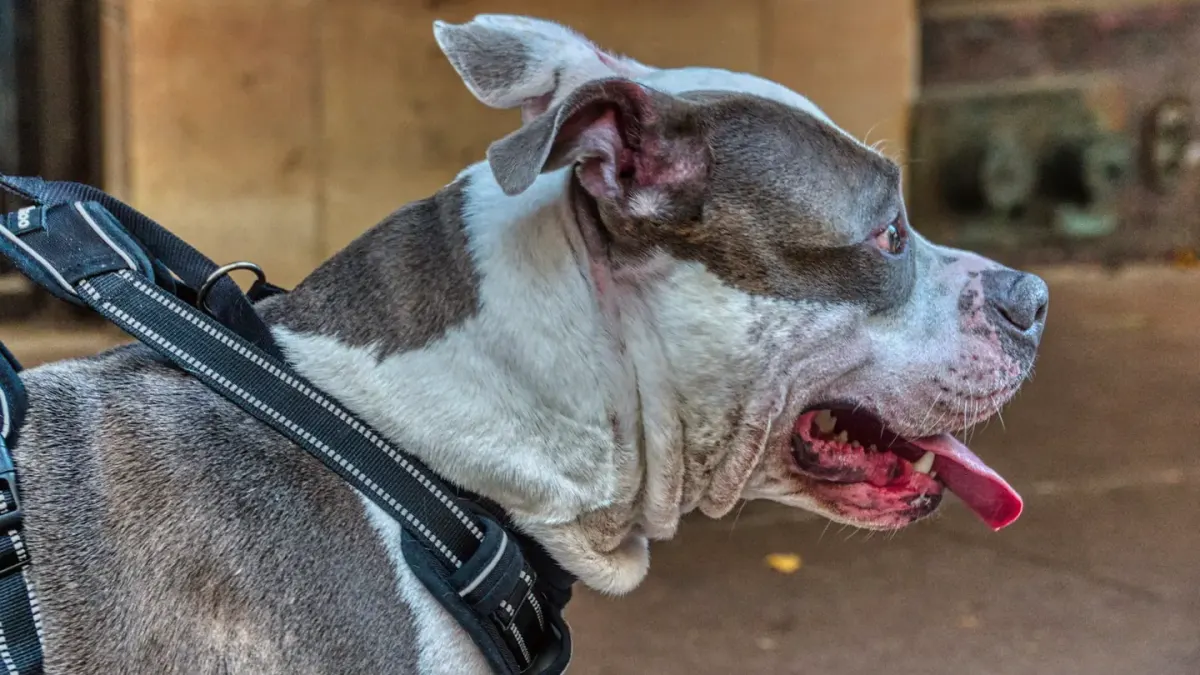
We first noticed the problem on a leash-training walk with Otto, a two-year-old Weimaraner whose owner had bought a harness sized off his shoulder height. Within a block, the sternum strap had crept sideways and was digging into the soft skin just behind his front leg. Otto wasn’t pulling hard. The harness simply didn’t have anywhere stable to sit, because his chest was deep front-to-back but narrow side-to-side — a shape that a lot of harness sizing charts don’t really account for.
That mismatch is common with deep-chested breeds: Great Danes, Dobermans, Weimaraners, Greyhounds, Boxers, and German Shepherds among them. Their torsos are built differently than a barrel-chested Labrador or a stocky Bulldog, and a harness that fits one shape poorly on the other isn’t a durability flaw so much as a design-to-anatomy mismatch. Here’s what we look at when a deep-chested dog needs a harness, based on hands-on fitting and what the available research says about strap placement.
Why chest shape changes the fit math
A harness has to cross two very different structures: the sternum (a narrow bony ridge on a deep-chested dog) and the ribcage just behind the front legs, which curves in sharply rather than staying round. On a barrel-chested dog, a girth strap has more flat surface to rest against and stays put. On a narrow, deep chest, that same strap has less to grip, so it slides — toward the armpit going one way, or up onto the throat area going the other, depending on the angle of the front strap.
This is also the conformation type most associated with a different, unrelated concern: gastric dilatation-volvulus, or bloat. According to Cornell University College of Veterinary Medicine, dogs with deep, narrow chests are considered at elevated risk for this life-threatening condition, and AAHA notes it’s a true emergency requiring immediate veterinary care. A harness itself doesn’t cause or prevent bloat — it sits across the chest, not the abdomen — but it’s a reason to avoid vigorous exercise right after a meal on this body type, regardless of what gear the dog is wearing that day.

What to actually check before buying
Start with where the front strap crosses the chest. Whether the harness is labeled Y-front or straight-strap, the section that runs across the front of the chest needs to sit above the point of the shoulder joint, not across or below it. A study on harness biomechanics published in the Journal of Applied Animal Welfare Science found that Y-shape harnesses restricted shoulder extension more than straight chest-strap designs during treadmill movement — but the researchers tied that difference back to strap position relative to the shoulder blade, not the shape alone. A well-positioned Y-front can still allow close to full shoulder movement; a poorly positioned one, in either style, will not.
Next, look at adjustability on the girth strap specifically. Deep-chested dogs frequently need the girth set several notches tighter than a height-based size chart implies, because their girth measurement (the loop just behind the front legs) can be modest compared to their overall height. A harness with only two or three girth adjustment holes gives you less room to correct for that mismatch than one with a longer adjustment range.
Finally, check the shape of the chest plate or Y-junction itself. On a narrow chest, a wide, flat chest panel can bunch or twist because there isn’t enough flat real estate for it to lie against. A narrower, contoured Y-junction tends to track the sternum’s actual shape more reliably on these dogs.
The two-finger check, applied to a narrow chest
Fit every harness the same way: slide two flat fingers under each strap at the neck, the chest, and the girth. You should feel steady, even contact — not loose enough to shift, not so tight it digs in. On a narrow-chested dog, pay particular attention to the girth strap immediately behind the front legs; this is where sliding is most likely because there’s less body surface for the strap to grip. If two fingers fit easily right after the walk starts but the strap has crept by the time you’re a block in, the girth is too loose for that dog’s shape, not necessarily the wrong size overall.
Where this fits with everything else
Harness choice is one piece of managing a deep-chested dog well, not the whole picture. If your dog also tends to bolt or slip leashes, it’s worth reading our guide on gear for a dog that runs off alongside this one, since a harness that fits poorly is more likely to allow an escape in the first place. Dogs that pull hard on walks are also worth watching for related behavior patterns; if a dog reacts sharply to being touched near the chest during fitting, our piece on why dogs growl when petted covers how to read that signal safely rather than pushing through it. And because many deep-chested breeds are large, active dogs, matching harness choice to actual daily exercise load matters — smaller or toy breeds have very different needs, which we cover separately in our guide to exercise for toy and small breeds.
A short note worth remembering: no harness style is universally correct for every deep-chested dog. Body shape varies even within a breed.
Bottom line: for a deep-chested dog, look for an adjustable Y-front or straight-strap harness with the front strap positioned above the shoulder joint, a girth strap with real adjustment range, and a chest panel narrow enough to track a sternum rather than a barrel — then confirm it with the two-finger check at every contact point, not just at purchase but after the first few real walks.
Frequently asked questions
Are deep-chested dogs more prone to bloat, and does a harness make that worse?
Deep, narrow chests are a recognized risk factor for gastric dilatation-volvulus, or bloat, according to Cornell University's College of Veterinary Medicine. A correctly fitted harness that sits across the chest and shoulders, not the abdomen, does not compress the stomach; the concern is unrelated to harness use itself, but it's a reason not to exercise a deep-chested dog vigorously right after eating regardless of what gear they're wearing.
Is a Y-front harness always the best choice for a deep-chested breed?
Not automatically. A Y-front design can work well because the strap crosses the sternum rather than the shoulder blades, but research on harness biomechanics found that Y-shape harnesses can restrict shoulder extension more than a straight chest-strap design if the front strap isn't positioned above the point of the shoulder. Fit matters more than the shape name on the label.
How do I know if the girth strap is too tight on a narrow-chested dog?
Use the two-finger check at every point of contact — you should be able to slide two flat fingers under the strap without it digging in. On a narrow, deep chest the girth strap often needs a shorter length setting than the sizing chart suggests, since these dogs can have a small girth relative to their height.
Sources
- Gastric dilatation volvulus (GDV) or "bloat" — Cornell University College of Veterinary Medicine
- Understanding Canine Bloat (GDV): A Medical Emergency — AAHA
- Effect of harness design on the biomechanics of domestic dogs (Canis lupus familiaris) — Journal of Applied Animal Welfare Science