
On this page
A family in my clinic waiting room once brought in a nine-month-old French Bulldog for a routine check and, in the next breath, asked me whether they should have gotten a Boston Terrier instead. Their Frenchie, Gus, had started snoring loudly enough to wake the household, and a neighbor’s Boston Terrier seemed to breathe just fine on the same summer walks. That comparison — two breeds that look like cousins from across the street — is one of the most common ones I field, and it deserves a real answer rather than a coin flip.
The Decision Fork Most Owners Actually Face
Before the ears and the color and the “which one is cuter” debate, there’s a structural fork: French Bulldogs and Boston Terriers are both brachycephalic, but they are not brachycephalic to the same degree, and that difference shows up in exercise tolerance, heat risk, and the odds of airway surgery down the road. If you’ve narrowed your search to these two, the decision isn’t really about temperament — both are affectionate, people-oriented companions — it’s about how much respiratory risk fits your household, your climate, and your budget for possible correction surgery.
Size and Structure, Side by Side
The American Kennel Club: French Bulldog breed standard caps weight at 28 pounds, with anything heavier disqualified in the show ring, and dogs typically stand 11 to 13 inches at the shoulder. They’re compact and heavy-boned, with the square head and bat ears that define the look.
Boston Terriers run smaller and are further subdivided by weight class — under 15 pounds, 15 to under 20, and 20 up to 25 — with a taller, leggier stance around 15 to 17 inches. The breed is built to look sturdy without being coarse, and the standard explicitly warns against a spindly frame. In practice, that means a Boston Terrier tends to move a little more freely than a French Bulldog of similar age, and owners who’ve had both often describe the Boston as “quicker on its feet.”
Why the Muzzle Length Matters More Than the Coat Color
Here’s the part that doesn’t show up in a cute Instagram comparison post: the two breeds’ skulls are not shaped the same way, and it changes their airway risk. A cross-sectional study on BOAS in the Boston Terrier: A healthier screw-tailed breed?: BOAS in the Boston Terrier found that brachycephalic obstructive airway syndrome is present at a reduced prevalence in Boston Terriers compared with French Bulldogs and English Bulldogs, largely because Bostons tend to retain a relatively longer muzzle. That doesn’t mean Boston Terriers are risk-free — the same research identified facial foreshortening, nostril stenosis, and scleral show as measurable risk factors within the breed, with nostril stenosis being the most visible obstruction site and the one most correlated with clinical BOAS.
French Bulldogs sit at the more extreme end of the spectrum. A widely cited conformational study of pugs, French Bulldogs, and bulldogs, published as Conformational Risk Factors of Brachycephalic Obstructive Airway Syndrome (BOAS) in Pugs, French Bulldogs, and Bulldogs, tied shorter, wider skull ratios to a higher likelihood of clinical airway obstruction, and French Bulldogs consistently score toward that shorter end. A follow-up cardiac imaging study, BMC Veterinary Research: Echocardiographic Parameters in French Bulldogs, Pugs and Boston Terriers with Brachycephalic Obstructive Airways Syndrome, examined 30 French Bulldogs, 15 Pugs, and 12 Boston Terriers against non-brachycephalic controls and found distinct downstream cardiovascular signs in the affected French Bulldogs, including smaller left atrium measurements and reduced caudal vena cava collapsibility — changes consistent with chronically increased effort to breathe. Boston Terriers with BOAS in that same study showed their own pattern of vena cava changes, which is a reminder that “mild” brachycephalic doesn’t mean “no consequence.”
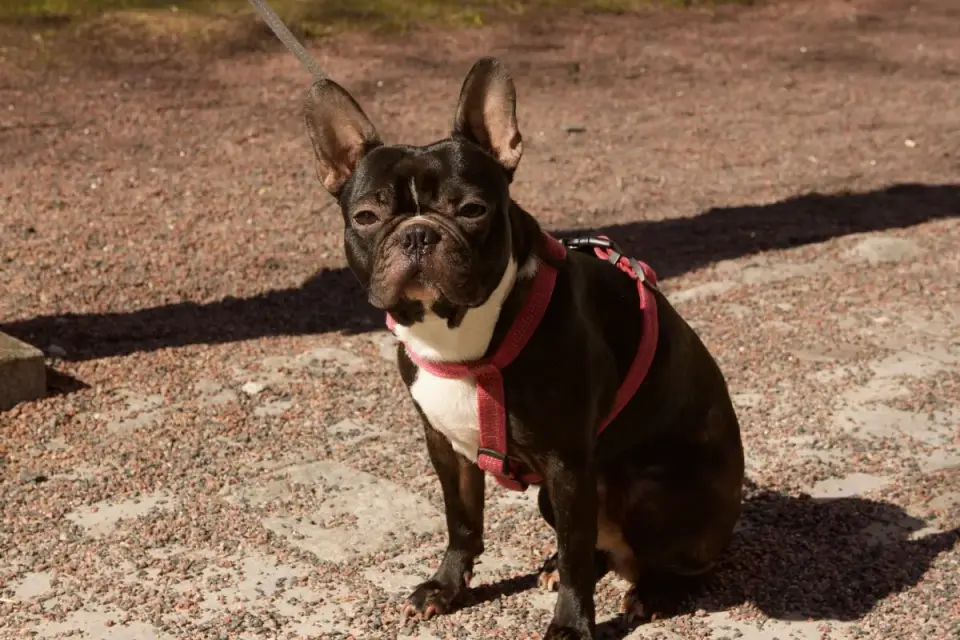
I’ve watched this play out with two patients almost back-to-back one August: a four-year-old French Bulldog named Biscuit, about 24 pounds, who’d start open-mouth breathing and drooling after barely six minutes on a 78-degree afternoon walk, and a five-year-old Boston Terrier, Pepper, closer to 18 pounds, who could handle a 15-minute walk at the same temperature before needing a break. Neither dog was overweight, and both owners were attentive. The difference tracked almost exactly with what their airway exams showed — Biscuit had narrower nostrils and a shorter muzzle on physical exam, Pepper’s airway looked comparatively roomier. I don’t take that as proof that every Frenchie struggles more than every Boston; individual anatomy varies a lot within both breeds. But it’s the pattern I see often enough that I now ask new Frenchie owners, at the first puppy visit, to plan walks around temperature the way they’d plan around traffic.
Temperament: Where the Two Breeds Actually Overlap
This is the one category where I won’t pretend there’s a clear winner. Both breeds are described in their respective standards as affectionate, adaptable companions — the French Bulldog standard calls for a dog that’s “well behaved, adaptable, and comfortable,” while the Boston Terrier standard emphasizes a friendly, intelligent, alert disposition. In clinic, I don’t see a consistent behavioral gap between the two; both tend to be people-focused, food-motivated, and reasonably easy to handle for low-stress exams, provided they’re introduced to handling early. If your decision is being made on personality alone, you’re choosing between two breeds that are more alike than different.
Grooming, Coat, and Everyday Care
Both breeds carry a short, smooth coat that sheds moderately and doesn’t require professional grooming, though the wrinkles around a French Bulldog’s face need more attention — regular cleaning of the folds helps prevent skin fold dermatitis, which I see far more often in Frenchies than in Bostons. Boston Terriers have flatter faces than a Labrador but not the deep wrinkling of a Frenchie, so that particular maintenance task is lighter. Neither breed needs elaborate grooming, but the daily habit of checking skin folds is one I’d call non-negotiable for French Bulldog owners specifically.
Puppy owners of either breed benefit from the same foundational setup — a consistent overnight routine matters for both, and our guide to crate setup for a puppy’s first night covers the basics that apply regardless of breed. Treat choice also deserves early thought, since both breeds can be prone to weight gain relative to their frame; our buyer’s guide to training treats breaks down sizing and ingredient quality for small dogs specifically.
Heat Management Isn’t Optional for Either Breed
Because both breeds carry some degree of airway restriction, neither dissipates heat as efficiently as a longer-muzzled dog, and summer planning matters regardless of which one you choose. Short walks in the cooler parts of the day, access to shade, and close attention to open-mouth panting that doesn’t resolve with rest are basics for both. If you’re leaning toward outdoor play as a cooling strategy, our roundup of backyard sprinkler and splash games for hot days includes lower-intensity options that don’t demand sustained aerobic effort — a meaningful distinction for a brachycephalic dog. For households in genuinely hot climates, it’s also worth reading our piece on cooling options for a thick-coated breed at home, since several of the cooling-mat and airflow strategies apply just as well to a short-coated, flat-faced dog working harder to regulate its temperature.
The Recommendation
If I’m counseling a family that’s genuinely torn between these two, I lead with the airway conversation first and the cuteness factor second — expectation before enthusiasm, because that’s the order that actually serves the dog. For a household in a hot climate, with young kids who’ll want long summer walks, or with a tighter budget for the possibility of BOAS surgery later, I’ll steer toward the Boston Terrier on the evidence: it’s not risk-free, but the published prevalence data gives it a real edge on airway tolerance. The strongest counterargument I hear is that plenty of French Bulldogs live long, comfortable lives without ever needing surgery, and that’s true — individual conformation varies, and a Frenchie with wider nostrils and a slightly longer muzzle for the breed can do just fine. But when an owner has no way to evaluate that anatomy themselves, I’d rather they start from the breed with the better odds on paper and let their vet confirm on exam, than start from the higher-risk breed and hope for the best. Whichever you choose, get a hands-on airway assessment at the first exam, ask your vet to grade nostril and soft palate conformation specifically, and build your walk schedule around your dog’s actual breathing, not the calendar.
Frequently asked questions
Which breed is healthier overall, French Bulldog or Boston Terrier?
Neither is free of health risk, but published prevalence data suggests Boston Terriers experience brachycephalic obstructive airway syndrome less often than French Bulldogs, largely due to a relatively longer muzzle. Individual dogs within each breed still vary widely.
Do Boston Terriers have breathing problems too?
Yes. Boston Terriers can still show facial foreshortening, nostril stenosis, and scleral show, all of which are measurable risk factors for airway obstruction, even though the breed's average risk is lower than a French Bulldog's.
Which breed handles heat better?
Neither breed handles heat as well as a longer-muzzled dog. In practice, many Boston Terriers tolerate mild exertion in warm weather a bit longer than French Bulldogs, but both need shortened walks, shade, and close monitoring for open-mouth panting that doesn't resolve with rest.
Sources
- French Bulldog Dog Breed Information — American Kennel Club
- BOAS in the Boston Terrier: A healthier screw-tailed breed? — PLOS One
- Conformational Risk Factors of Brachycephalic Obstructive Airway Syndrome (BOAS) in Pugs, French Bulldogs, and Bulldogs — PLOS One
- Echocardiographic Parameters in French Bulldogs, Pugs and Boston Terriers with Brachycephalic Obstructive Airways Syndrome — BMC Veterinary Research