On this page
Picture a Tuesday-night kitchen: a loaf fresh out of the bread machine, one end already sliced for sandwiches, and a beagle whose whole body has reoriented toward the counter. The dog isn’t headed for a crisis over a dropped crust. That instinct to reach for a slice and toss it down is fine, most of the time. The instinct to hand over a fist-sized wad of unbaked dough because it’s just flour and water is where I want owners to stop and think differently, because those two scenarios are not the same category of question.
The Fork: A Crust on the Counter vs. Dough on the Rise
This is really two questions wearing one name. Baked bread is a low-risk, low-value food: it won’t hurt a healthy dog in a small piece, and it won’t help much either. Raw dough containing active yeast is a different substance entirely once it’s inside a warm, moist stomach that behaves a lot like a proofing drawer. I treat these as different conversations with different urgency, and I’d rather an owner remember the fork than a single blanket rule that stops holding up once dough enters the picture.
Plain Baked Bread: What It Actually Adds to the Bowl
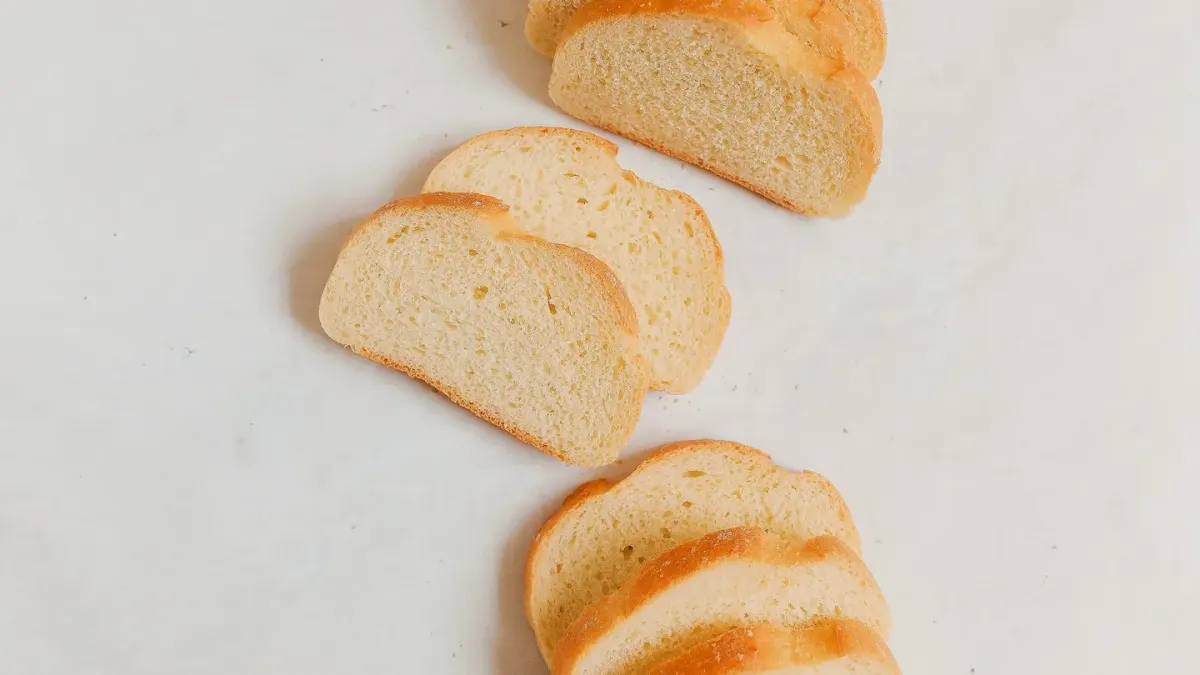
A small piece of plain white or whole-grain bread, fully baked and free of raisins, garlic, xylitol, or heavy seasoning, is generally safe as an occasional bite. It’s mostly refined carbohydrate and a modest amount of fiber, with little protein and almost no micronutrient density a dog can’t already get from a complete diet. That’s the honest read: it isn’t dangerous, it just isn’t doing anything for the dog nutritionally. I’d rather see a training treat or a spoonful of plain cooked vegetable used for the same purpose, since at least that contributes something. If you’re already weighing carbohydrate fillers against each other, the same portion logic applies to sweet potato as a treat swap — more fiber for a similar calorie hit.
One short sentence, because it earns its own line: portion is the whole game here.
A single slice of sandwich bread runs somewhere around 70 to 100 calories depending on the loaf, which for a 20-pound dog can be a genuinely significant slice of a daily budget. Fed occasionally and in pieces smaller than a full slice, that’s rarely a problem. Fed as a daily habit, it starts crowding out the balanced calories a dog actually needs, and in a dog already carrying extra weight, it works against the plan rather than for it. Enriched loaves deserve a second look too — brioche, challah, and some sweet breakfast breads carry butter, eggs, and sugar that push the calorie count and fat load well past a plain baguette, and specialty low-carb or diet breads sometimes use xylitol as a sweetener, which is a genuine toxin for dogs even in small amounts. Read the label before you assume any loaf is interchangeable with another.
Raw Yeast Dough: The Version That Actually Sends Dogs to the ER
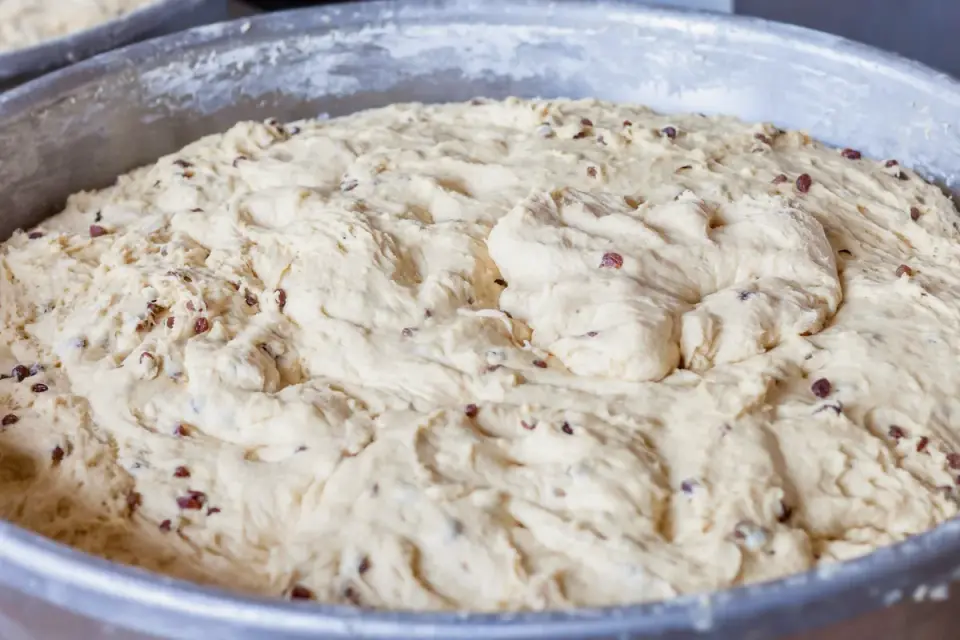
This is the half of the question that deserves real weight, not a footnote. Unbaked dough made with live yeast keeps doing in a dog’s stomach exactly what it does on a counter: it rises. A warm, moist stomach is close enough to a proofing environment that the dough can expand significantly in volume, distending the stomach and, in some dogs, contributing to a life-threatening bloat-type presentation. At the same time, the yeast ferments the sugars in the dough and produces alcohol, so a dog that swallows raw dough can end up dealing with both a mechanical problem and an ethanol toxicity problem at once. Neither of those resolves on its own, and neither is something I’d wait out at home. If a dog gets into rising dough, that’s a same-day call to a veterinarian or animal poison control, not a wait-and-watch situation.
When Bread Becomes a Problem Even Baked
Healthy dogs with no GI history have real room to tolerate an occasional bite of bread. That changes for dogs managing certain conditions. Consider a middle-aged dog living with exocrine pancreatic insufficiency, a condition where the pancreas no longer produces enough digestive enzymes to properly break down food. According to a review in JAVMA, “EPI is treated by pancreatic enzyme replacement therapy, nutritional management (low-residue diets with moderate fat content), and supplementation of cobalamin.” A refined-carbohydrate food like bread isn’t automatically off-limits for that dog, but it isn’t a neutral add either — it’s another variable layered on top of a diet that already has to be managed with more precision than a healthy dog’s. Diabetic dogs and dogs prone to pancreatitis fall into a similar category: bread’s simple carbohydrate load and, in enriched versions, its fat content are exactly the levers those conditions are sensitive to.
Gut microbiome research adds a related caution about how individual dogs can respond differently to dietary changes than expected. Work published in Frontiers in Veterinary Science on probiotic response in dogs found that “diversity metrics did not distinguish non-responders from responders,” a reminder that a dog’s gut doesn’t always react to a dietary shift the way a simple before-and-after story would predict. That’s part of why I don’t hand out a single bread rule for every dog. A dog transitioning off a prescription GI diet, or one being eased through a food change like the process described for switching a senior dog to new food, is not the dog I’d hand a bread crust to as an experiment, even if the ingredient itself is bland.
The Practical Rule
My bottom line: a small piece of plain, fully baked bread, given occasionally, is not a health risk for the average healthy dog, and I don’t lose sleep over it. Raw dough is not a smaller version of that same risk; it’s a different emergency entirely, and it should be treated that way every time. For dogs managing pancreatic, GI, or metabolic conditions, or for owners who already read ingredient labels carefully for things like the amount of garlic that’s actually safe for dogs, bread is worth folding into that same label-reading habit rather than treated as an automatic yes. Keep the crust occasional, keep the dough locked away, and check what’s actually baked into a specialty loaf before it becomes a routine treat.
Frequently asked questions
Can dogs eat white bread or only whole wheat?
Both are technically fine in small amounts. Whole wheat contributes a bit more fiber and micronutrients, but neither is a meaningful nutritional addition to a dog already eating a complete diet, so the choice matters less than the portion.
What if my dog eats a whole slice of raw dough before I catch it?
Treat it as an emergency and call your veterinarian or an animal poison control line right away. Rising yeast dough continues to expand and ferment in a warm stomach, and that combination is not something to watch and wait on.
Sources
- Exocrine pancreatic insufficiency: nutritional management and treatment review — JAVMA
- Probiotic response and gut microbiome diversity in dogs — Frontiers in Veterinary Science