
On this page
The question I actually get from owners isn’t whether banana is safe. It’s how much — and that’s where most quick internet answers fall apart, because ‘in moderation’ means something different for a 9-pound Yorkie than it does for an 80-pound Lab.
Picture a retriever mix named Coco, who’d picked up the habit of sitting under the kitchen counter every morning while her owner made a smoothie, waiting for the heel of a banana to come her way. It started as half a banana most days. Coco was a healthy weight, active, no history of GI trouble — and yet over a few months her stool went softer and her energy after breakfast dipped a little, for no obvious reason. Nothing dramatic. Just a dog whose gut was quietly absorbing more fruit sugar and fiber than it was built to process daily. The fix wasn’t cutting banana out entirely — it was resizing the portion to what a dog Coco’s size can actually metabolize without the digestive drag.
That’s the myth worth correcting up front: ‘safe’ doesn’t mean ‘unlimited,’ and a lot of banana-feeding advice treats the two as interchangeable.
What a Banana Actually Contributes
A ripe banana brings potassium, magnesium, vitamin B6, vitamin C, and a modest amount of fiber, according to the American Kennel Club (AKC). None of that is unique to banana — you’ll find comparable or better fiber-to-sugar ratios in sweet potato — but banana’s soft texture and mild flavor make it an easy, low-effort way to add a small amount of fiber and potassium to a dog’s day, particularly for dogs that turn their nose up at vegetables.
Where the Fiber Argument Holds Up
Fiber genuinely does something useful in a dog’s gut: it feeds beneficial bacteria and can firm up loose stool or ease mild constipation, depending on the dog. But fiber’s job in the GI tract is context-dependent, not a blanket fix. A balanced gut microbiome supports overall immune function, which is exactly why I’m cautious about swapping in a new fiber source abruptly rather than gradually — the same caution I’d apply to any diet change, including the slow transitions I recommend when switching an older dog’s food. Dogs with a sensitive GI history, or ones actively managing dysbiosis, are the ones most likely to notice a fiber swing either direction.
The Sugar Math Most Owners Skip
Here’s the part that gets glossed over: banana is one of the higher-sugar fruits dogs commonly eat. A slice here and there is trivial for a healthy adult dog. A half banana daily, for a small dog, is a meaningfully larger share of that dog’s daily carbohydrate and sugar intake than owners tend to picture. Dogs managing weight, diabetes, or pancreatitis history are the dogs I’d steer away from banana as a routine treat, full stop — not because banana is dangerous, but because the sugar load doesn’t buy enough nutritional benefit to justify the tradeoff in those dogs specifically.
A Different Dog, a Different Answer
Contrast Coco with an older beagle managing chronic loose stool on a standard diet, the kind of case that shows up constantly in vet forums and owner groups. For a dog like that, a thin slice of banana mixed into a bland recovery meal can serve a real purpose — a palatable way to add a little fiber and potassium during a GI flare, under veterinary direction, rather than as a daily snack. That’s a completely different use case from Coco’s counter-side habit, and it’s the distinction that gets lost when ‘can dogs eat bananas’ gets answered with a flat yes or no.

Where GI Disease Changes the Calculus
For dogs with diagnosed exocrine pancreatic insufficiency, fiber and fat management aren’t optional extras — JAVMA notes that EPI is treated by pancreatic enzyme replacement therapy, nutritional management (low-residue diets with moderate fat content), and supplementation of cobalamin, and that future studies are needed to further understand the causes of persistent dysbiosis in animals with EPI following initiation of pancreatic enzyme replacement therapy and assess the efficacy of treatments to ameliorate these abnormalities. Banana’s fiber content isn’t automatically compatible with a low-residue diet, so any fruit add-in for a dog with a diagnosed GI condition should go through your vet, not a feeding chart. The same logic applies to any borderline ingredient, the way we’ve written about garlic being technically tolerable in tiny amounts but not worth the risk for most owners.
Probiotic supplementation is sometimes floated as a companion fix when fruit or fiber changes unsettle a dog’s stool, but a Frontiers in Veterinary Science pilot study on probiotics in dogs with diarrhea found that diversity metrics did not distinguish non-responders from responders — meaning a probiotic didn’t reliably separate dogs who improved from dogs who didn’t, at least on that measure. Fiber and probiotics both may help support digestive resilience, but neither is a guaranteed fix for a dog whose stool changed because the portion, not the ingredient, was the actual problem.
My Verdict
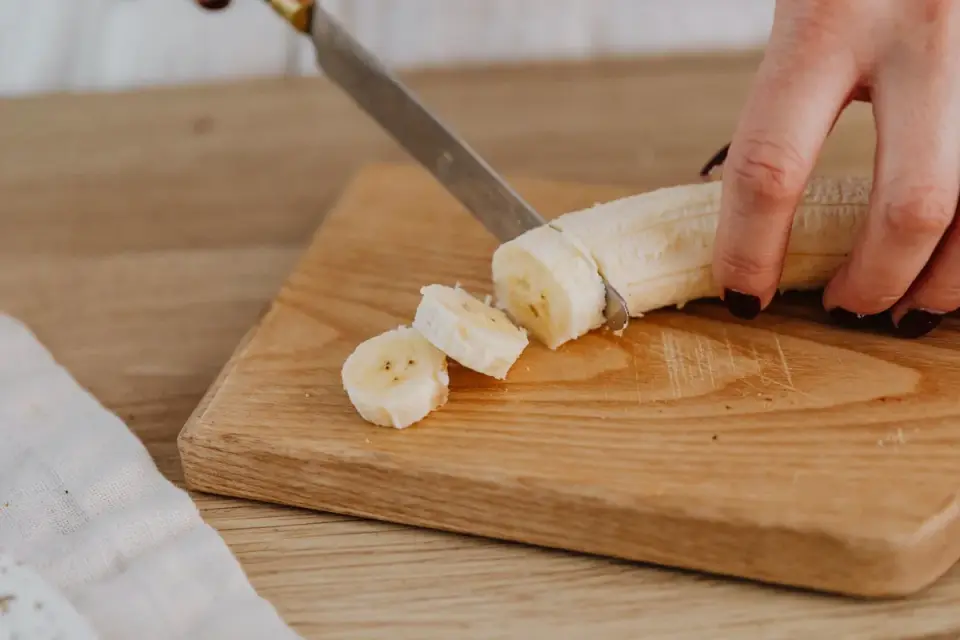
Feed banana the way you’d feed any calorie-dense treat: sized to the dog, not to the fruit. A couple of quarter-inch slices for a small dog, more for a large one, peel removed, and skip it altogether for dogs managing weight, diabetes, or a diagnosed GI condition unless your vet says otherwise. Coco didn’t need to give up banana — she needed a smaller one. What would change if you actually measured your own dog’s treat instead of eyeballing it?
Frequently asked questions
Can puppies eat banana?
A very small taste is generally fine as an occasional treat, but a puppy's developing gut tolerates less variety than an adult dog's, so keep the amount minimal and watch stool the next day.
Is banana peel dangerous for dogs?
The peel isn't toxic, but it's fibrous and tough to digest, and can contribute to an upset stomach or, in rare cases, a partial obstruction in a dog that swallows a large piece whole. It's simplest to just remove it.
How much banana is too much for a dog?
More than a slice or two for a small dog, or roughly half a banana for a large dog, starts pushing sugar and fiber intake past what most dogs handle well in one sitting, especially dogs managing weight or blood sugar issues.
Sources
- Exocrine pancreatic insufficiency in dogs and cats — JAVMA
- Pilot study evaluating tolerability and changes in fecal microbiota associated with novel probiotic administration to dogs with diarrhea — Frontiers in Veterinary Science
- Can Dogs Eat Bananas? — American Kennel Club (AKC)