On this page
A kitchen counter in early fall. A dog stands at heel while an owner cores an apple for a lunch, and half a slice lands on the floor before anyone decides whether that was a good idea. It’s a scene that repeats in a lot of houses this time of year, and it sits at a real decision fork: hand over the slice, or sweep it up and move on.
The short answer is that most healthy dogs can eat apple flesh safely, in modest amounts, prepared with the core and seeds removed. The longer answer is where the actual judgment lives, and it depends less on the fruit than on the dog standing in front of you.
The Decision Fork: Slice, Core, or Skip Entirely
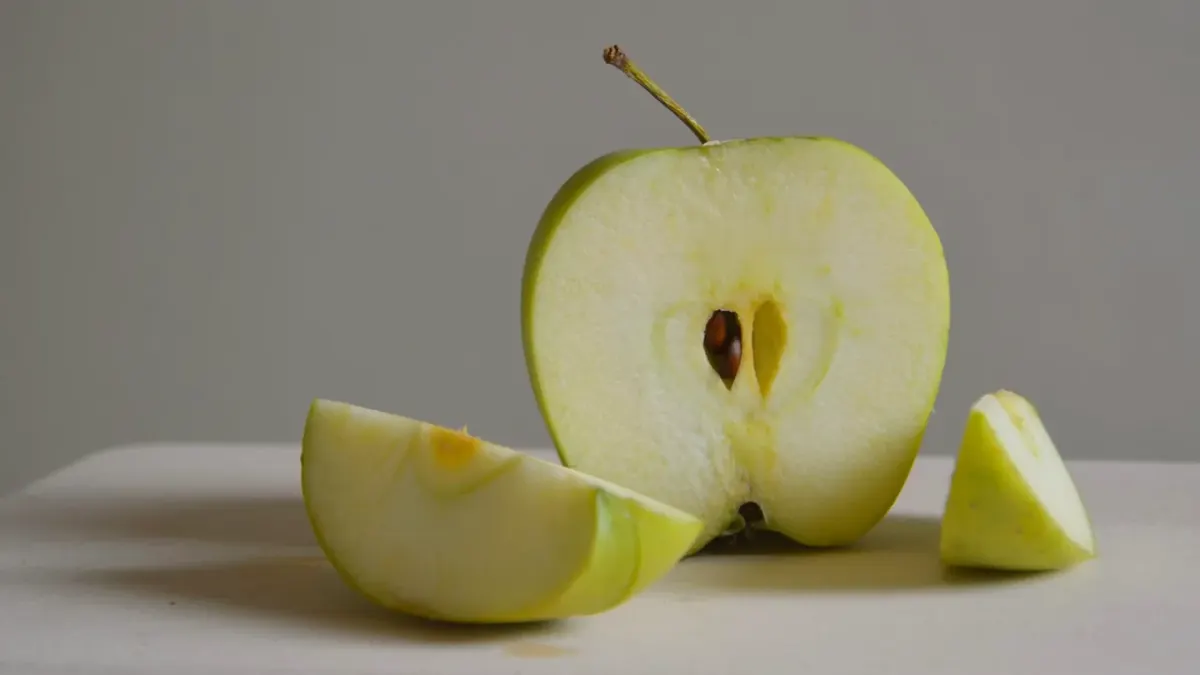
Apples are not a uniform food once you look past the produce-aisle label. The peel carries most of the fiber. The flesh carries the water and the sugar. The core, stem, and seeds carry a genuine, if overstated, toxin risk. Treating apple as one decision collapses three separate ones into a single yes-or-no, and that’s how owners end up either overly anxious about a fruit bowl or careless about a part of it that actually deserves caution.
According to the ASPCA, apple seeds, stems, and leaves contain a cyanide-producing compound, and that classification is accurate as far as it goes. What it doesn’t convey is scale: a dog would need to chew through a substantial quantity of seeds, not a stray one or two from a dropped core, before the compound became a clinical problem. Coring the fruit sidesteps the question rather than settling it by argument, which is the more useful habit to build anyway.
What’s Actually in an Apple’s Fiber Ledger
The reason apples show up in dog-nutrition conversations at all is fiber, mainly pectin, a soluble fiber that behaves differently in the gut than the insoluble fiber in, say, wheat bran. Pectin absorbs water and can firm loose stool, and it’s fermented by colonic bacteria into short-chain fatty acids that feed the gut lining rather than passing through inert. That’s a real mechanism, not marketing language, and it’s part of why a balanced gut microbiome supports overall immune function, a relationship that shows up consistently across the Frontiers in Veterinary Science: probiotic and gut-diversity literature in dogs.
But fiber is not a one-direction lever. A gut that’s already inflamed, recovering from an illness, or managing a diagnosed condition doesn’t always respond to added fiber the way a stable, healthy gut does. Diversity metrics alone don’t reliably separate the dogs whose systems tolerate a dietary change from the ones that don’t, which is a research finding worth taking seriously rather than a technicality. Fiber being good for a dog is not a safe universal rule; it is only a directionally true one.

When a Sensitive Gut Changes the Math
This is where a Western workup and an integrative read on the same dog tend to converge rather than compete. I reach for both the imaging study and the acupuncture needle in cases where a client wants a quick dietary fix for a dog whose gut has been unsettled for weeks, because the honest answer usually isn’t in the fruit bowl at all. A dog with exocrine pancreatic insufficiency, for instance, is typically managed with pancreatic enzyme replacement, a low-residue diet with moderate fat, and cobalamin support, not with an added fiber source layered on top, per the JAVMA review of the condition. Apple pectin isn’t dangerous to that dog by itself. It’s simply the wrong tool for that particular gut, and reaching for it without diagnosing what’s actually going on is where owners lose time.
Consider a lean, active dog with a history of loose stool every few weeks, no clear trigger identified, and an owner who has quietly stopped offering table scraps out of guesswork rather than evidence. That’s a dog who may benefit far more from a structured elimination approach and a vet visit than from another well-meaning fruit experiment. Persistent dysbiosis after a digestive diagnosis is still an area researchers are working to fully understand, and that uncertainty is exactly why guesswork treats deserve more caution in these dogs.
The Prep Rubric I Actually Use
For a healthy dog with no diagnosed digestive condition, thin slices of cored, unpeeled apple flesh in small quantities are a defensible treat. The American Kennel Club suggests keeping fruit treats to a modest share of daily calories and notes that dogs managing diabetes or similar conditions need veterinary sign-off before apples become routine, given the natural sugar content. That’s consistent with how I’d counsel an owner in clinic: apples are a treat category, not a supplement, and they don’t substitute for a diagnosed dog’s actual management plan.
A related decision shows up with other fruits and vegetables owners ask about in the same breath. If you’re weighing apples, you’re probably also weighing sweet potato portions, wondering whether garlic in small amounts is ever really fine, or rethinking a senior dog’s whole bowl during a food transition, which is its own slower process worth doing carefully. The pattern across all of them is the same: individual foods matter less than the dog’s baseline health and how gradually a new item gets introduced.
So where does that leave the slice on the kitchen floor? Probably fine to let the dog have it, cored and modest, assuming a healthy gut and no diabetes diagnosis sitting behind the question. What would change your answer if that dog had been having loose stool for the past month instead?
Frequently asked questions
Can dogs eat apple skin?
Yes. The skin holds most of the fiber and some of the plant compounds owners are after, and it isn't a hazard on its own. The concern is the core, stem, and seeds underneath it, not the peel.
How many apple seeds are dangerous to a dog?
The amount that actually causes harm is far higher than most owners assume, since a dog would need to chew through a large quantity of seeds for the cyanide compound inside them to matter. That said, coring the apple before feeding it removes the question entirely, per the ASPCA.
Are apples safe for a diabetic dog?
Not automatically. Apples carry natural sugar, and a dog managing diabetes or another condition that requires tight dietary control should only get apples with a veterinarian's specific input, per the American Kennel Club.
Can apples upset a dog's stomach?
They can, particularly in a dog with an already sensitive gut or a diagnosed digestive condition. Introducing any new fiber source gradually, in small amounts, is the safer path.
Sources
- Toxic and Non-Toxic Plants: Apple — ASPCA
- Can Dogs Eat Apples? How to Safely Feed Apples to Dogs — American Kennel Club
- Exocrine pancreatic insufficiency review — JAVMA
- Probiotic response and gut diversity metrics in dogs — Frontiers in Veterinary Science