On this page
Expectation first: your dog will not learn to ignore other dogs by practicing at the exact distance where he already loses control. If you want a calmer pass-by, you train the nervous system below threshold, then you shrink distance in inches over days.
That is the decision fork I give every client. You can spend five minutes rehearsing explosions on a narrow sidewalk, or you can spend five minutes building a repeatable pattern where your dog can still think. Only one of those changes baseline behavior.
Last spring I counseled a household with a 3-year-old, 68-pound mixed-breed dog who barked and lunged every time another dog appeared across the street. They were walking him twice daily on a 6-foot leash, treats in a pocket they never reached in time, and correcting with leash pops after he erupted. By day 10 of switching to a parking-lot setup at 40 to 50 feet from a helper dog, with a high rate of marking and rewarding for eye contact, his shoulders stayed lower and he could take food again within two seconds of noticing the trigger. The owners had wanted closer passes immediately, but distance was the treatment.
Threshold first, sidewalk manners second
Reactivity on leash is largely arousal plus restricted movement. The sympathetic response rises, cortisol and adrenaline shift attention toward the trigger, and learning drops as the dog tips over threshold. That is why mechanism matters more than obedience here.
Below threshold, the prefrontal circuits can still link cue to consequence. Above threshold, you get barking, lunging, freezing, or frantic scanning, and no treat or “leave it” will rewire that moment. The AVSAB position on humane training makes the same point in practical terms: favor reinforcement-based methods that keep stress low enough for the animal to learn, rather than suppression that masks the outward behavior.
I reject tight-leash, face-to-face greetings as practice. They flood the dog. I prioritize lateral distance, movement, and an exit route.
The five-minute drill I actually prescribe
You need a 6-foot leash on a well-fitted harness, pea-sized soft treats, and a quiet location where you can control distance. If you use food rewards, keep training treats small and account for daily intake, a point covered well in guidance on Best Training Treats for Dogs: A Buyer’s Guide to Size, Value, and Ingredients.
Set a timer for five minutes. Spend minute one on baseline: walk, mark and reward two to three check-ins with a verbal marker such as “yes.” That primes the pattern before any other dog is visible.
Then use the 1-2-3 pass pattern:
- Notice the other dog at a distance where yours sees it but can still eat and turn his head. That is your working distance.
- Say your marker the instant your dog glances at the trigger, then feed at your pant seam. You are building a conditioned association: dog appears, good things happen near you.
- Arc away three to five steps, reward the turn with you, then reset.
Aim for 8 to 12 repetitions, then stop. Short sessions may help support focus without fatigue.
The Merck Veterinary Manual describes normal canine social signaling as highly distance-sensitive, which is why adding 10 to 20 feet often does more than any cue. Watch body language: soft eyes and loose tail mean you chose well; hard stare, closed mouth, high stiff tail, or refusal of food mean you are too close.
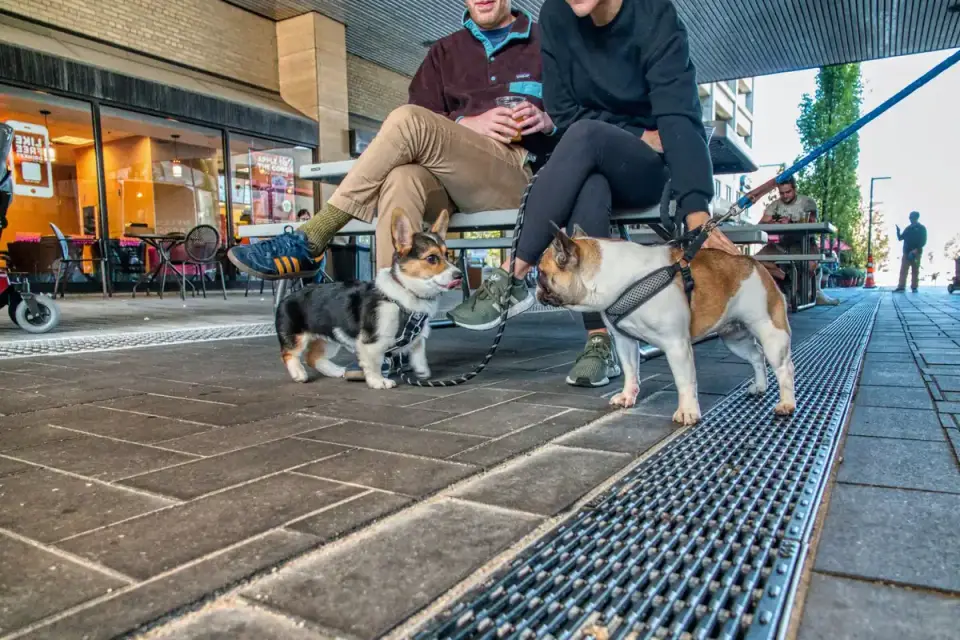
One client tried the opposite for three weeks with a 1-year-old, 42-pound shepherd mix: they held position on a busy trail and fed through the barking, hoping she would settle. She did not. Each pass started with whining at 60 feet, escalated to lunging by 30 feet, and by the third dog she would not take chicken at any distance for the rest of the walk. When we moved practice to an empty tennis court and used a friend as a helper at 70 feet, rewarding only quiet glances and U-turns, she could disengage in under three seconds by the end of week two. The tradeoff was clear: fewer “real world” reps, but every rep was learnable.
That failure is common. Owners think proximity equals progress. Physiology says the reverse.
When distance alone does not hold
Some dogs cannot eat outdoors, freeze, or scan constantly even at 80 feet. That usually means generalized anxiety, insufficient sleep and decompression, or too much trigger stacking that day. Do not drill through it.
Shorten the session to two minutes of scatter feeding in grass, increase distance, or quit and try the next morning. Counterconditioning and desensitization only work when exposure stays mild and paired with something pleasant, as outlined in hospital guidance from VCA Hospitals. Flooding at full intensity is not braver training.
This is also where marker choice matters. A clicker can give sharper timing than voice for some handlers, though consistency matters more than the tool. I walk through that tradeoff in Clicker vs Verbal Marker Word: Which One Should You Actually Use?. And if your household cues are inconsistent, fix that first with help from Common Dog Training Mistakes Beginners Make.
A 6-year-old, 24-pound terrier I followed taught me the edge case. He was perfect with calm helper dogs by day 14, passing at 25 feet with a single check-in. Then a loose off-leash dog rushed him at a park entrance and he regressed for four days, barking at dogs he had previously ignored. We did not restart at 25 feet. We rebuilt at 60 feet with parallel walking and no direct approaches, and added a visual barrier — a parked car — for the first two sessions back. For sensitive dogs, one scary event resets the baseline, and your plan has to respect that timeline.
Progress is not linear.
What I want you to do tomorrow
Pick one quiet spot. Work for five minutes. End while your dog can still succeed.
Keep the same rubric every day: fit of your gear, comfort of the distance, durability of the check-in pattern, and value per rep. If passes fall apart, add distance before you add correction. If your dog offers eye contact unprompted, pay it well.
Could you trade one frustrating neighborhood loop this week for three short setups where your dog actually learns?
Frequently asked questions
How close should the other dog be when we start?
Start where your dog notices the trigger but can still eat, move, and turn away — often 40 to 80 feet for reactive dogs. If he cannot take treats or keeps fixating, add distance.
What if my dog will not take treats outside?
He is likely over threshold or too stressed to learn. Increase distance, try higher-value soft treats in tiny pieces, or end the session and practice engagement without triggers first.
Should I let dogs greet on leash to get it over with?
For most reactive dogs, no. On-leash greetings restrict movement and raise arousal. Teach calm pass-bys with an arc and distance first.
Sources
- Position Statements — AVSAB
- Social Behavior of Dogs — Merck Veterinary Manual