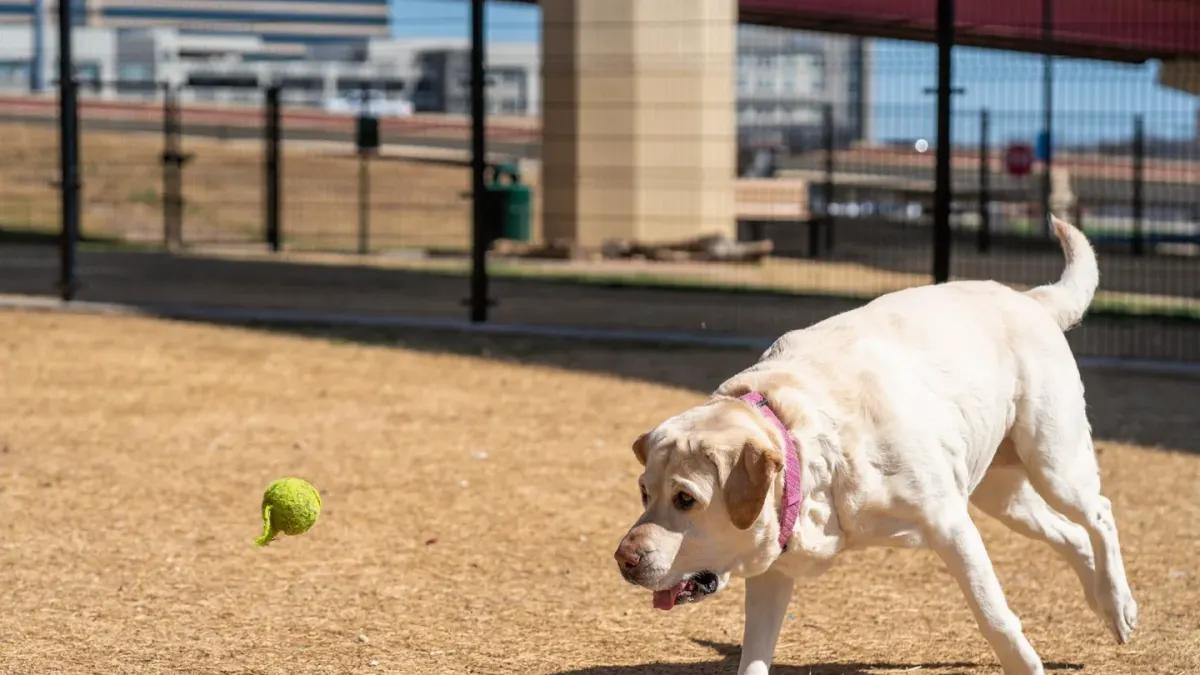
Every fetch session is a fork in the road: reach for the classic fuzzy tennis ball, or grab a solid rubber one. Most owners never think twice about which they pick. I do, and not because one is “bad” and the other is “good” — because they fail in genuinely different ways, and which failure mode matters more depends on the dog in front of you.
I remember a seven-year-old Labrador, Otis, who came into my practice for a routine dental. His owner was stunned when I pointed out flattened, grooved lower canines and premolars — what a lot of us in dental medicine just call tennis ball mouth. Otis had chased the same brand of tennis ball three or four times a day, rain or shine, for most of his life. He wasn’t in obvious pain day to day, but the enamel wear was advanced enough that we talked seriously about switching his fetch routine entirely, not just trimming it back. His owner’s first question was the one I hear constantly: “But he loves it — what do I throw instead?”
What actually wears a tennis ball down — and what it wears down in return
The felt covering on a tennis ball is designed to grip a hard court, and that same texture works like fine sandpaper against tooth enamel. As dogs carry, chew, and repeatedly clamp down on the fuzz, that abrasive surface gradually blunts the crowns of the canines and premolars — a pattern well documented enough that dentistry-focused veterinary sites, including Animal Care Clinic, describe visible tennis-ball-shaped grooves on the chewing surfaces of affected teeth. Dirt and grit embedded in the fuzz make this worse, not better — a ball dragged through sand or gravel is effectively picking up its own abrasive coating between throws. This is a slow, cumulative injury. It won’t show up after one afternoon of fetch; it shows up after years of it, which is exactly why it’s easy to miss until a dental exam flags it.
Rubber balls sidestep that particular problem almost entirely. A smooth or lightly textured rubber surface doesn’t have the felt nap that grinds against enamel, so dogs who chew or carry the ball between throws aren’t sanding their teeth down the same way. The tradeoff moves to a different kind of risk.
Where rubber balls get dangerous — and it’s not durability
The real hazard with rubber balls isn’t that they break; it’s that some of them are sized to fit exactly where they shouldn’t. The Center for Pet Safety has specifically warned that many mass-market rubber ball toys sold in big-box stores are around 2.5 inches in diameter — a size that can lodge in the airway of a medium or large dog and cause a genuine choking emergency, not just a vomiting scare. Their guidance is blunt: solid or semi-solid rubber balls that are smooth, heavy, or undersized for the dog should be pulled from rotation. A ball has to be wide enough that a dog physically cannot close their jaw around it and pull it past the back of the throat with one hard inhale during an excited retrieve.

Tennis balls have their own version of this risk in small and toy breeds — a standard tennis ball can be swallowed or become lodged in a small dog’s throat in a way it simply can’t in a Labrador. So size-matching isn’t a rubber-ball-only conversation; it applies to both categories, just for dogs at opposite ends of the size spectrum. The American Kennel Club recommends supervising fetch sessions and retiring any ball once the felt is worn thin or the rubber shows cracking, because a compromised surface is more likely to shed pieces a dog can swallow.
I’ve watched this play out from the other side too. A client with a nine-month-old Border Collie mix, Piper, switched to a large, solid rubber ball specifically because Piper had already worn through two tennis balls in about six weeks of daily obsessive fetch — chewing them to shreds between throws rather than just carrying them. The rubber ball held up, but Piper’s owner had picked one sized generously for an adult dog closer to 50 pounds, well past the golf-ball-for-small-dogs, few-inches-for-medium-dogs range that keeps a ball from ever reaching the back of the throat. That’s the piece worth weighing before the material question even comes up: does this specific ball fit this specific dog’s mouth with real margin, not just enough to seem snug.
How to actually decide, dog by dog
I think about this less as “tennis ball versus rubber ball” and more as matching the tool to the dog’s play style, because the two failure modes — slow dental wear versus acute choking risk — trade off differently depending on how a dog plays.
- Heavy chewers who mouth the ball between throws: lean rubber, sized so it can’t be closed inside the jaw, and inspected regularly for cracks or chunks missing.
- Dogs who only ever carry or nose a ball, never gnaw it: a tennis ball’s dental risk is lower, though it still climbs with years of use and should factor into cleanliness — dirty, gritty felt is worse for teeth than a clean one, which is part of why the how to clean and disinfect dog toys routine matters for balls specifically, not just chew toys.
- Small and toy breeds: oversized rubber or tennis balls that physically can’t reach the airway beat “regular size” of either material.
- Senior dogs with existing dental disease: rubber is the more conservative pick, since enamel that’s already thin from age or prior wear has less margin left to lose.
None of this means retiring tennis balls outright for every dog — plenty of dogs play with them their whole lives without meaningful dental consequences, especially if the balls are kept relatively clean and swapped out before they get gritty or shredded. It’s a matter of degree, weighed against how a given dog actually uses the ball, not a blanket verdict either way.
By the time Otis came in for his recheck, his owner had rotated in a large rubber ball for daily fetch and kept a tennis ball on hand only for lower-intensity backyard time, cleaned regularly per the routine above. The wear on his teeth didn’t reverse, but it stopped progressing at the same rate — which, for a dog that age, was the realistic goal. If your own dog treats fetch like a full-contact sport rather than a light retrieve, and you’re weighing which ball to hand them next, the honest answer is to size it first and pick the material second. What does your dog actually do with the ball once it’s in her mouth?
If you’re building out a fuller toy rotation, this pairs naturally with thinking through interactive toys vs. chew toys and, for puppies specifically, knowing when puppies stop teething and need different toys, since a teething puppy’s mouth handles both materials very differently than an adult dog’s does.
Frequently asked questions
Are tennis balls bad for all dogs' teeth?
Not universally — the risk climbs with how often and how hard a dog chews the ball, and how gritty or worn the felt gets, rather than being an automatic problem for every dog.
What size ball is safest for my dog?
A ball should be wide enough that your dog cannot close their jaw fully around it. The Center for Pet Safety specifically flags common 2.5-inch rubber balls as risky for many medium and large dogs.
Can rubber balls damage teeth too?
They're far less abrasive than felt-covered tennis balls, but any hard ball can still contribute to fractured teeth in dogs who bite down on it aggressively rather than carrying it.
Sources
- Are Tennis Balls Safe for Dogs? — American Kennel Club
- Tennis Balls & Teeth Wear — Animal Care Clinic
- Warning: Ball Toys for Dogs Can Cause Choking — Center for Pet Safety