On this page
A Lab mix named Otis, three years old and about sixty-five pounds, used to make his owner freeze every time he wrestled with the neighbor’s dog. He’d growl low, mouth wide open, and pin the other dog’s shoulder with his paw. She’d call him off, worried it was about to turn into a fight. It never did. What she was hearing was a play growl, and what she needed was a five-second checklist, not a leash yank.
That’s the fork most owners are standing at when they ask me about growling: is this dog having fun, or is this dog telling me to back off? The two sounds can be nearly identical in pitch. The difference is almost never in the growl itself — it’s in everything happening around it.
Start with the body, not the sound
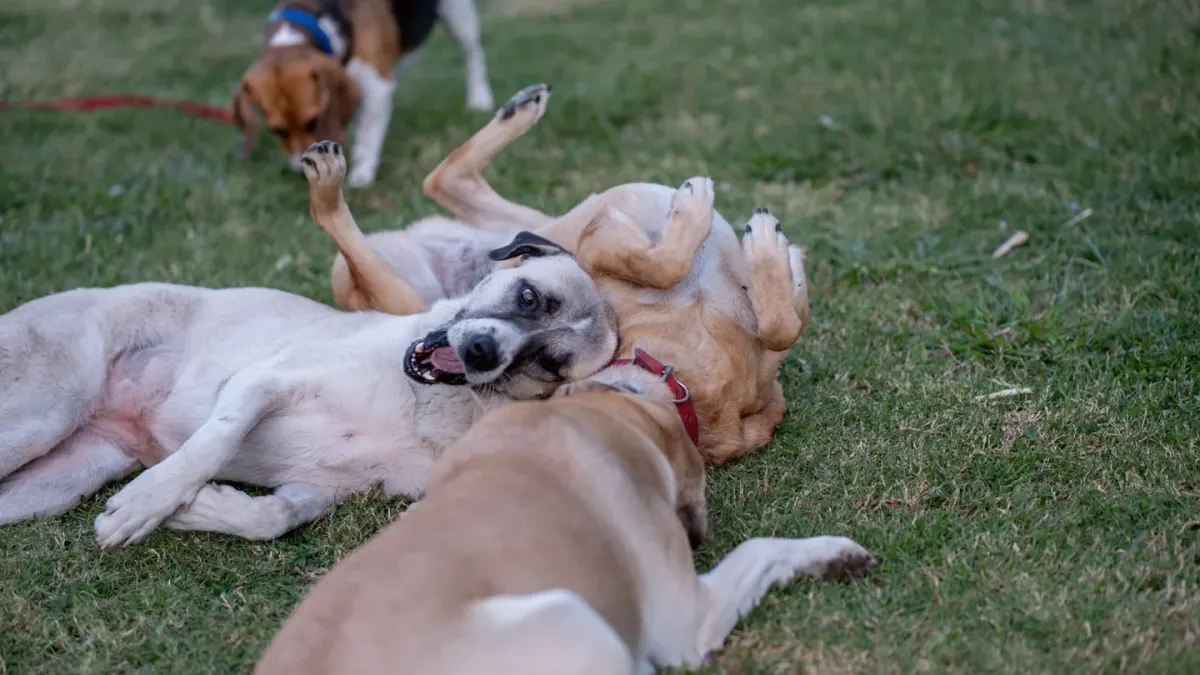
I tell clients to mute the growl mentally and just watch the rest of the dog for two or three seconds. A play growl travels with loose, exaggerated movement: a bouncy gait, a play bow with the front end down and rear end up, big open-mouth “play face,” and repeated self-interruption — the dog will growl, back off, then dive back in. A warning growl travels with stillness or stiffness: a closed or tight mouth between growls, weight shifted back or frozen in place, whale eye (the whites showing at the corner), ears pinned or held rigid, and a tail that’s either tucked or held high and stiff rather than loose and wagging.
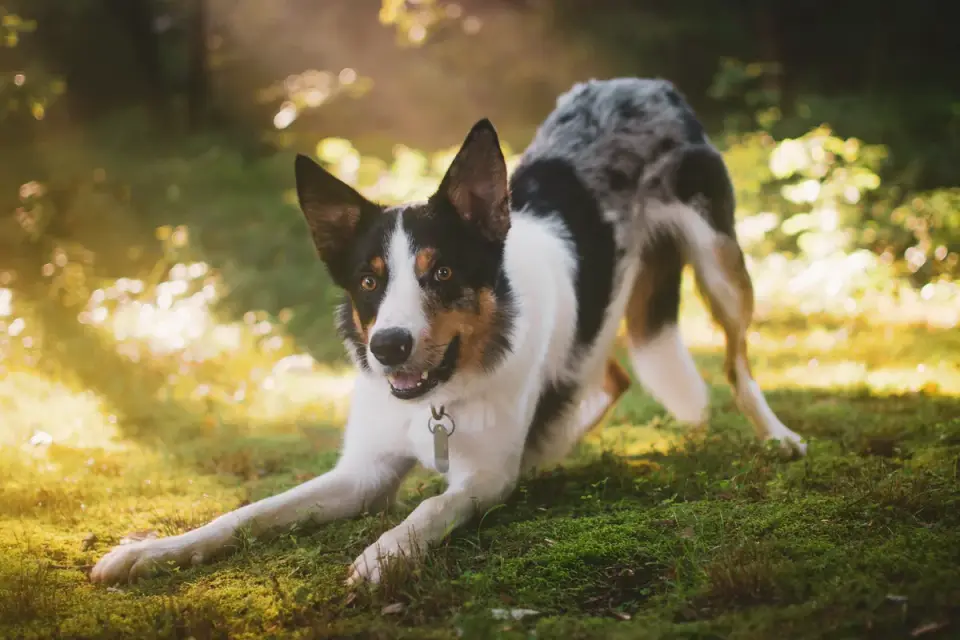
If you only remember one rule from this article, make it this one: play growling escalates and de-escalates on its own within a few seconds, and the dogs keep choosing to stay close to each other. Warning growling doesn’t reset — it holds, or it climbs, and the growling dog is trying to increase distance, not decrease it.
Pitch and rhythm carry real information too
Play growls tend to be more variable — rising and falling in pitch, sometimes almost sing-song, often mixed with play barks or that odd guttural “grumbling” some breeds do while tugging a rope toy. Warning growls are usually flatter and more sustained, a steady low rumble that doesn’t waver much. It’s not a perfect rule; some dogs are naturally growly players and sound more serious than they are. That’s exactly why body language has to be the tiebreaker, not the sound in isolation.
In my practice, I’ve watched this play out most often with owners of bully breeds and terriers, who tend to be vocal, physical players and get flagged by well-meaning strangers at the dog park as “aggressive” when they’re having the time of their life. One owner I worked with had a two-year-old Staffordshire mix, Cash, who growled almost constantly during play — deep, loud, and continuous. She’d been told by three different people at the park that he was “too much.” What she actually had was a dog with a soft mouth, loose hips, and a partner dog who kept coming back for more. We watched video together frame by frame: play bow, growl, bounce back, repeat, tail up and loose the entire time. Nothing about it matched a warning pattern. The growl was noise. The behavior around it was the answer.
Where the two get genuinely confusing
The gray zone is real, and I don’t want to pretend it isn’t. Play can tip into overstimulation, especially with young or high-energy dogs, and a play growl can shift into a real warning growl within the same session if one dog gets overwhelmed. Watch for the moment a dog stops initiating and starts avoiding — turning away, moving behind furniture or a person, or repeatedly trying to create distance while the other dog keeps pressing. That shift, more than any single growl, is the signal to step in and separate the dogs for a breather. This is also the exact pattern to watch for with a newly adopted dog still settling in; the What Is the 3-3-3 Rule for Rescue Dogs? guide covers why a rescue dog’s early growls often read as more serious than they are simply because the dog hasn’t built trust yet.
A warning growl aimed at a person, rather than another dog, deserves its own read. If your dog growls when you reach toward him during petting, cuddling, or a nail trim, that’s a different situation than dog-dog play, and it’s worth walking through separately — our piece on Why Does My Dog Growl When I Pet Him? breaks down the pain-driven and fear-driven versions of that specific growl and how to respond in the moment.
What I actually tell owners to do about it
If the body is loose and the dogs keep returning to each other, let the growl happen — it’s part of normal canine communication, and dogs who are never allowed to growl during play don’t stop feeling the impulse, they just lose an early warning system they might need later in a genuinely tense moment. If the body is stiff, the eyes are hard, or one dog is clearly trying to leave and can’t, separate them calmly without punishing the growl itself. Punishing a warning growl doesn’t remove the discomfort behind it; it just teaches the dog to skip the warning next time, which is a worse outcome for everyone in the room.
For dogs who run hot in general — the ones who seem perpetually keyed up around other dogs, new people, or a busy household — some owners look at calming support as one piece of a broader plan alongside training and management. The evidence there is real but modest and mostly about lowering baseline stress, not a fix for reading growls correctly. A 2026 review in Biomedicines notes that for chamomile’s use in anxiety and stress, “for the remaining species, evidence is derived mainly from preclinical studies or traditional use,” which is a fair summary of where a lot of calming-ingredient research still sits. A systematic review in Cureus found that KSM-66 ashwagandha “has a moderate positive impact on stress reduction and cognitive performance” across multiple RCTs, though that body of work is heavily weighted toward human studies. And a review in Molecular Psychiatry on L-theanine found a meaningful effect in one study on anxiety at a dose of 400 mg/day for 8 weeks — again, human data, not a canine dosing guide. None of that changes how you should read a growl in the moment; it’s context for owners managing a generally anxious dog long-term.
A dog who startles easily and growls defensively at sudden loud noises — like a garbage truck rumbling by — is often dealing with sound sensitivity rather than a behavior problem, and it’s worth ruling that out before assuming every growl is about play or dominance; see My Dog Panics at the Sound of the Garbage Truck for how that fear response typically looks.
I still see owners hesitate here, worried that reading it wrong even once could matter more than it does. It usually won’t, as long as you’re watching the whole dog and not just listening for a sound that, by itself, was never going to tell you the whole story.
When to call in a professional
If you genuinely can’t tell which growl you’re hearing, if the growling escalates into snapping or biting, or if one dog in the pair seems consistently unable to get away from the other, that’s the point to bring in a certified trainer or veterinary behaviorist rather than guessing. Otis, the Lab mix from the start of this piece, never needed one — his growl was just noise wrapped around a very good time. Cash didn’t either. But plenty of dogs do, and there’s no harm in getting a second, trained set of eyes on a pattern that worries you.
So which is it — the loose, bouncy dog growling through a game of tug, or the still, stiff dog trying to put distance between himself and whatever’s in front of him? Once you’re watching for the whole picture instead of just listening, most owners find the answer is louder than the growl itself.
Frequently asked questions
Can a play growl turn into a real fight?
It can, especially if one dog gets overstimulated. Watch for the moment a dog stops initiating contact and starts trying to leave — that shift is more telling than any single growl, and it's the cue to separate the dogs for a break.
Should I correct my dog for growling?
Generally no, especially for a warning growl. Punishing the growl doesn't resolve the discomfort causing it — it just risks removing the warning signal, which can make a future situation harder to read, not safer.
Do some breeds growl more during play than others?
Yes. Bully breeds, terriers, and some herding dogs tend to be more vocal players, with growls, grumbles, and play barks layered together. Loudness alone isn't a reliable sign of a warning growl — body language still is.
Sources
- Chamomile in Human Diseases: A Narrative Review of Clinical Trials — Biomedicines
- KSM-66 Ashwagandha and Stress: A Systematic Review — Cureus
- L-Theanine and Anxiety: A Review — Molecular Psychiatry