On this page
Here’s the fork most owners land on at the dog park: two dogs are body-slamming each other, growling, mouths wide open, and you have about two seconds to decide whether to laugh or intervene. Get it wrong in either direction and you either yank two happily playing dogs apart for no reason, or you stand there narrating “oh, they’re fine” while a real fight develops.
In my practice, I’ve watched this play out dozens of times in the waiting room and the exam parking lot, which turns out to be a surprisingly good place to observe dog body language because everyone is a little tense. I remember a 14-month-old Vizsla named Otto whose owner brought him in convinced he was “aggressive” after a dog park incident. She’d seen him pin another dog to the ground, growling, and pulled him off immediately. When we walked through what happened second by second — Otto had done a full play bow before the chase started, the other dog kept coming back for more after being pinned, and both dogs’ tails were up and loose the whole time — it became clear this was rough play, not a fight. The tell wasn’t the pinning itself. It was that the “victim” dog kept re-initiating within seconds of being released.
The signals that separate play from a fight
Real play has a grammar to it, and once you know the vocabulary you stop needing to guess. The play bow — front legs stretched out flat, rear end in the air, tail loose — is the clearest single signal in the canine repertoire, and it usually shows up at the start of an interaction or as a reset in the middle of one. Watch for it bracketing the rougher moments: a dog that bows, then body-slams, then bows again is telling you the slam was play.
Self-handicapping is the second big tell. A 70-pound dog playing with a 20-pound dog who deliberately flops onto his back, slows his chase, or lets the smaller dog “win” a wrestling match is regulating his own strength on purpose. Dogs in a real conflict don’t do this. Neither do they take turns — genuine play involves role reversal, where the chaser becomes the chased and the pinner becomes the pinned, usually within the same session.
Then there’s the sound. Growling during play can be loud and can sound alarming to a new owner, but play growls tend to be higher-pitched, shorter, and paired with a loose, wiggly body. A growl tied to a stiff, still body, hard eye contact, or a closed mouth is a very different signal — that’s a warning, not an invitation.
Pauses matter more than intensity
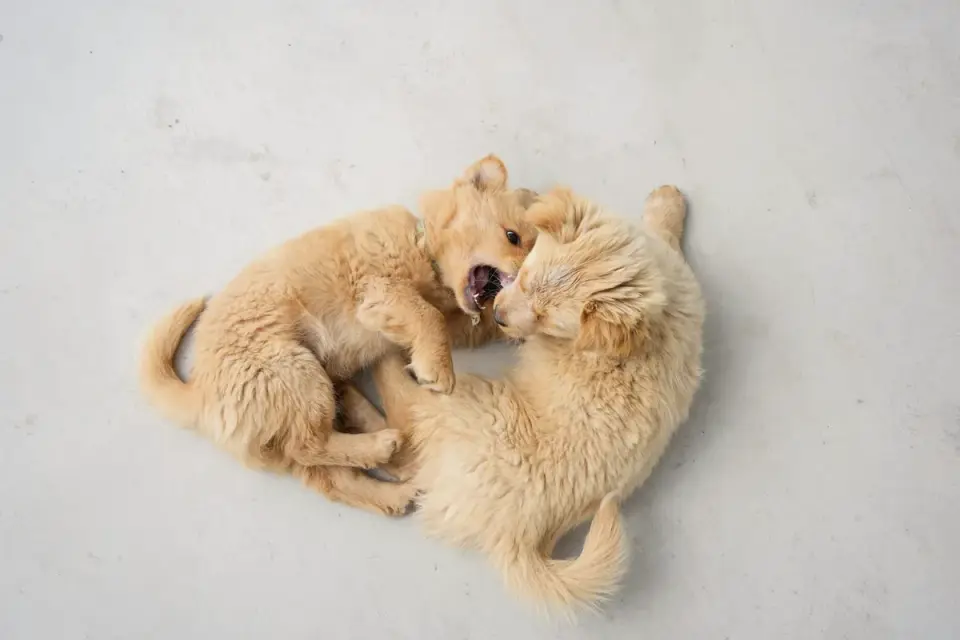
If I had to give owners one rule to take home, it’s this: watch for the pause, not the noise. Play that’s genuinely mutual includes natural breaks — a few seconds where both dogs shake off, sniff the ground, or trot a short distance apart before diving back in. Those micro-breaks are a form of consent-checking, and dogs use them constantly during healthy play. A fight, by contrast, doesn’t self-interrupt. It escalates, and if you try to insert a pause by calling the dogs or making noise, one or both dogs will ignore you or turn on whoever tries to intervene.
Body stiffness is the other reliable marker. Play is loose — bouncy gaits, relaxed ears, tails that wag in broad sweeps rather than held high and vibrating. A dog heading toward real aggression goes still first: weight shifted forward, tail high and stiff, hackles up along the whole spine rather than just the shoulders, and a hard, fixed stare instead of the darting, playful eye contact you see in a bow-and-chase sequence.
I keep a short mental checklist for owners who are anxious about their dog’s play style, because most of the “aggression” calls I get turn out to be normal rough play between dogs who are well matched in size and experience:
- Does either dog freeze completely, or does the action stay loose and bouncy?
- Are both dogs coming back for more, or is one trying to escape and being followed?
- Is there a play bow anywhere in the sequence, especially near the start?
- Do the dogs self-interrupt with sniffing, shake-offs, or a brief separation?
- Is the bigger or stronger dog visibly self-handicapping?
If the answers point toward mutual, bouncy, self-interrupting play, you’re almost always looking at exactly that. If a dog is trying to leave and can’t, if the body goes rigid and quiet, or if there’s no play bow anywhere in the interaction, that’s the moment to step in calmly rather than wait and see.
Why some dogs read signals poorly — and what actually helps
Some of this comes down to socialization history rather than temperament. Dogs who missed the critical socialization window between about three and fourteen weeks, or who had a bad experience at a dog park early on, sometimes struggle to read or send these signals accurately. They might play too rough without realizing it, or misread another dog’s play bow as a threat. That’s a training and exposure problem, not a character flaw, and it’s usually workable with structured, low-stress introductions rather than avoidance.
For dogs who get overaroused quickly during play — the ones who start appropriately, then escalate past the point of self-regulation — owners often ask what else might help take the edge off before a stressful encounter, like a park visit or a new dog introduction. The honest answer is that supplements are a minor supporting piece, not a fix for reading skills or training gaps. Biomedicines notes that for many calming botanicals used in companion animals, “for the remaining species, evidence is derived mainly from preclinical studies or traditional use,” which is a fair summary of where a lot of this category actually stands. A systematic review in Cureus looking at ashwagandha found that it “has a moderate positive impact on stress reduction and cognitive performance” across multiple human RCTs, and L-theanine has shown a comparable effect in at least one study, per a review noting a benefit “except for one study on psychotic anxiety (SMD = 0.54; 400 mg/day for 8 weeks),” as reported in Molecular Psychiatry. None of that replaces reading the dog in front of you, but it’s a reasonable, evidence-bounded reason not to dismiss the category outright either.
If a dog’s arousal during play is a recurring issue rather than an occasional overshoot, that’s worth working on directly. Owners dealing with a dog who reads social cues poorly across contexts, not just at the dog park, may find useful groundwork in a guide to why dogs growl when petted, since the underlying skill — reading a dog’s threshold before it’s crossed — is the same one this topic depends on.
A case where it went the other way
Not every rough interaction is fine, and I want to be honest about that. I once worked with a household running two dogs, a 6-year-old spayed female Cattle Dog mix and a newly adopted 2-year-old male Shepherd mix, about three weeks after the second dog came home. What looked like play at first — chasing, some vocalizing — had no bows, no self-interrupting, and the older female was consistently trying to get to higher ground on the couch or behind a chair to get away. The owner had been treating it as normal adjustment friction because “they’re just figuring out the pecking order.” By the time she called, the female had a small puncture wound near her ear. We separated the dogs, reset the introduction using leashes, short structured sessions, and a lot more supervision, and things improved over the following weeks — but that outcome came from changing the management, not from waiting it out. The lesson I give every owner in that spot: if one dog is repeatedly trying to leave and being followed, that is not play regardless of how “mutual” it looks on the surface.
That kind of full reset — separate the dogs, reintroduce slowly on leash, and rebuild trust in short sessions — draws on the same principles used for dogs who need more structured social reintroduction generally, including some of what’s outlined in a guide to the 3-3-3 rule for a new rescue dog, which covers pacing expectations during that early adjustment window.
The bottom line
Watch the pause, not the volume. Genuine dog play is loud, physical, and can look alarming to someone who’s never learned the vocabulary — but it self-interrupts, includes role reversal and self-handicapping, and almost always features a play bow somewhere in the sequence. A real fight doesn’t pause on its own, doesn’t reverse roles, and comes with a stiff, quiet body rather than a loose, bouncy one. If you’re ever genuinely unsure and one dog can’t get away, that uncertainty is itself the signal to step in.
Frequently asked questions
Is growling always a bad sign during dog play?
Not necessarily. Play growls tend to be higher-pitched and paired with a loose, wiggly body. A growl paired with a stiff body, hard stare, or closed mouth is a different, more serious signal worth stepping in on.
What's the fastest way to tell if I need to intervene?
Check whether one dog is repeatedly trying to leave and being followed, and whether the interaction pauses on its own. No self-interrupting plus one dog seeking distance is the clearest sign to separate them.