On this page
Here’s the fork almost every owner hits: force the crate now and deal with the fallout later, or go slow and deal with a few rough nights up front. I’ve counseled clients through both, and I land firmly on the second — not because it’s gentler in some abstract sense, but because it’s faster in the way that actually matters, which is permanently.
In my practice, one of the dogs I still think about is a nine-month-old Shepherd mix named Ranger, about 55 pounds, whose owners had tried crating him cold on night one — closed the door, left for work eight hours later, came home to a crate with bent bars at the door seam and a dog who was drenched in sweat and wouldn’t go near it again for a week. What they’d first noticed wasn’t fear exactly; it was refusal. Ranger would sit at the crate opening and simply not cross the threshold, ears back, weight shifted onto his hindquarters like he was bracing to bolt. We rebuilt from zero: crate in the living room, door removed entirely for the first four days, meals fed just inside the doorway and then progressively deeper. It took about three weeks before he’d nap in there on his own with the door open, and closer to six before he’d settle through a closed door for an hour. The owners’ tradeoff was real — six weeks of managing him loose or tethered instead of crated — but it held.
Why the fast-track method backfires
The instinct to just get it over with is understandable. Nobody wants a multi-week project for what looks like a metal box. But a crate that’s introduced as a place where scary things happen — being shut in, being left, being ignored while whining — teaches a dog that the crate itself is the threat. Once that association forms, you’re not troubleshooting a crate problem anymore; you’re troubleshooting a fear problem, and fear generalizes. Dogs that panic in crates often start panicking in cars, in vet waiting rooms, in any small enclosed space, because the nervous system doesn’t file “crate” as a narrow category.
This is the core of what the AVSAB position on humane training gets right for crate work specifically: reward-based, gradual exposure produces more reliable, longer-lasting behavior change than flooding a dog with a stressor and waiting for it to stop reacting. A dog that stops struggling in a crate isn’t necessarily comfortable — it may just be shut down, which looks like success and isn’t.
The rule I actually use with clients
I tell owners to treat the crate door like a volume knob, not a switch. Open, unlatched, latched-for-ten-seconds, latched-for-a-minute — each step only after the dog is visibly loose in the body at the step before it: sighing, resting a chin down, ears relaxed. If a dog goes rigid or starts pacing when you introduce a new step, you didn’t fail, you just moved a step too fast. Go back one.
Where the crate actually fits in a routine
A crate earns its keep as a management tool, not a punishment or an all-day storage solution. The AKC recommends starting sessions in short blocks and building duration gradually, rewarding calm behavior inside the crate rather than just tolerance of the door closing. That’s a meaningful distinction — a dog that’s quiet because it’s given up is different from a dog that’s quiet because it’s genuinely settled, and only the second one holds up over months.
Feeding meals in the crate is one of the more efficient tools here, because it converts a neutral or negative space into one tied to something the dog already wants three times a day. The ASPCA Pet Insurance: ASPCA recommends starting with treats scattered near, then just inside, then fully inside the crate, before progressing to full meals eaten there — a sequence that respects the dog’s pace rather than the owner’s schedule.
Reading the signs between sessions
Whining in the first few sessions isn’t automatically a red flag — it’s information. A dog who whines for thirty seconds after the door closes and then lies down is adjusting. A dog who escalates for ten straight minutes, drools, or scrabbles at the door hardware is telling you the step was too big. The difference matters because owners who wait out the second kind of episode, thinking they’re “not giving in,” often reinforce the exact panic response they’re trying to avoid — the dog eventually goes quiet from exhaustion, not comfort, and the fear resets the next session.
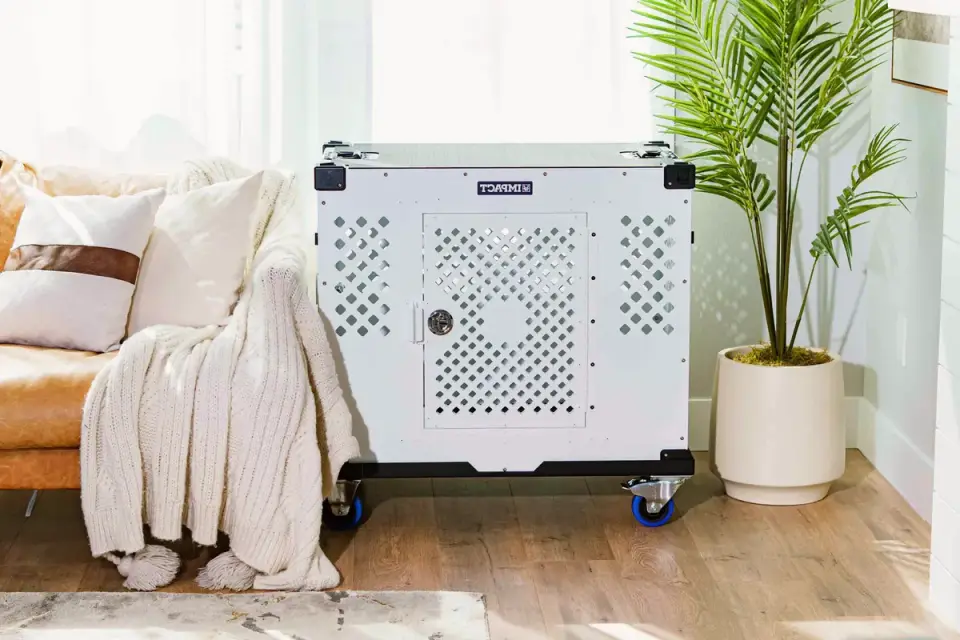
This is also where crate size gets underrated as a variable. A crate too large lets a dog use one end as a bathroom and the other as a bed, undermining the potty-training value entirely; this pairs naturally with the schedule side of house-training covered in A Puppy Potty-Training Schedule That Works. A crate too small creates physical discomfort that gets misread as behavioral resistance. The dog should be able to stand, turn around, and lie flat without touching the sides.
When the schedule stalls out
Plateaus happen, usually around the two-week mark, when the novelty of treats wears thin and duration is climbing. If a dog that was previously fine suddenly regresses, look first at what changed around the crate — a new latch sound, a different room, a schedule shift — before assuming the dog is “testing” you. Dogs mostly aren’t strategizing; they’re reacting to a variable you haven’t isolated yet.
I’ve watched this play out with a rescue Beagle named Daisy, roughly four years old and about 22 pounds, whose owners had crate training going smoothly for ten days and then hit a wall the exact week they switched her crate from the bedroom to a spare room downstairs. She went from settling within two minutes to barking for twenty. Nothing about the crate itself had changed — the variable was isolation, not confinement, since she’d been sleeping near people her whole life in the shelter and prior foster home. Moving the crate back upstairs next to the bed solved most of it within days, and only after several more weeks of steady, uneventful nights did they attempt the downstairs move again, this time in shorter blocks. The lesson I give owners from cases like hers: don’t assume the crate is the variable that broke. Isolation, sound, and schedule changes cause regressions just as often as anything about the crate hardware itself.
This is closely related to how reward timing and clarity affect any behavior work, which is worth understanding if you’re building crate cues alongside other training — see Clicker vs Verbal Marker Word for how a consistent marker can speed up the “good, that’s the behavior” moment during crate sessions.
Where I land, and the counterargument I take seriously
The counterargument to slow desensitization is real: some dogs need to be crated sooner than a six-week timeline allows — for surgery recovery, for a move, for a landlord’s insurance requirement. In those cases, I don’t pretend gradual is always possible. What I tell those owners instead is to compress the steps but not skip them, and to accept a higher baseline of stress during the compressed window rather than pretending it isn’t happening. That’s different from the fast-track approach that assumes the dog will “just get used to it” with no plan for the distress in between.
Where I land for the majority of owners, who don’t have a hard deadline: go slow, feed in the crate, watch the body language more than the clock, and treat a plateau as information rather than defiance. If you’re working with a trainer on this alongside other foundational skills, it’s worth confirming their approach lines up with reward-based methods described in How to Choose a Qualified Dog Trainer — crate work is exactly the kind of sensitive, easy-to-botch process where a trainer’s actual methodology matters more than their marketing.
The bottom line
A crate a dog loves is built the boring way: short sessions, food, a door that opens more than it closes for the first couple of weeks, and steps small enough that setbacks are rare instead of routine. It typically takes two to six weeks depending on the dog’s temperament and prior experience, sometimes longer for a dog with an existing bad association. That’s a real cost. It’s also the version that sticks.
Frequently asked questions
How long does it take for a dog to like their crate?
Most dogs show real comfort — settling with the door closed for an hour or more — within two to six weeks of consistent, gradual sessions. Dogs with an existing negative association can take longer.
Should I let my dog cry it out in the crate?
Brief settling whines in the first minute or two are normal, but prolonged escalating distress usually means the step was too big, not that the dog needs to "get used to it." Scale back to the last comfortable step.
Is it okay to feed my dog's meals in the crate?
Yes — feeding meals inside the crate, starting near the doorway and moving deeper, is one of the more effective ways to build a positive association, per ASPCA guidance.
Sources
- Position Statement on Humane Dog Training — AVSAB
- How to Crate Train Your Dog: Expert Tips for Every Age — AKC
- How to Crate Train a Puppy — ASPCA Pet Insurance