On this page
Quick checklist before you pick up the rope:
- Your dog reliably drops the toy on cue (“out” or “drop it”) before you start.
- Sessions run short — roughly 10 to 15 seconds per bout, with a clear stop.
- You initiate the game and end it, not the dog.
- Your dog doesn’t guard toys, food, or other objects.
- Your dog can settle within a minute or two after a bout, not stay wound up.
- Small kids aren’t holding the other end of the rope.
If most of those are true, tug is a reasonable game. If several aren’t, it’s worth working on those pieces first — or skipping tug for a different outlet.
The fork most owners are actually standing at
A dog owner asks their trainer, or their vet, or a well-meaning relative, whether tug is going to make their dog aggressive. The honest answer isn’t a flat yes or no — it’s “it depends on how you play it and which dog you’re playing it with.” That’s a less satisfying answer than a headline, but it’s the accurate one, and it’s the one I give in an exam room.
In my practice, the dogs I worry about during tug aren’t the ones tugging hard — that’s normal play arousal. It’s the dogs who won’t let go, who stiffen or go still when you reach toward the toy, or who started the game themselves by shoving a rope into your hand and then guarding it when you tried to take it back. I had a client with a two-year-old Belgian Malinois, an intense, drivey dog who loved tug more than food, more than walks, more than almost anything. The owner had noticed over about three weeks that the dog was starting to growl low in his chest whenever she reached for the toy at the end of a session, and that he’d started guarding his food bowl too around the same time. That wasn’t a tug problem exactly — it was an emerging resource-guarding pattern that tug was surfacing, and the fix wasn’t to quit the game, it was to rebuild the rules: she started the game, she called the stop, and he had to release on cue before the toy came back out. Within a few weeks the growling at the toy handoff had stopped.
What the actual behavior research shows
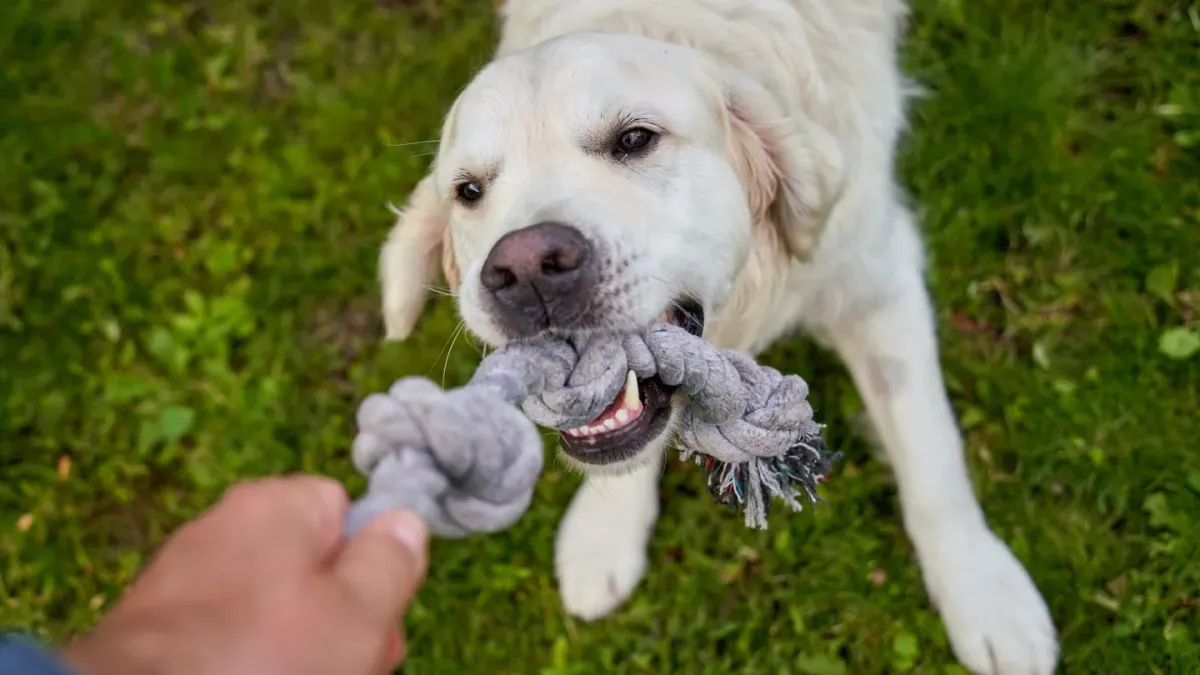
The old idea that tug makes a dog “dominant” or teaches it to challenge its owner doesn’t hold up. Research on tug-of-war play has found the game itself isn’t associated with increased aggression, and dogs that play tug with their owners tend to show more confident interaction, not less, according to AKC. The variable that actually predicts problems isn’t the game — it’s who’s setting the terms. Dogs that are allowed to initiate tug on their own terms and never given rules around starting or stopping tend to be more reactive and less responsive during play than dogs whose owners control when the game begins and ends.
That distinction matters more than the game itself. A rope toy is not a dominance contest. It’s a form of predatory-motor play that taps into a dog’s natural grab-and-pull instincts, and like any high-arousal activity, it needs structure, not avoidance.
Where tug genuinely helps
Played with rules, tug is a legitimate training tool, not just a way to burn energy. Teaching a dog to release a high-value object on cue — mid-arousal, mid-game — is a harder and more useful impulse-control exercise than almost anything you can practice with a bowl of kibble on a quiet afternoon, as noted by Preventive Vet. That skill transfers: a dog who can drop a coveted toy on command is generally easier to redirect away from something dangerous on a walk, too.
It’s also just useful exercise for dogs whose bodies can handle it — a way to work drive and engagement into a short session rather than a long one. That’s worth factoring in the same way you’d think about a dog park versus a structured exercise session: the format matters as much as the activity.
Where I tell owners to skip it
Tug is the wrong game for a dog that’s already resource-guarding — growling, stiffening, or snapping over food, toys, or space. It’s also not the right fit for a dog that can’t settle afterward: if your dog stays wound up, mouthy, or overstimulated for twenty minutes after a bout instead of ten seconds, the game is doing more harm than good for that particular dog on that particular day. Puppies with growing joints and open growth plates are worth being gentler with too — sharp, hard yanks aren’t the same as a controlled back-and-forth, and it’s a similar logic to how you’d think about pacing any physically demanding activity for a young dog, the way you would before a first swim.
One short, single-sentence rule covers most of this: if you wouldn’t trust your dog to calmly hand over a stick, don’t hand them a tug rope yet.
The recommendation
Tug-of-war isn’t the behavioral hazard it’s sometimes made out to be, and it isn’t a free pass either. Play it with a dog who doesn’t guard objects, keep sessions short, make yourself the one who starts and stops the game, and build in a real “drop it” before you ever pick up the rope. I’ve watched the same game go two very different directions in the exam room — one dog calmer and more responsive for it, another one escalating — and the difference was never the rope. It was the rules around it, and whether the dog’s owner was paying attention to what their dog was actually telling them mid-game. If you’re not sure which side of that line your dog falls on, that’s worth working out with a trainer before the toy comes out again — what does your dog do in the ten seconds after you say “enough”?
Frequently asked questions
Does playing tug of war make a dog aggressive or dominant?
No. Behavior research hasn't found that tug play itself increases aggression; problems track with who controls the start and stop of the game, not the game itself, per AKC.
How long should a tug session last?
Short bouts, roughly 10 to 15 seconds, with a trained release cue between rounds, work better than long unstructured pulling.
Should I let my dog win at tug?
Winning or losing isn't the relevant variable — a dog reliably releasing the toy on cue and settling afterward matters more than who ends up holding the rope.
Sources
- Is Tug-of-War Bad for Dogs? — AKC
- Play Tug of War Without Encouraging Aggression — Preventive Vet