On this page
Brian throws a small red fetch ball across a sunny Miami lawn for Raya, his 4-year-old spayed female Cockapoo, and watches her run past it twice at about 20 yards before finding it by smell.
That miss is not stubbornness or poor training. Dogs have two cone types instead of three, with peak sensitivity in blue and yellow wavelengths, a pattern established in the classic canine color-vision work summarized on PubMed.
The National Eye Institute explains the general principle behind that difference: color perception depends on which cone types are present, and missing a cone type shifts reds and greens toward a similar neutral tone.
The fork: buy for your eyes or for her nose and eyes?
Shelves reward human eyes. Bright reds, oranges, and lime greens look vivid to us under store lights and photograph well for reviews.
Field performance rewards dog eyes. Against green grass, a red or orange toy falls close to background brightness and hue for a dichromatic visual system, so the dog must rely more on motion, scent, and memory of the fall area. A saturated blue or yellow toy holds luminance and chromatic contrast, so Raya can track it longer and line up the final few feet by sight.
My bias is practical: weigh what a change can realistically do for daily function and recovery from frustrating sessions. Color will not fix fit, texture preference, or chewing style, and it may help support cleaner retrieves, shorter searches, and less mouthing of sticks and debris while hunting for a lost toy.
Why red disappears and blue holds
Dogs retain excellent rod-driven night and motion vision at the cost of fine color detail. In daylight, blues around 429–435 nm and yellows around 555 nm separate cleanly, while longer red wavelengths lose distinctness.
That is why a red ball on mown grass, a rust-colored bumper in leaf litter, or an orange dummy against autumn turf all read as brownish-gray on brownish-green. A royal blue ball, a bright yellow bumper, or a blue-and-yellow striped tug keeps an edge the dog can follow.
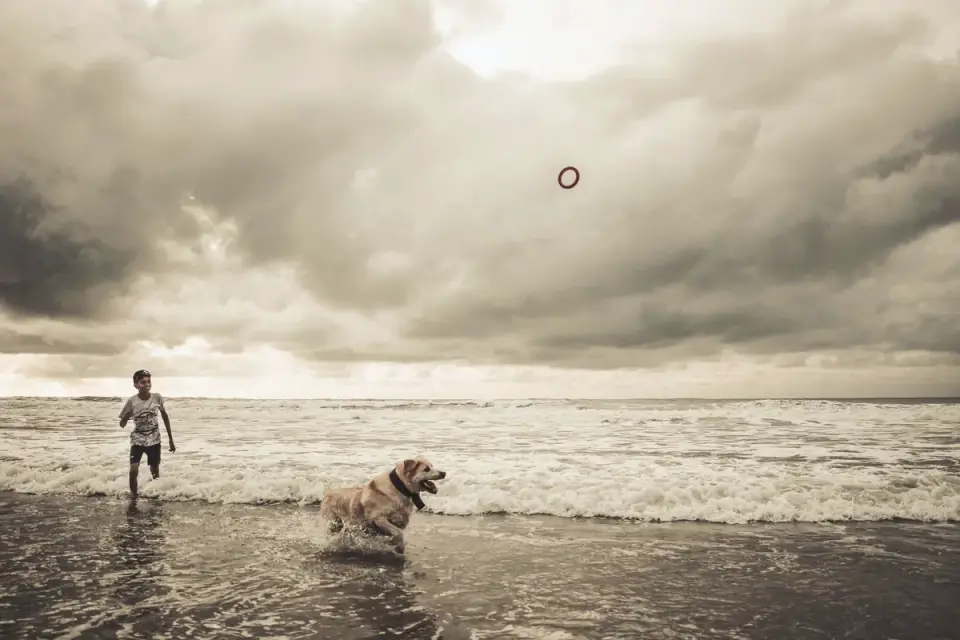
Brightness contrast matters as much as hue. A faded yellow ball bleached to off-white, or a navy toy used at dusk, loses the advantage. Choose saturated color plus a light-dark difference from the background.
What to pick for grass, water, snow, and home
For grass and woods, default to blue for fetch and yellow for search games. Blue separates best from green; yellow reads bright against shade and soil. Avoid solid red, orange, or green as the primary fetch color.
For water and beach sand, yellow and white ride higher visually against dark water, while blue can sink visually in deep water. Many owners do best with yellow with a blue band, which gives both sky-to-water and hand-to-throw contrast.
For snow and pale flooring indoors, blue wins outright. For low-light hallways, add size, squeak, and texture rather than counting on color alone, and keep night play to familiar spaces.
This is also where toy category matters more than shade. A high-contrast ball that splits in two sessions is still a poor pick. Match visibility to durability and use case first with our notes on Chew Toys vs. Edible Chews: What’s the Difference and Rope Toys vs. Plush Toys for Chewers: How to Actually Choose, then rotate textures to manage arousal with Interactive Toys vs. Chew Toys: When to Use Each.
One short test settles it.
Toss the old red toy and a blue or yellow toy of similar size to the same distance on the same grass, and count hesitations and passes before pickup.
Where I land when owners want one answer
If you buy one fetch color, buy blue. If you buy a second for variety and indoor work, add yellow. Keep reds and oranges for your gym bag, not the dog park bag, and wash toys regularly because dirt dulls contrast — see How to Clean and Disinfect Dog Toys.
Vets often see the opposite problem in winter: an owner in Rochester throwing a white plush for a dark-coated dog at dusk, then wondering why the dog quits early. Contrast, size, sound, and short, successful reps may help support motivation and joint-friendly play better than longer blind searches.
Forward-looking play is easier to sustain than perfect color theory. Pick the shade your dog can track, retire the shade that keeps getting lost, and spend the saved time on training rather than hunting in the grass.
Frequently asked questions
Are dogs color blind?
Not fully. Dogs see color through blue and yellow cone channels and distinguish those hues well, but reds, oranges, and greens look muted and similar.
What toy color is easiest for a dog to see on grass?
Saturated blue is usually easiest on green grass, with bright yellow second. Solid red, orange, and green blend in most.
Will a blue toy help if my dog still loses it?
It helps with visual tracking, but size, brightness contrast, motion, scent, and throw distance still matter. Test two similar toys side by side.
Sources
- Color vision in the dog — PubMed
- Color Blindness — National Eye Institute