
On this page
Here’s the fork most owners hit at the pet store: one carrier folds flat and has mesh windows, the other looks like a cooler with a door. Both say “airline approved” on the tag. Only one of them is actually right for what you’re planning to do.
I get some version of this question almost every week in exam rooms — usually from a client who’s booked a flight, or one who just white-knuckled a hard stop on the highway and started wondering if their dog would’ve been thrown into the footwell. Those are two different problems, and the carrier that solves one usually isn’t the carrier that solves the other.
The decision fork: cabin travel or car safety
If you’re flying with your dog in the cabin, the airline is going to want a carrier that compresses to fit under the seat in front of you — soft-sided carriers are built for exactly that. Most airlines want something in the neighborhood of 18 x 11 x 11 inches once compressed, with the combined pet-plus-bag weight under 20 pounds, according to the Chewy airline pet policy guide. That flexibility is the whole point — a rigid box either fits under the seat or it doesn’t, and there’s no give.
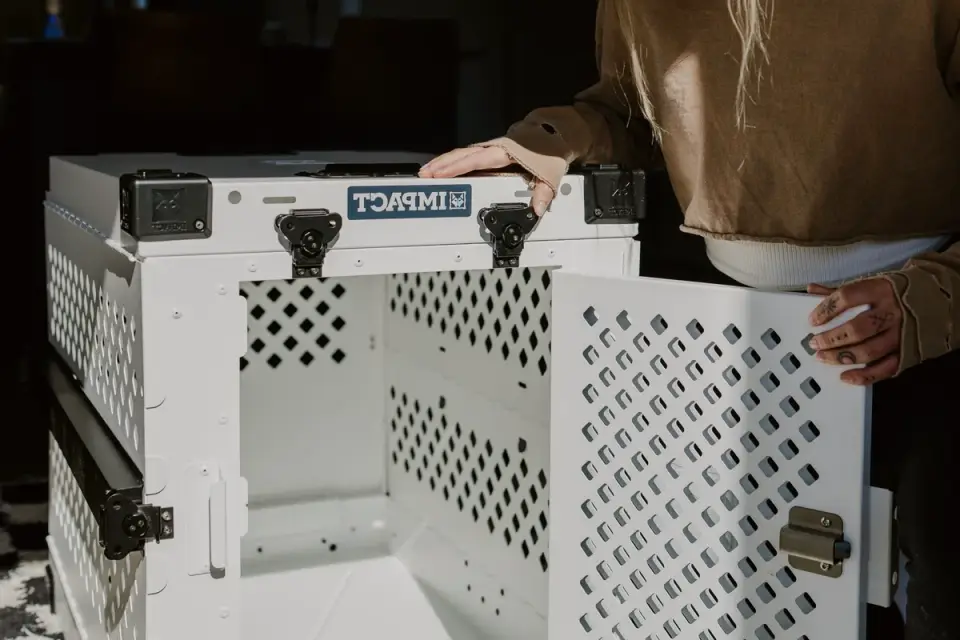
If your dog is flying as cargo, the rules flip completely. The International Air Transport Association’s Live Animal Regulations require a solid, hard-sided container — rigid plastic, fiberglass, or wood construction, metal hardware instead of plastic clips, ventilation on at least three sides with nose-and-paw-proof openings, and a secure spring-locked door, according to travel guidance summarized by NBC News. No soft-sided or collapsible carrier is allowed in the cargo hold, full stop.
For car travel, it’s a third question entirely: crash protection. This is where I see the most confusion, because “sturdy-looking” and “crash-tested” are not the same thing.
What I’ve watched happen with the wrong carrier for the trip
I had a client bring in a nine-pound terrier mix named Biscuit for a wellness visit a couple years back, and she mentioned she’d just bought a hard plastic crate specifically because she wanted “the safe one” for her daily commute — a 20-minute drive with a lot of stop-and-go traffic. What she hadn’t done was secure it to anything. It sat loose on the back seat, sliding a few inches every time she braked hard. A rigid crate that isn’t tethered down is arguably worse than a soft carrier belted in properly, because an untethered hard shell becomes its own projectile in a sudden stop. We talked through anchoring it with a cargo strap through the back seat’s LATCH points, and she switched her daily routine that week. It’s a small fix, but I bring it up constantly now because owners default to “hard equals safe” without finishing the thought — safe requires the carrier to actually be restrained, not just rigid.
Reading crash-test evidence honestly
The Center for Pet Safety is the group doing independent, science-based crash testing on carriers and crates, not the manufacturers themselves. In their published studies, results have been mixed across both soft and hard products — some hard crates held together well under test conditions, and some failed outright, which is exactly why “hard-sided” alone isn’t a reliable stand-in for “crash-tested.” If crash protection in the car is your priority, look for a product with a specific, named crash-test result behind it rather than assuming shape equals safety. This overlaps a lot with the reasoning behind crash-tested vs. standard car harnesses — the label “safety” gets used loosely across the whole gear category, and it’s worth being skeptical of it wherever you see it.
Fit, comfort, and what your dog actually needs inside
A carrier of either material needs to let your dog stand up, turn around, and lie down without folding themselves in half. That’s a baseline, not a bonus feature. Soft-sided carriers tend to win on comfort for smaller dogs on short trips — they flex with the dog’s movement, and most have mesh panels for airflow and visibility, which matters for anxious flyers who do better seeing out. Hard-sided crates tend to win on containment for dogs who dig, scratch, or chew at zippers, and on structural integrity if something falls on top of the carrier or it gets jostled in cargo handling.
One thing I tell clients booking their first flight with a puppy: practice sessions matter more than the shell material. A dog who’s never spent time zipped into any carrier is going to struggle regardless of what it’s made from. I usually recommend a few short at-home sessions with treats and the carrier door open, building up to closed-door naps in it, over one to two weeks before travel — not the morning of the flight.
Where this fits with the rest of your gear bag
Carriers rarely travel alone. If you’re managing a dog who pulls or panics near the security line, pairing the carrier decision with the right leash setup matters — a bungee leash for a lunging dog can take some of the jolt out of an airport hallway. And if your dog needs a muzzle for vet visits or unfamiliar environments during travel, it’s worth reading through basket vs. fabric muzzle guidance before you’re standing in a terminal trying to figure it out. For dogs who ride loose in a car rather than in a carrier at all, the same crash-testing logic applies — see our breakdown of crash-tested vs. standard car harnesses for that comparison.
The bottom line
For cabin flying, get a soft-sided carrier sized to your specific airline’s under-seat dimensions — check before you buy, because the numbers vary by carrier. For cargo travel, you don’t have a choice; IATA requires hard-sided. For everyday car trips, the material matters less than whether the carrier is actually tethered down and, ideally, backed by a named crash-test result rather than a marketing label. I’d rather see a client with a modest soft carrier that’s properly secured than an expensive hard crate sliding loose on the seat. Match the carrier to the trip you’re actually taking, not the one that sounds safest on the shelf.
Frequently asked questions
Can I use a hard-sided crate for in-cabin airline travel?
Some airlines allow a hard-sided kennel in the cabin if it fits under the seat, but soft-sided carriers are more forgiving because they compress to fit varying under-seat dimensions, per the airline pet policy guidance from Chewy.
Is a hard-sided carrier automatically safer in a car?
Not by itself. Center for Pet Safety crash testing has shown mixed results across both soft and hard products — what matters most is whether the carrier is properly restrained and has a specific crash-test result behind it.
Do soft-sided carriers work for cargo travel?
No. IATA Live Animal Regulations require solid, hard-sided containers with metal hardware for cargo transport; soft-sided and collapsible carriers are not permitted.