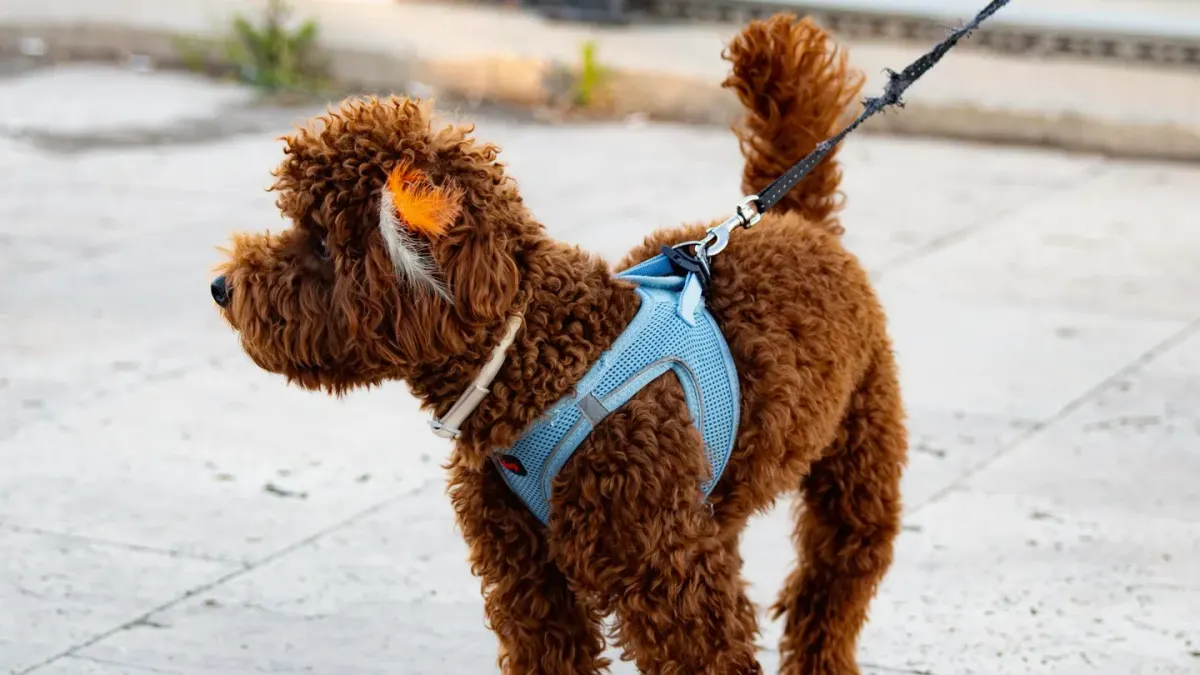
The fork most owners hit isn’t which brand to buy — it’s whether to change where the leash attaches at all. A front-clip harness moves the attachment point from the back or neck to the sternum. A head halter moves it to the muzzle and poll, behind the ears. Both are trying to solve the same mechanical problem — a dog that leans into opposition reflex and drags — but they solve it in different tissue.
In my practice I’ve had this conversation more times than almost any other gear question. A Labrador retriever named Otis, four years old and about 68 pounds, came in for a lameness recheck, and almost as an aside his owner mentioned he’d started coughing after walks. He’d been on a standard collar for two years and pulled hard enough that she’d braced her shoulder against every walk. We weren’t there for the harness question, but it came up because the coughing pattern — a dry, gagging sound right after a hard pull — is one I associate with tracheal irritation from neck-based restraint. That’s the case that usually convinces owners to move the attachment point off the throat, whether they land on a harness or a halter.
What the leash attachment point is actually doing
A collar or back-clip harness lets a dog’s full body weight and drive work against the handler in a straight line, which is why dogs pull harder against them — pulling triggers opposition reflex, and a straight-line pull rewards leaning in. Front-clip harnesses interrupt that by attaching at the chest: tension on the leash turns the dog’s shoulders sideways instead of letting them drive forward, so a pulling dog gets redirected rather than braced against. Research comparing neck collars to chest harnesses found that maximal and mean leash tension were actually greater under harness restraint when dogs were pulled toward food, per a study in National Center for Biotechnology Information: Dog Pulling on the Leash: Effects of Restraint by a Neck Collar vs. a Chest Harness — a reminder that “less pulling force reaches the dog’s neck” and “less pulling behavior” are not the same claim.
A head halter works on a different lever entirely: where the head goes, the body follows, similarly to how a horse’s head position controls a lead. Pressure on the nose band and the strap behind the ears gives a handler more direct steering than a body harness can, which is why it’s often the tool of choice for dogs who lunge at triggers rather than simply leaning into a walk.

Where each one costs the dog something
Neither tool is free of tradeoffs, and this is where I get more decisive than I used to be. Front-clip harnesses restrict shoulder motion. Biomechanical work on harness design found that front-clip designs allowed the least elbow and shoulder extension and flexion among the harness types tested, according to research summarized in ResearchGate: Effects of restrictive and non-restrictive harnesses on shoulder extension in dogs at walk and trot. A Y-front, non-restrictive harness cut shoulder extension by roughly 5 degrees at a walk and 10 degrees at a trot in that work — a front-clip design, which crosses further forward over the point of shoulder, tends to restrict more, not less. For a dog on short daily walks that’s rarely consequential. For a dog doing structured exercise, agility foundations, or long-distance work, repeated restriction of forelimb excursion is a legitimate concern for shoulder tendinopathy over time, and I weigh that against the neck-injury risk the harness was chosen to avoid.
Head halters carry their own, more acute risk. The upper cervical spine is the area most stressed when a head halter is used incorrectly — specifically when a dog hits the end of the leash at speed and the head snaps sideways rather than the chest absorbing it. That’s a fundamentally different failure mode than a harness restricting a joint’s range of motion; it’s a sudden torque on the neck rather than a chronic limitation. It’s also why head halters are not appropriate on a retractable leash or a dog prone to explosive lunging without conditioning first — the tool’s safety profile depends heavily on how it’s introduced and how the leash is handled, not just on the halter itself.
What actually changes the calculus in the exam room
I’ve watched the same pattern play out with reactive dogs specifically. A German Shepherd mix I worked with, a rescue with an unknown history, would lunge at joggers on a greenway path near her owner’s apartment — not daily, but consistently enough that the owner had started avoiding certain routes. She’d tried a front-clip harness first, and it did nothing for the lunges themselves, because a harness redirects a steady pull, not a sudden explosive one. A head halter, introduced slowly over about three weeks with treats before any leash pressure was applied, gave the owner enough head control to turn the dog’s attention before a lunge became a full event. That’s a steering problem a chest attachment point can’t solve, and it’s the case that keeps me from recommending one tool categorically over the other.
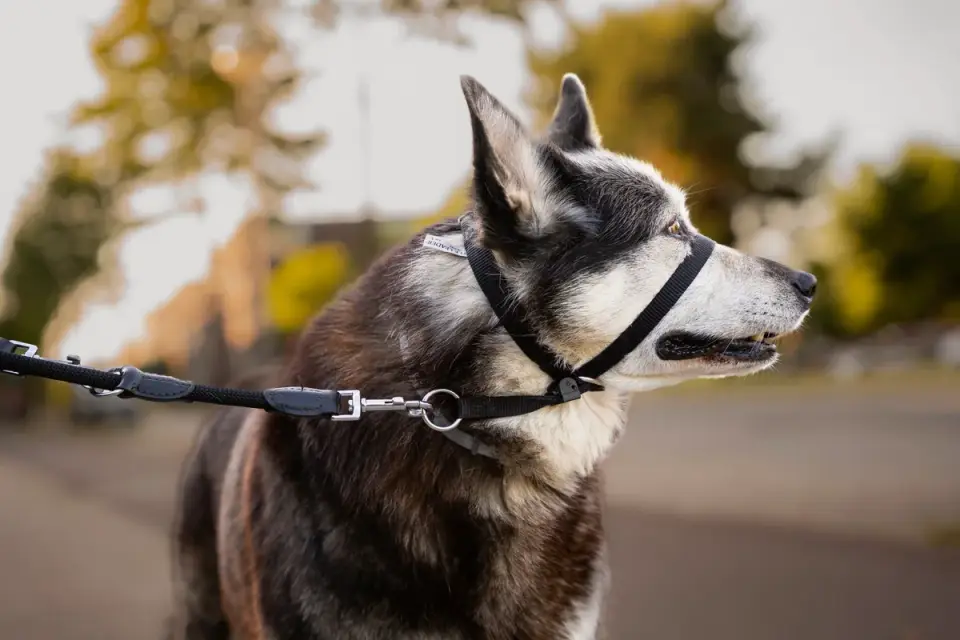
If the problem is a dog that plants its weight and drags at a steady pace, I favor a front-clip harness first and accept the modest gait tradeoff, especially for a dog that isn’t doing serious athletic work. If the problem is sudden, unpredictable lunging where a half-second of head control changes the outcome, a properly conditioned head halter earns its place despite the cervical-spine caution, because the failure mode of an unmanaged reactive dog is usually worse. Neither tool replaces training, and neither should be paired with a retractable leash or hard corrections — that’s where injuries in both categories actually happen. Fit matters as much as the category: a harness that rides forward into the armpits or a halter with a nose band sitting too low undoes whatever mechanical advantage the design was supposed to offer, so I check strap position at every recheck before I trust either one for daily use.
If your dog’s pulling is tangled up with car rides, muzzle training, or leash reactivity more broadly, it’s worth reading about how crash-tested harness hardware differs from a standard daily harness, how to size a basket muzzle if reactivity is part of the picture, and why a bungee leash changes the physics of a hard hit at the end of the line regardless of which attachment point you choose.
The bottom line: pick the front-clip harness for a steady puller you’re not training for athletic performance, pick a properly conditioned head halter for sudden lunging you need to interrupt, and treat either one as a management tool riding alongside training, not a substitute for it.
Frequently asked questions
Is a front-clip harness or a head halter better for stopping pulling?
It depends on the pulling pattern. A front-clip harness redirects a steady, leaning pull by turning the shoulders sideways, while a head halter gives more direct steering for sudden lunging because the head controls where the body goes.
Can a head halter hurt a dog's neck?
Used correctly, on a standard leash with slow introduction and no hard corrections, the risk is low. The main danger is a dog hitting the end of the leash at speed, which can strain the upper cervical spine.
Do front-clip harnesses restrict a dog's movement?
Research on harness biomechanics found front-clip designs allowed the least shoulder and elbow extension among the harness types tested, which is a meaningful consideration for dogs in regular athletic activity but usually minor for short daily walks.
Sources
- Dog Pulling on the Leash: Effects of Restraint by a Neck Collar vs. a Chest Harness — National Center for Biotechnology Information
- Effects of restrictive and non-restrictive harnesses on shoulder extension in dogs at walk and trot — ResearchGate