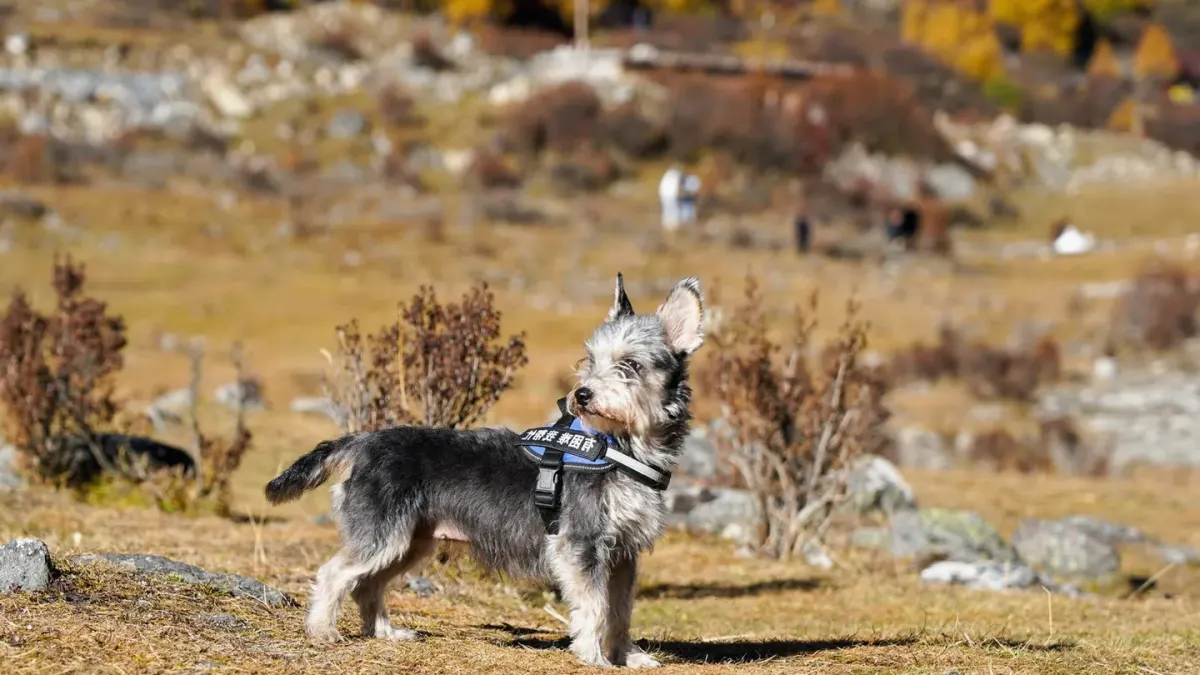
You’ve got a dog who backs out of a flat collar, and you’re wondering if a martingale will solve it without becoming a choke chain. That’s the exact fork to sort first: if your dog’s head is narrower than the neck — think Greyhounds, Whippets, Shibas, lots of rescues — a well-fitted martingale may help support safer control on walks. If you’re trying to fix hard pulling or lunging with hardware alone, no collar will do that job for you.
A lanky rescue I worked with recently made the choice concrete. He was a 58-pound mixed-breed with a classic escape-artist build, a 14-inch neck that flared to almost 17 inches behind the jaws when he tucked his head. His owner had tried a flat buckle collar cinched tight enough to leave a rub line, and he still slipped it at the park gate twice in one week. We switched the question from tighter to smarter — could a limited-slip loop close that 3-inch difference only when the leash went taut, then release when he walked loose?
As a sports-medicine vet I weigh what gear can realistically do for mobility and recovery the same way I weigh supplements — it may help support steady, low-stress walks, but it won’t train a loose leash by itself.
Should you reach for a martingale at all?
A martingale has two loops: a large loop that sits around the neck like a collar, and a small control loop where the leash attaches. When your dog pulls forward or tries to back out, the control loop tightens the large loop a set amount, then stops. The American Kennel Club describes that limited closure as the feature that separates martingales from choke chains, which have no stop.
Pick a martingale when fit is the problem, not manners. Good candidates are narrow-headed dogs, fearful dogs who reverse out of collars, and middle-ground dogs between sizes. Skip it — or pair it with a training plan and harness — if your dog coughs, gags, has a collapsing trachea, neck pain, or pulls so hard you’re relying on neck pressure to steer. And if you haven’t measured yet, start with How to Measure Your Dog’s Neck for a Collar before you buy width or length.
If it can’t tighten, it’s just a loose flat collar.
Fitting it in order, without the guesswork
Lay the collar flat and learn the parts. The large loop often has a slide adjuster or buckle; the small loop has two D-rings and should hang empty with a 1- to 2-inch gap when there’s no tension. Clip your leash to the D-ring on the control loop, never to one side of the large loop.
Here’s the sequence I use:
- Measure relaxed. Tape around the middle of the neck where the collar will sit, snug enough for two fingers underneath. Note that number.
- Measure behind the jaw. Tape around the widest part of the head — ears tucked — to confirm the tightened collar can still slip over. Most martingales slide on; buckle styles open instead.
- Set the large loop. Open the slider and make the large loop about 1 to 1.5 inches larger than the relaxed neck measurement. Slide or buckle it on, wide fabric centered over the throat, control loop sitting at the back of the neck.
- Pull the test. With the collar on, pull the small control loop down as if the dog hit the end of the leash. The two D-rings should draw toward each other but not touch — about a finger’s width apart at full closure.
- Check open and closed. Relaxed, you should slide two fingers flat under the large loop all the way around. Pulled tight, the collar should hug without pressing hard into the windpipe, and the dog should not be able to tuck chin and back out.

A stocky terrier mix showed me how easy it is to get this backward. His owner set the slider once in the living room and left it, and after six walks the dog started coughing at the curb and pawing at the collar on stairs. When we pulled the control loop, the D-rings clinked together and the large loop kept cinching past snug — there was no stop left. We’d created a choke by over-tightening the adjuster to stop slipping. We loosened the large loop by three-quarters of an inch, re-tested to a one-finger gap between the D-rings, and the coughing on leash tension eased on the next outing while the collar still held during a head-tuck test.
The checks I won’t skip before you leave the driveway
Do the two-finger test in three spots — throat, sides, and nape — because thick ruffs lie. You’re feeling for even contact, not a dip where you can fit a fist. Then do a gentle slip test: with a slack leash, cup the collar and try to ease it forward over the ears with light pressure. A correct fit resists without you hauling.
Watch the dog, not just the tape. Lip-licking, freezing, high-pitched cough, or a goose-honk sound means pressure is landing on the airway and you need a looser closed setting, a wider 1- to 1.5-inch band, or a different tool entirely. I also check hardware — smooth slider, stitched D-rings, no sharp martingale chain links catching coat — the same durability, fit, comfort, and value rubric I use for any gear test.
For overnight and crate questions, see Is It Safe to Leave a Collar On All the Time?. The ASPCA reminds owners to keep ID on the dog and to remove collars where they could snag, which matters more with a looped collar.
A fluffy adolescent Samoyed is where I bend the textbook. She was 9 months old, still filling out, with 3 inches of coat that compressed to nothing under tension. Relaxed, two fingers disappeared into fluff; tightened, the collar sank and looked severe even though the D-rings still held their gap. The usual advice — fit to the fur — would have left her slipping it by winter shed. We did it differently: fitted to compressed coat, rechecked every two weeks on the same gatepost, and switched to a wider flat martingale for the coat season so pressure spread instead of digging.
So here’s where I land. Measure twice, set the stop so the D-rings never touch, and prove it with a pull test and a slip test. If a friend says it’s just a fancy choke, I’d tell them a choke has no endpoint — a fitted martingale does, and that endpoint is the whole point.
Frequently asked questions
How tight should a martingale collar be when relaxed?
Snug enough that you can slide two fingers flat under the large loop all the way around, with about a 1- to 2-inch gap in the empty control loop. When you pull the control loop tight, the two D-rings should come close but not touch.
Can my dog slip a martingale if it’s fitted right?
A correct fit resists a gentle head-tuck test without hauling on the neck. If it slides over the ears with light pressure, shorten the large loop slightly and re-test the D-ring stop.
Are martingale collars safe for puppies or long-haired dogs?
They can work, but recheck often. Puppies outgrow settings in weeks and thick coats compress under load, so fit to compressed fur, use a wider band to spread pressure, and re-measure every couple of weeks.
Sources
- General Dog Care — ASPCA