
On this page
The single detail owners skip most often is whether the dog can still feel her back paws, and that one data point is what separates a same-day neurology visit from a slow rehab plan. Everything else — the buckling, the dragging nails, the sudden collapse mid-walk — is downstream of that one question. Nerve conduction is either intact or it isn’t, and testing it takes thirty seconds.
Imagine a nine-year-old Labrador who has always taken the porch steps two at a time. This week she hesitates at the bottom step, then her hips dip sideways and she sits down hard. No yelp, no flinch when her owner runs a hand down her spine. She’s alert, eating normally, tail still wagging. That combination — painless, gradual, otherwise well — is a different animal entirely from a dog that screams once and can’t stand at all ten minutes later. Both look like “back legs giving out” from the couch. They are not the same emergency, or the same non-emergency.
The five-minute check before you call anyone
Run through this before you search anything else:
- Weight-bearing. Can she stand at all, even briefly, or does she collapse the instant weight goes on the hind end?
- One side or both. Symmetric weakness and asymmetric weakness point toward different problem categories.
- Pain response. Press gently along the spine and hips. Crying, tensing, or a hunched posture signals pain; a dog that lets you manipulate the limb without reaction is more likely dealing with a painless neurologic process.
- Paw placement (knuckling). Flip a back paw over so the top touches the floor. A dog with intact proprioception rights it almost instantly. A dog that leaves it knuckled under has a conduction problem, not just a weak muscle.
- Bladder and bowel control. Any loss of control here moves the whole situation up in urgency, regardless of how mobile the dog otherwise looks.
- Onset speed. Minutes to hours, or weeks to months? Write down the actual timeline; your vet will ask, and “it’s been getting worse since spring” changes the differential list more than the gait itself.
What “giving out” actually means, mechanically
A hind leg fails for one of three reasons: the structure holding it up gave way (a torn ligament, a luxating patella, arthritic joint failure), the blood supply to the cord or limb was interrupted (a fibrocartilaginous embolism, a clot), or the signal telling the muscle to fire never arrived (disc compression, degenerative nerve loss). Structural failure is usually painful and often asymmetric. Vascular events are often sudden and strikingly painless. Signal failure sits on a spectrum — acute and painful with a herniated disc, or slow and painless with degenerative myelopathy, per the Cornell University College of Veterinary Medicine, which describes initial signs as incoordination and knuckling in the hind limbs that progress over roughly a year toward inability to walk on the hind legs, with no pain component at any stage. That absence of pain is a real clinical clue, not a reassurance to wait.
Compare that to a mechanical disc event. Veterinary Partner describes thoracolumbar disc disease as a compressive process where diagnosis and treatment decisions hinge on how fast signs are progressing and how much motor function remains — a dog that’s still walking, even poorly, is managed differently than one that’s lost the ability to move the limb entirely. Time to treatment tracks with outcome here in a way it doesn’t with a slow degenerative process.
Where I draw the support-versus-therapy line
Consider a fourteen-year-old terrier whose owner has already tried three joint chews by the time hind-leg wobbling shows up on a vet’s exam table. None of them were wrong to try. None of them were going to do what the owner hoped, either, because none of them address a compressed nerve root or a narrowed vessel. That’s the line I want named before any recommendation, not after: a supplement supports normal cellular and joint function over time. It is not a therapy for a structural or vascular problem that already exists. The strongest counterargument is that some dogs genuinely improve on joint support alongside conservative management, and that’s true — but improvement on a multi-week supplement course, on a dog you haven’t imaged, does not tell you whether you avoided surgery you needed or waited out something that would have resolved on its own. I’d rather have that answer before deciding what to buy.
Gear that helps once you know what you’re managing
Once a diagnosis is in hand, gear stops being a guess and starts being useful. A rear-support harness gives you a handle for hips that buckle on stairs, without pretending to fix why they buckle. A ramp reduces jumping load on a healing disc or an arthritic joint. A wheelchair cart restores independent movement for a dog whose nerve conduction won’t come back, letting her stay mobile and social rather than housebound. None of these change the underlying pathology, and none should be bought as a stand-in for the exam that tells you which pathology you have.
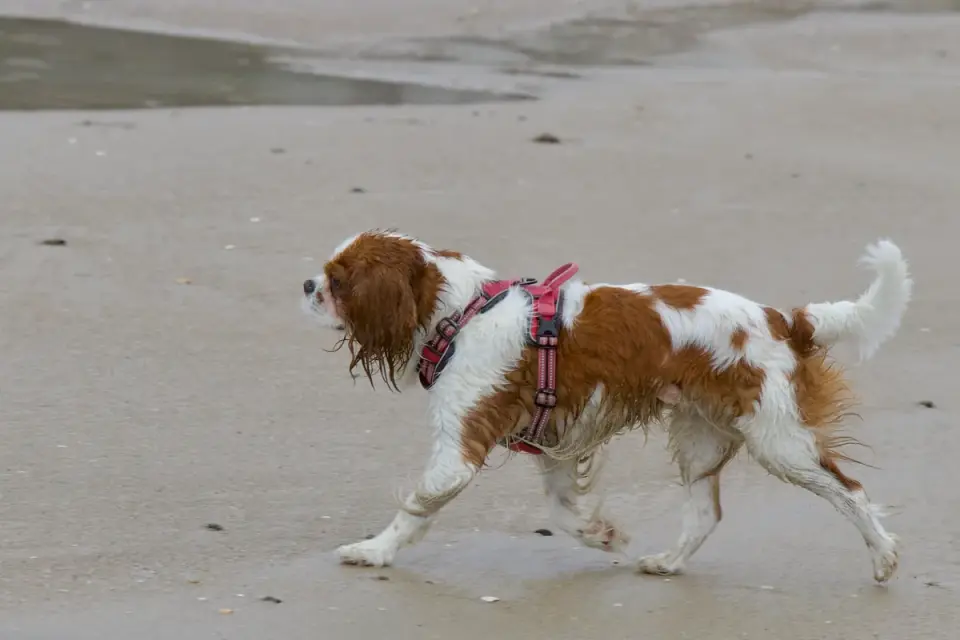
A senior dog losing hind-end coordination is also losing some of the sensory feedback that made the world predictable, which is worth reading alongside how an old dog startles at sounds he used to ignore — sensory decline rarely arrives through just one channel. And because a dog on restricted activity still needs an outlet, see how to mentally tire a dog that can’t exercise for options that don’t load the spine or joints.
When this is tonight, not next week
Call an emergency clinic immediately if the dog cannot bear weight at all, cries out when the spine or hips are touched, has lost bladder or bowel control, or went from normal to down within hours. Per Veterinary Partner, disc-related compression can progress from mild discomfort to inability to walk within a single day, and outcomes track closely with how quickly treatment starts. A slow, painless decline over weeks to months is still worth a scheduled workup, just not a 2 a.m. drive.
The bottom line: check for pain, check for feeling in the paws, and write down how fast this started, before you buy anything or search for a supplement. That triage takes five minutes and it’s the difference between managing the right problem and managing a guess.
Frequently asked questions
Can a dog's back legs give out and then look almost normal the next day?
Yes, and it's one of the more misleading patterns. Fibrocartilaginous embolism can cause sudden, painless loss of hind-end function that partially resolves within days, while a slipped disc can wax and wane before a bigger episode. Improvement is not the same as resolution; both still warrant an exam.
Will a joint supplement fix sudden hind-leg weakness?
No. Supplements support tissue comfort and normal function over time; they do not decompress a disc, restore a blocked vessel, or reverse nerve conduction loss. That's the support-versus-therapy line I'd draw before anyone reaches for a jar.
What's the practical difference between IVDD and degenerative myelopathy?
IVDD is a mechanical, often painful, sudden-onset compression problem. Degenerative myelopathy is a slow, painless, progressive loss of spinal cord conduction, most documented in breeds like German Shepherds and Boxers. The timeline and the presence or absence of pain separate them more reliably than the gait alone.
Is a rear-support harness or ramp a substitute for a vet visit?
No. Gear manages the symptom you already have a diagnosis for. Buying a harness before you know whether you're managing arthritis, a healing disc, or a progressive neurologic disease means you're guessing at the wrong problem.
Sources
- Degenerative Myelopathy — Cornell University College of Veterinary Medicine
- IVDD (Thoracolumbar to Tail Intervertebral Disc Disease) in Dogs - Diagnosis and Treatment — Veterinary Partner