On this page
- Why a harness glows in headlights but disappears in a store
- Reflective, retroreflective, and LED are three different tools
- Where the reflective material needs to be, and how much
- Reflective gear is passive, so pair it with an active light
- Fit, durability, and comfort still come first
- Building a realistic night-walk setup
A harness printed with reflective ink only works when a driver’s headlights are pointed almost straight at it, which is why placement and material type matter more than the word “reflective” on the tag. So what is actually happening on the label, and does it hold up once you are three blocks from the nearest streetlight?
Why a harness glows in headlights but disappears in a store
Retroreflective material is engineered to send light back in the direction it came from, rather than bouncing it off in every direction the way a plain shiny fabric does. The classic version uses thousands of tiny glass beads or micro-prisms embedded in a coating; each one acts like a miniature mirror aimed back at the light source. That is why a strip of true retroreflective tape can look almost dull under a store’s overhead fluorescent lights, then flare bright white the moment a car’s headlights sweep across it. Printed silver or metallic-look trim, by contrast, is closer to ordinary reflective fabric: it looks shiny under any light, including store lighting, but sends far less light back toward a specific viewing point, such as a driver’s eyes.
This distinction is the whole reason two harnesses can look equally “reflective” on a product page and behave completely differently on a dark street.
Reflective, retroreflective, and LED are three different tools
Manufacturers use “reflective” loosely, so it helps to separate the three approaches you will actually encounter on dog gear.
True retroreflective tape or piping is a passive material. It does not glow on its own; it needs an external light source, such as headlights, a porch light, or a flashlight, hitting it at roughly the right angle. Once it does, it is highly effective, which is why it shows up on road crews’ vests, cyclists’ ankle bands, and school-crossing signage. Printed metallic or holographic trim is decorative reflectivity: it adds shine but not the directional bounce-back effect, so treat it as a bonus, not a safety feature. LED and fiber-optic elements are active light sources built into a collar or harness strap; they generate their own light rather than depending on another light hitting them, which makes them useful in stretches with no ambient light at all, such as an unlit trail or a rural road with no headlights approaching.
Where the reflective material needs to be, and how much
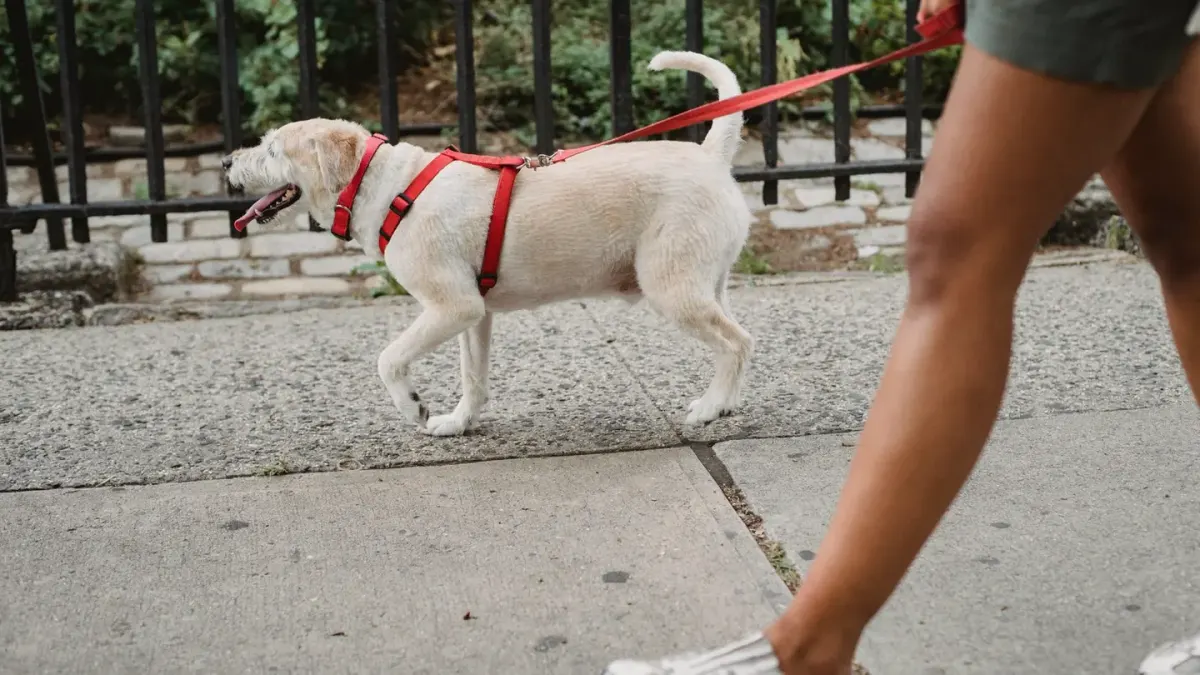
Coverage and placement matter as much as the material itself. A harness wraps around the dog’s chest and ribcage, which puts reflective strips on the front, both sides, and often the back in one continuous system, according to the AKC, whereas a collar sits low on the neck and shows a much narrower band to an approaching vehicle. Look for reflective piping that runs the full length of the strap rather than a single small logo patch, and check whether it wraps enough of the body that the dog reads as visible whether it is facing the car head-on, walking parallel to traffic, or standing broadside at a crosswalk.

Reflective gear is passive, so pair it with an active light
It is worth saying plainly: reflective material does nothing until light hits it. On a well-lit street with passing headlights, that is rarely a problem. On an unlit trail, a rural road, or the stretch between streetlights, there may be no light source aimed at the dog at all. Preventive Vet recommends pairing reflective gear with an active light, such as a clip-on LED beacon or a handheld flashlight, precisely because the two solve different parts of the problem: one makes the dog visible when a light source finds it, the other supplies the light source when nothing else will. Whole Dog Journal similarly frames high-visibility gear for dogs as a layered system rather than a single product, since no single reflective harness performs the same job as a flashlight in an unlit area.
Fit, durability, and comfort still come first
None of this matters if the harness does not fit correctly, because a poorly fitted harness can twist, ride up into the armpits, or slip loose during a hard pull, and a dog that is straining against a bad fit is not walking calmly enough for reflective material to do its job anyway. Use the same fit checks that apply to any harness: two fingers should slide comfortably under every strap, the chest strap should sit against the sternum without pressing into the throat, and pulling the leash in different directions should not let the dog back out of it. Reflective strips should be sewn or bonded into the webbing rather than glued on as a separate patch, since glued-on trim is usually the first thing to peel or crack after repeated washing.
Building a realistic night-walk setup
Test any new harness before dark, not during the first real walk. Stand a friend or family member across the street at dusk with the harness on the dog, then check what is visible from the front, side, and rear while the dog is both standing still and moving, since reflective material that looks bright head-on can disappear entirely from a side angle. If the walk includes any stretch without streetlights, add a clip-on light rather than assuming the harness alone will carry the whole route.
A harness earns the word “reflective” only when its material actually bounces light back toward a driver’s eyes, not just when it looks shiny on the shelf; buy on that distinction, and treat the harness as one piece of a layered visibility setup rather than the whole solution.
Frequently asked questions
Is a reflective collar enough, or does my dog need a reflective harness?
A collar sits low, close to the ground, and shows a much smaller surface to an approaching driver. A harness wraps around the chest and ribcage, so it exposes reflective material from the front, sides, and top of the dog, which is a meaningfully larger and more consistent target for headlights to catch.
Do I still need a flashlight or clip-on light if the harness is reflective?
Yes, in unlit areas. Reflective material only works when an external light source hits it directly, so on a dark trail or a street between streetlights, an active light source closes the gap for the stretch where no headlights are pointed at your dog.
How do I know if reflective trim is actual retroreflective material?
Shine a flashlight on it from a few feet away in a dark room. True retroreflective tape bounces a distinct, bright point of light back toward the flashlight. Printed silver or metallic-look trim tends to look flat and dull under the same test, even though it can look shiny under bright store lighting.
Sources
- How to Find the Right Dog Harness for Your Dog — AKC
- Light-Up Collars & Harnesses For Dogs At Night — Preventive Vet
- High Visibility Clothing and Gear For You and Your Dog — Whole Dog Journal